Senior Editor: Alan Agbele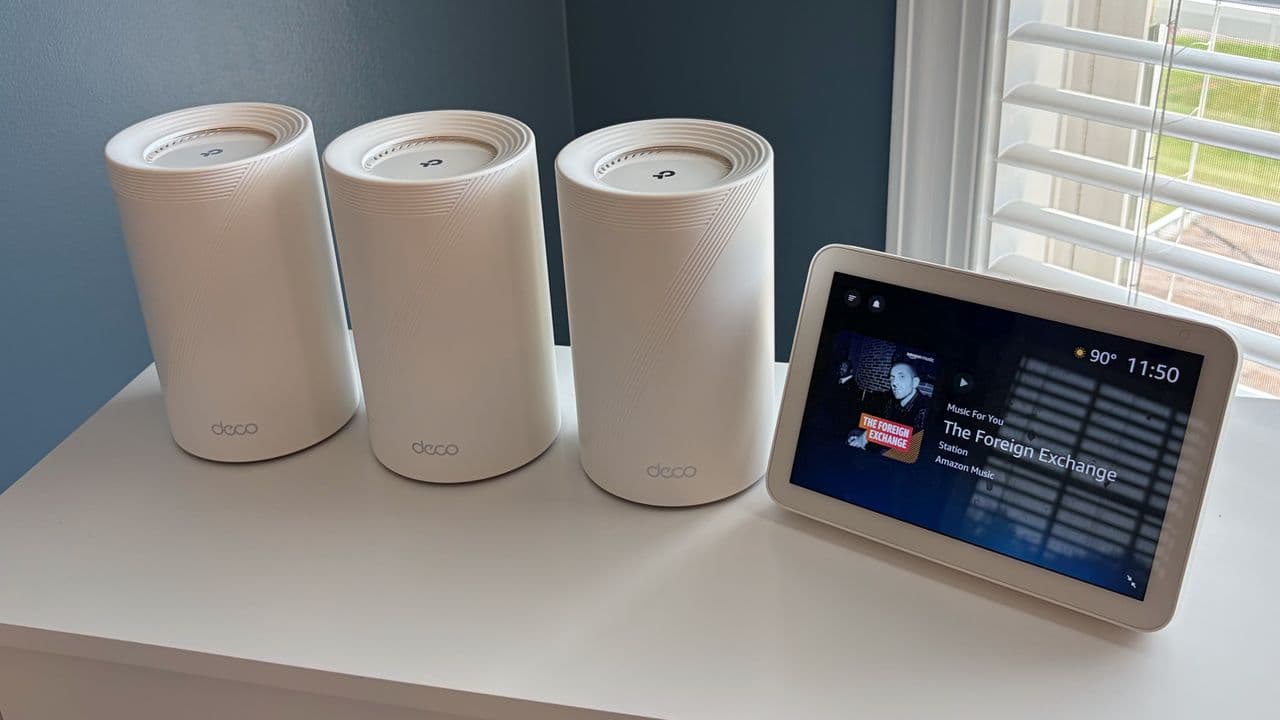
TP-Link has built one of the broadest Wi-Fi 7 mesh router families on the market, but keeping track of the models can be confusing. The latest addition, the Deco 7 Pro BE13000, is a tri-band system sold exclusively as a three-pack through Costco. At $399 and coverage for up to 8,100 square feet, it undercuts many competitors on price. However, early testing reveals a key compromise: average throughput and an unconventional port configuration that may frustrate power users.
Design and Port Trade-Offs
Physically, the Deco 7 Pro BE13000 matches the familiar Deco Wi-Fi 7 family: white cylinders standing about seven inches tall. A stylized “7” adorns the front, and a status LED glows green when online, red when disconnected. The back panel, however, reveals a curious decision. Unlike the Deco BE63, which packs four 2.5 GbE LAN/WAN ports, the Pro BE13000 offers one GbE, one 2.5 GbE and one 5 GbE port per node. With the Pro BE13000, users get three total wired connections across mixed speeds; the single GbE port can become a bottleneck if wired clients are used.
Performance and Setup Experience
Setup follows the same smartphone-driven process as other Deco products. Users install the Deco Wi-Fi app on iOS or Android, create a free TP-Link account and scan for nodes. The system automatically designates the first node connected to the modem as the main router. In testing, network detection was quick. The app allows a single SSID across 2.4 GHz, 5 GHz and 6 GHz bands, plus support for Multi-Link Operation (MLO) and separate guest or IoT networks.
Wireless performance, while stable, falls short of the theoretical BE13000 rating. The system’s average throughput sits noticeably below that of the Deco BE63 and the MSI Roamii BE Pro, especially at longer range. The mixed port speeds also limit wired backhaul to the slowest common denominator if users connect multiple nodes via Ethernet. Buyers chasing top-tier speeds may want to consider a different model.
Why This Matters
Wi-Fi 7 is still early in its adoption cycle, and manufacturers are racing to hit different price points. The Deco 7 Pro BE13000 demonstrates that value pricing alone does not guarantee strong performance. For the typical family streaming video and browsing the web, the system’s coverage and reliability will suffice. However, households with wired servers, gaming consoles or high-bandwidth NAS devices will feel the pinch of the single GbE LAN port. The exclusive Costco deal also means buyers cannot easily compare units from other retailers. As the market matures, consumers should expect better price-to-performance ratios from Wi-Fi 7 mesh systems later this year. For now, the Pro BE13000 is a solid entry-level option with a clear cost vs. capability trade-off.