Senior Editor: Alan Agbele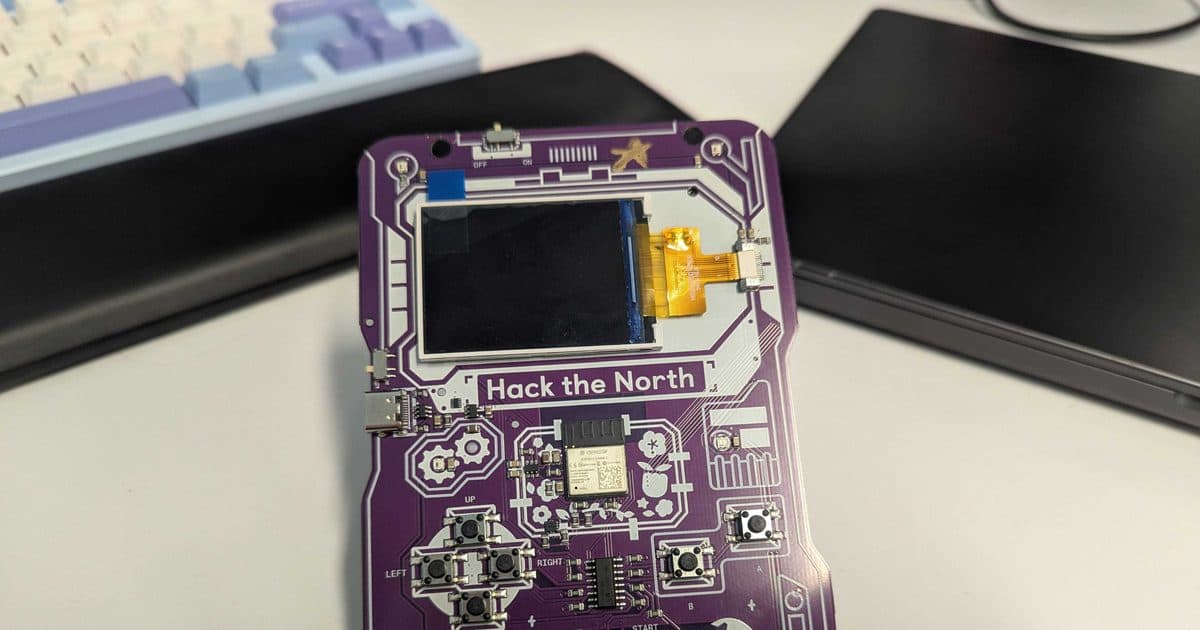
Building 1,750 programmable printed circuit boards for a single event is an unusual engineering challenge. It sits somewhere between a product launch and a manufacturing sprint, and it is exactly what one hardware team took on for Canada's biggest hackathon.
The badges are not simple name tags. Each unit is a functional, reprogrammable circuit board that attendees can hack, modify and carry home. That decision turned a logistics problem into a distributed lesson in embedded systems design.
Why Programmable Badges Became a Hackathon Staple
The badge-as-hardware trend has been building for years. What began as decorative conference swag evolved into a deliberate recruitment and education tool, because a board that runs code invites tinkering.
Making 1,750 units for Canada's largest hackathon pushes that idea to an industrial scale. The volume matters more than the novelty. At that size, every design choice compounds across thousands of boards.
From Swag to Soldering Practice
A programmable badge gives a participant something a sticker never could: a reason to open a development environment. Attendees can flash new firmware, wire up sensors or simply inspect how the traces route across the board.
That hands-on exposure is the real product. Hackathon organizers increasingly treat badges as a pipeline into hardware communities, not as a cost center.
What You Need to Know About the Build
Producing 1,750 boards is not a weekend soldering session. It requires a repeatable process, consistent component sourcing and a testing plan that catches failures before the event starts.
The team behind the project had to balance cost against capability. Every added feature, from extra sensors to wireless modules, multiplies across the full run.
Each of those decisions carries a trade-off. Faster assembly often means less inspection, and cheaper components can limit what the badge is capable of running.
Why This Matters
Small-batch hardware manufacturing is quietly becoming a competitive skill. The same workflows used to build 1,750 hackathon badges resemble the early production runs of many hardware startups.
Teams that can source, assemble and test a few thousand units efficiently gain an advantage that larger factories cannot match on speed. The badge project is a public rehearsal for that capability.
Participants, however, are the ones who benefit most directly. A programmable board in hand lowers the barrier to embedded development far more than a lecture or workshop.
The Broader Signal for Hardware Education
Canada's largest hackathon functions as a testing ground for how hardware skills spread. If 1,750 attendees leave with a working board and a flashing tool, some fraction will keep building.
That outcome is hard to measure but easy to spot over time. Hardware communities grow through exactly this kind of low-stakes, high-access exposure.
The badge run also demonstrates that open, reprogrammable design is now a default expectation. Attendees increasingly assume their event hardware can be modified, not just worn.