Senior Editor: Alan Agbele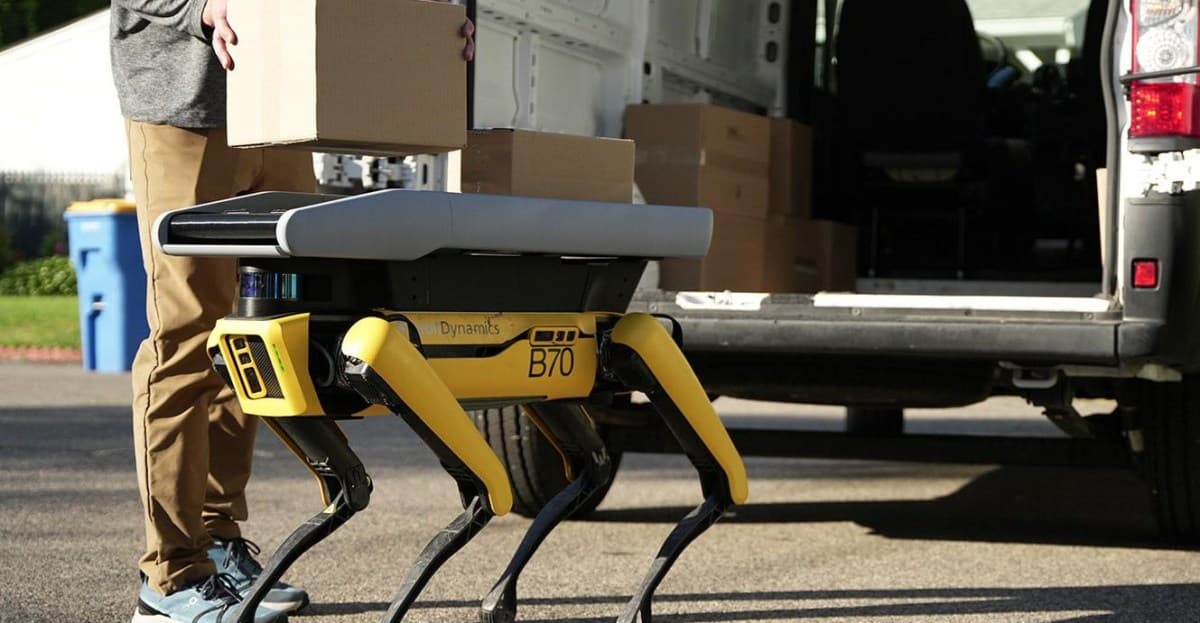
Boston Dynamics is testing a new conveyor belt accessory for its quadruped robot Spot, designed to autonomously unload packages from a delivery truck onto a customer's doorstep. The move represents the company's latest effort to commercialize the robot beyond industrial inspections and security patrols. By automating the final unloading step, Boston Dynamics hopes to reduce the physical workload for delivery drivers while preserving the flexibility of human carriers for complex routes.
How Spot’s Delivery System Works
The conveyor belt mounts directly to Spot’s payload platform and is controlled by the robot’s onboard computer. A delivery driver places packages onto the belt while still in the truck. Spot then walks to the front door, reverses the belt direction and slides the package onto the doorstep. The process eliminates the need for the driver to repeatedly exit and re-enter the vehicle for every stop.
Boston Dynamics has demonstrated the system in a controlled environment. The company says the accessory can handle standard parcel sizes and is designed to work with existing delivery vehicle layouts. Spot retains its full range of motion, allowing it to climb stairs and traverse uneven terrain while carrying a load.
Key Advantages Over Existing Delivery Robots
Most autonomous delivery vehicles today use wheels or tracks, which limits them to paved surfaces and gentle slopes. Spot’s legs provide a clear operational advantage where stairs, loose gravel or snow are common. The combination of autonomous navigation and the new unloading mechanism addresses what the logistics industry calls the “porch gap” — the final few feet between the truck and the door.
Why This Matters
The logistics industry faces persistent labor shortages and high injury rates among delivery drivers. Automating even a portion of the physical task could improve job satisfaction and retention, though the upfront cost of a robot like Spot — which sells for about $75,000 — means the system is unlikely to replace human delivery on a large scale. Instead, the technology could be deployed on high-density urban routes or for premium same-day deliveries where speed and reliability justify the investment.
Competitors such as Amazon and FedEx have tested wheeled droids and drones, but none have addressed the “last meter” with a legged platform. If Boston Dynamics can prove the system’s reliability and bring down unit costs through production scale, Spot could carve out a niche in parcel delivery that no other autonomous vehicle has reached.
What’s Next for Spot in Delivery
Boston Dynamics has not announced pilot programs with logistics partners. The company is likely gathering data on battery life, payload weight limits and real-world obstacle handling before moving to field trials. Regulatory questions also remain, especially around sidewalk operation and liability for package damage. For now, the conveyor belt accessory underscores how Boston Dynamics continues to expand Spot’s role from a research curiosity into a practical tool across multiple industries.