Senior Editor: Alan Agbele
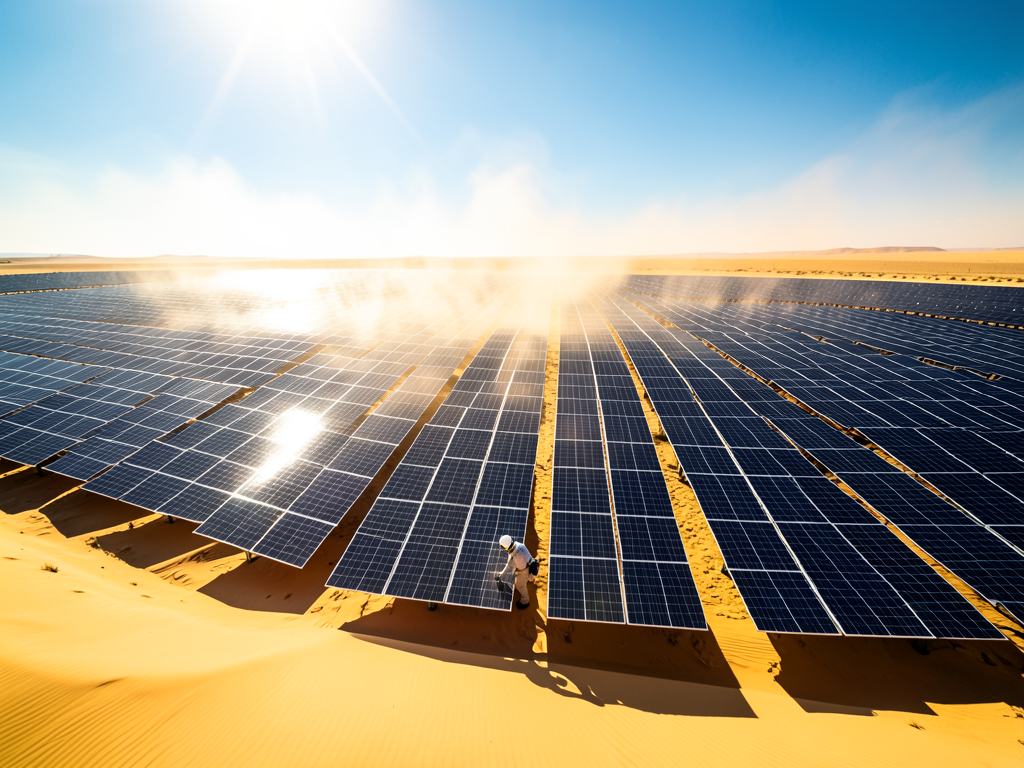
Building vast solar arrays across the Sahara Desert could do more than generate clean electricity. Research suggests it may also reshape the global climate in ways that scientists are only beginning to understand.
The Albedo Problem Beneath the Panels
Solar panels are designed to absorb sunlight, not reflect it. When deployed across bright desert sand, they replace a highly reflective surface with a dark one. That shift in surface albedo is the mechanism behind the climate effects researchers have identified.
The Sahara Desert's pale sand and rock reflect a substantial share of incoming solar radiation. Dark photovoltaic cells, by contrast, absorb most of it. At scale, this can warm the land surface and alter the energy balance that drives regional winds.
How Regional Changes Could Go Global
The Sahara is not a closed system. Its heat and dust influence atmospheric circulation across the Atlantic and into the Mediterranean. Changes to surface temperature gradients over the desert can therefore propagate outward.
Research suggests that large solar farms could affect wind patterns, precipitation and even cloud formation. Some modeling indicates potential shifts in rainfall over the Sahel, the semi-arid belt south of the Sahara. Others point to effects on the West African monsoon.
These are not trivial outcomes. The Sahel is home to millions of people whose agriculture depends on predictable seasonal rains. A change in monsoon timing or intensity could carry serious humanitarian implications.
Why This Matters
The implications extend well beyond climate science. Solar developers, governments and international financiers are pouring capital into desert renewable projects. If large-scale installations carry unintended climate effects, those risks must be priced into project design and siting decisions.
Policymakers in Europe and North Africa, who have discussed Saharan solar as a pillar of energy transition strategy, now face a more complex calculus. The technology remains essential to decarbonization. The question is how to deploy it without creating new environmental problems.
For investors, the research adds a layer of due diligence. Climate risk is no longer only about what weather does to a project. It is also about what a project does to weather.
The Path Forward for Desert Solar
None of this means desert solar should be abandoned. The Sahara Desert's solar resource is too vast to ignore in a warming world that needs clean power. The challenge is to design projects that minimize albedo disruption and monitor regional climate effects.
Researchers have proposed strategies such as pairing panels with reflective surfaces, optimizing spacing and siting arrays to reduce circulation impacts. Continued modeling and field observation will be essential. The solar industry has an opportunity to get this right before deployment reaches climate-altering scale.