Editor: Porcia Akua Holmes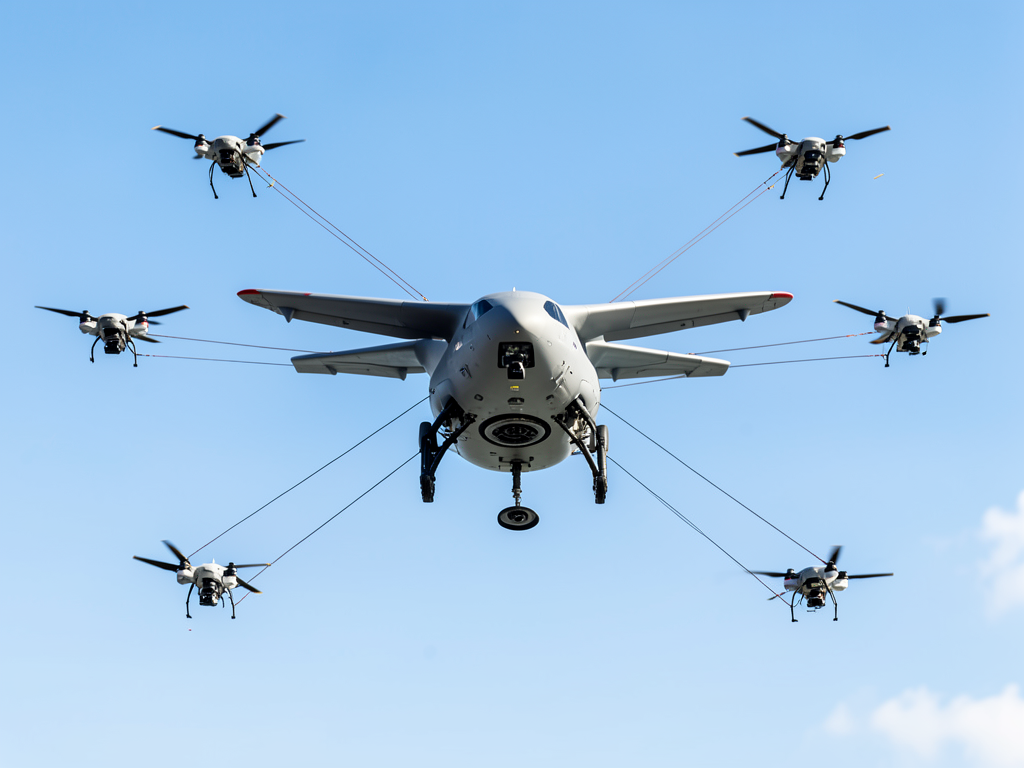
A new Russian drone patent reveals a mothership aircraft designed to control up to six tethered reconnaissance copters, each connected by a physical cable that supplies power and commands. The system aims to overcome radio jamming in contested environments.
How the Tethered Mothership Works
Engineers at the Novosibirsk Higher Military Command School (NVVKU) filed the patent through Russia's Ministry of Defence. The carrier drone hovers as a command hub, receiving instructions from a ground operator through its own tethered connection to a reel station. Onboard, it holds a flight controller, power system, camera and protective grille. Landing brackets secure each remote copter until deployment.
Once launched, each mini UAV operates with its own flight controller, gyroscopes, camera and video transmitter. The key difference from a typical swarm is the physical cable tying each drone back to the carrier. That cable supplies both power and control signals, removing the need for independent batteries or radio links.
Why This Matters
Jamming radio-controlled UAVs has become standard on modern battlefields. This wired approach sidesteps that vulnerability entirely, although it introduces a new limitation: range is capped by cable length, and the carrier itself becomes a static target while deployed. Removing onboard batteries from each remote copter frees weight for additional sensors, potentially improving reconnaissance quality. The system's built-in retrieval suggests it is designed for repeated missions rather than disposable scouting, which could reduce the number of aircraft a unit needs for persistent surveillance. Opponents may target the tethers themselves, creating a cat-and-mouse dynamic with physical security.
A New Phase in Drone Warfare Tactics
Tethered drones are not new, but using one aircraft as a mobile hub for multiple wired copters is a novel approach. The patent reflects a broader trend: militaries are adapting to electronic countermeasures by relying on physical connections for control. While cable-bound UAVs lack the range of autonomous systems, they offer reliability in environments where radio signals are unreliable. If fielded, this mother drone could shift how units conduct close-range surveillance in contested areas. The design also highlights the tension between mobility and resilience in drone development.