Senior Editor: Alan Agbele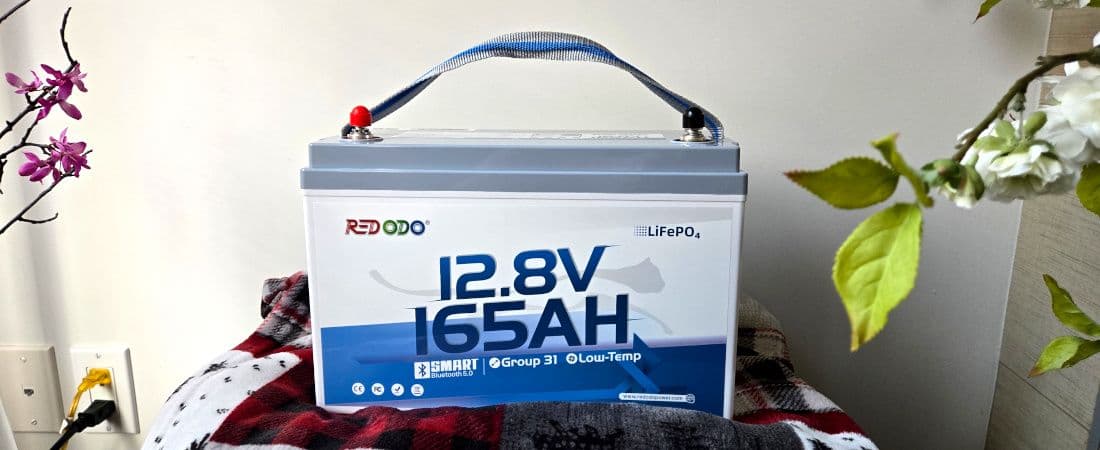
Portable power stations typically lock users into a fixed set of specifications. The Redodo battery and its supporting system break that mold, allowing users to assemble a power station piece by piece and upgrade components as needs change.
Modular Design and Core Specifications
The Redodo 12V 165Ah battery uses LiFePO4 chemistry, providing a rated capacity of 2112Wh. It supports over 4,000 charge cycles before a 20% drop in capacity, significantly outlasting standard lithium-ion packs. The unit weighs 15kg and measures 33 cm x 17 cm x 22 cm, making it compact for its capacity class.
Key specifications include:
The battery carries an IP65 water-resistant rating and operates in temperatures from -20 to 60 degrees Celsius. Charging, however, is limited to 0 degrees Celsius and above. The enclosure uses ABS plastic with a single top strap handle for portability.
Building a Complete System
To function as a full power station, the Redodo battery requires several accessories. A 40A battery charger costs $260, while a battery monitor adds $100. For AC output, a 120V 3000W inverter costs $570. The base battery retails for $499 and is often available for $370.
The battery monitor provides voltage, current and cell capacity information through an illuminated LCD screen. It includes over-discharge protection with an audible alarm. The 40A charger, while functional, operates at a noisy level and charges slightly above the recommended 33A rate.
Installation involves connecting wires to the battery terminals, charger, AC inverter and monitor in parallel. The monitor uses a low-side sensor for accurate readings. Two M8 bolts built into the case serve as positive and negative terminals and require proper torque tightening.
Bluetooth Connectivity and App Control
Redodo’s mobile app connects to the battery via Bluetooth using a QR code pairing system. The app displays real-time charge level, output voltage, current and power. Users can turn off the Bluetooth module through the app to save energy, and Bluetooth automatically re-enables when the battery charges.
The battery uses LFP EV type cells rated for up to 15,000 charge cycles or over 10 years of usage. Internal resistance measures 40 mOhm, supporting a maximum output power of 2.1kW. The manufacturer recommends charging at 33A to prevent heat buildup, which extends charge time to five hours.
Why This Matters
The Redodo system shifts the economics of portable power. Instead of replacing an entire power station when capacity or output needs grow, users can upgrade individual components. This modular approach reduces long-term costs and electronic waste. For off-grid enthusiasts, van dwellers and emergency preparedness users, the ability to start small and expand over time makes high-capacity LFP power more accessible. The trade-off involves higher upfront complexity and the need to select compatible components, but the flexibility may outweigh those challenges for users with evolving power requirements.