Senior Editor: Alan Agbele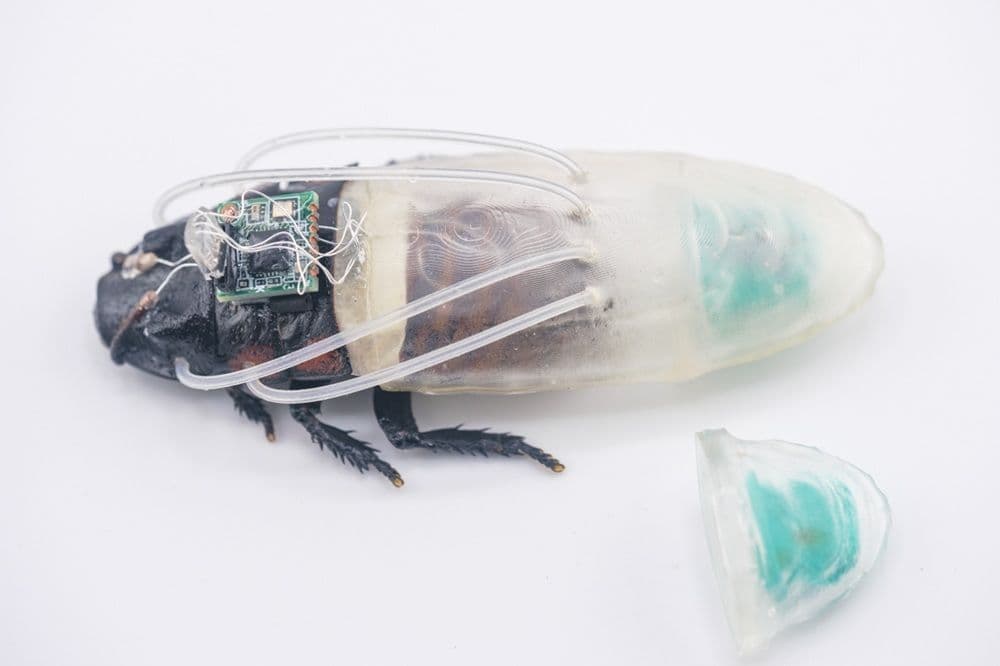
Scientists at Nanyang Technological University have equipped living cockroaches with 3D-printed diving suits and infrared cameras, enabling the insects to operate underwater for up to three hours. The cyborg cockroaches, developed by a team led by Hirotaka Sato, represent a major step forward in using hybrid living machines for search and rescue operations.
How the Cyborg Cockroach Works
The team designed a custom 3D-printed suit that attaches to the cockroach's body. Key components include a tiny air tank that generates oxygen through a chemical reaction between hydrogen peroxide and manganese dioxide, feeding it to the insect's spiracles. An infrared camera and wireless control module are powered by a small battery pack, while the cockroach itself provides biological locomotion.
Electrical impulses guide the cockroach's legs, allowing precise remote control. Underwater tests showed the cyborg insect can move at roughly 3.1 inches per second while submerged, only slightly slower than its land speed of 3.5 inches per second. The current depth limit is about 20 inches, sufficient for shallow floodwaters and puddles.
Why Cockroaches Make Ideal Platforms
Cockroaches are already nature's survivors. They can go weeks without food or water and function in environments with low oxygen or high carbon dioxide. Their bodies resist radiation that would kill a human, and their immune systems can metabolize many pollutants and pesticides. The insects close their spiracles to hold their breath for up to 40 minutes, a trait that makes underwater adaptation more feasible.
The cockroach's legs are easy to control with electrical stimulation, and its gait handles nearly every terrain type. Unlike miniature robots that run out of battery quickly, the living insect can forage for food on its own, potentially extending missions from hours to days. This combination of built-in resilience and low energy overhead makes the cockroach an unmatched chassis for hybrid cyborg systems.
Why This Matters
The immediate impact of this research lies in disaster response. Flooded buildings after hurricanes or earthquakes are notoriously difficult to search. Cyborg cockroaches can crawl through small openings and swim through shallow water while transmitting infrared video to rescue teams, potentially finding survivors faster than human searchers or wheeled robots can.
Looking further ahead, Sato's team has its sights set on extraterrestrial exploration. The cockroach's hardiness suggests it could survive the harsh conditions on Mars far better than a conventional robot. Scientists could equip future cyborg insects with scientific instruments and deploy them across Martian terrain, using the living platform's natural resilience to overcome environmental challenges. The cockroach's ability to adapt and reproduce also raises long-term questions about biological contamination of other worlds, but for now the focus remains on terrestrial rescue missions.
The cyborg cockroach project demonstrates a pragmatic approach to robotics: instead of engineering every component from scratch, researchers are augmenting nature's already optimized designs. The result is a hybrid machine that is cheaper, more durable and more energy efficient than many fully artificial robots.