Senior Editor: Alan Agbele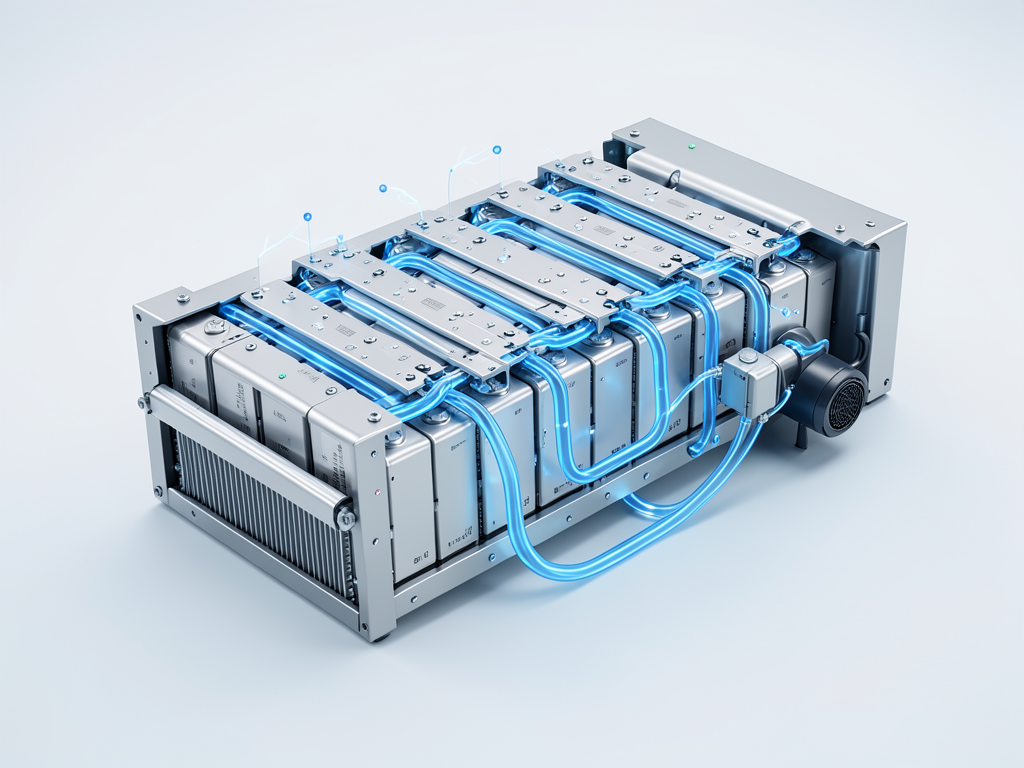
As electric vehicles push toward faster charging and longer range, managing battery temperature has become a critical engineering challenge. The question Do Electric Vehicles Use Liquid Cooling For Their Batteries has a clear answer: most modern EVs, especially high-performance and long-range models, rely on liquid cooling systems to keep battery cells within an optimal temperature window. Without effective thermal management, batteries degrade faster, charge slower and can even pose safety risks.
How Liquid Cooling Works in Electric Vehicles
In a typical EV battery pack, coolant flows through a network of tubes or between metal plates that sit between individual cells or modules. The coolant absorbs heat and carries it to a radiator where it releases that heat into the ambient air. A pump drives circulation, and a thermostat or control unit regulates flow based on temperature readings from sensors throughout the pack. This closed loop system keeps battery cells at roughly 25 to 40 degrees Celsius, the ideal range for lithium-ion chemistry.
Automakers design these systems to handle both extreme heat from fast charging and cold weather that can reduce battery efficiency. During winter, some liquid cooling systems can also warm the battery using resistive heaters or by reversing the heat pump cycle.
Liquid Cooling vs. Air Cooling: Key Trade-Offs
Air cooling, which uses fans to blow air over the battery pack, is cheaper and lighter but less effective at rejecting heat. The trade-offs between the two approaches are clear:
Most automakers have concluded that the performance gains justify the added complexity. Entry-level EVs like the original Nissan Leaf used air cooling but newer models have shifted to liquid cooling as battery capacities and charging speeds increase.
Why This Matters
Liquid cooling directly determines how quickly an EV can charge and how long its battery lasts. For consumers, this translates into real-world differences in daily convenience and long-term ownership costs. As automakers compete to offer 350 kW charging or higher, thermal management becomes a key differentiator. Without adequate cooling, batteries must throttle charging power to avoid overheating, turning a promised 15-minute charge into a 40-minute wait.
Battery degradation also hits resale value and total cost of ownership. A vehicle that maintains 90 percent of its original capacity after 200,000 miles is significantly more valuable than one that degrades to 70 percent. Liquid cooling is the primary technology enabling that durability.
Industry Adoption and Trends
Nearly every major EV platform now uses liquid cooling. Tesla has used it since the Roadster. Hyundai's E-GMP platform, used in the Ioniq 5 and Kia EV6, relies on a sophisticated liquid cooling system. Ford's Mustang Mach-E and F-150 Lightning include liquid cooling as standard. Even luxury automakers like Porsche and Mercedes use liquid cooling to support their high-voltage architectures.
Future trends point toward more advanced thermal management. Some research explores two-phase cooling, where coolant boils at the hot surface and condenses elsewhere, offering even higher heat transfer. Others are developing immersion cooling, where cells are directly submerged in a dielectric fluid. These innovations could further boost charging speeds and battery longevity.