Editor: Porcia Akua Holmes
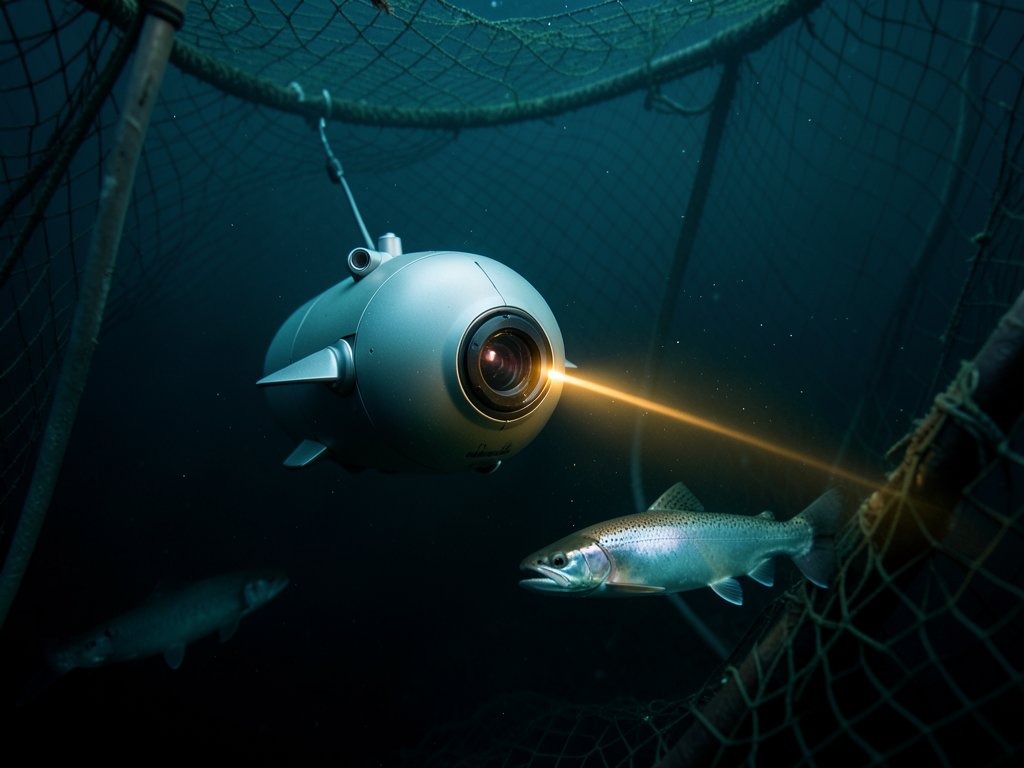
More than 3,500 autonomous underwater robots now patrol salmon pens along the Norwegian coast, each armed with lasers and artificial intelligence. The fleet, built by Oslo-based Stingray Marine Solutions, protects an estimated 112 million farmed fish and represents one of Scandinavia's largest commercial AI deployments.
From Chemical Baths to Precision Lasers
Traditional sea lice control has relied on chemical treatments that bathe entire pens of fish. These methods are effective at scale but carry significant drawbacks: they can stress fish, pollute surrounding waters and lead to pesticide resistance in lice populations.
Stingray's solution flips that model. Its Submarine AI units operate continuously, scanning fish as they swim normally. When the onboard AI recognizes a sea louse, it fires a targeted laser pulse to eliminate the parasite. The fish barely notice.
The shift from broad-spectrum chemicals to precision robotics mirrors a broader trend in agriculture and aquaculture: moving away from prophylactic treatments toward real-time, individual-level intervention. This approach reduces waste, lowers environmental load and improves animal welfare outcomes.
How the Stingray System Works
Each Stingray unit is a self-contained underwater drone equipped with cameras, machine vision processors and a laser. The AI model is trained to distinguish sea lice from the salmon's skin and other features, enabling it to target only the parasite.
The system operates 24/7, patrolling the pen and maintaining low lice populations before infestations can take hold. According to Stingray Marine Solutions, the continuous presence reduces the need for cleaner fish, which are sometimes used to eat lice but can suffer high mortality rates themselves.
Deployments have grown rapidly. The company's 2025 annual report notes that over 3,500 units are now active, up from roughly 2,500 a year earlier. The fleet protects more than 112 million fish across Norwegian salmon farms.
Limits and Challenges
Despite its promise, the Stingray system is not a complete solution. The units operate within the salmon pen, leaving corners and murky areas outside their patrol range where lice can gather. The technology is best used as a preventative measure, keeping lice numbers low rather than eradicating an established infestation.
Upfront costs also remain a barrier. Stingray Marine Solutions does not disclose pricing, but the capital expense of deploying thousands of units across a farm can be significant. Smaller operators may find the investment difficult to justify without long-term data on ROI.
Competition is emerging. Other companies are developing similar laser-based and mechanical delousing systems, and traditional chemical treatments remain widely available. Stingray's first-mover advantage and scale, however, give it a substantial lead.
Why This Matters
The success of Stingray's fleet signals a turning point for aquaculture. Norway is the world's largest producer of farmed salmon, and sea lice have long been the industry's most costly and persistent problem. A scalable, chemical-free solution could reshape production economics and reduce the sector's environmental footprint.
For consumers, the impact may be indirect but meaningful: cleaner fish farming could lead to more stable salmon prices and fewer chemical residues in the food supply. For the broader tech industry, Stingray's deployment demonstrates that AI and robotics can deliver tangible value in unglamorous, high-stakes niches far from the consumer spotlight.
Regulators, too, are watching. Norwegian authorities have tightened lice limits in recent years, pushing farmers to adopt new technologies. If Stingray's model proves replicable in other regions, it could become a global standard for parasite control in aquaculture.