Editor: Porcia Akua Holmes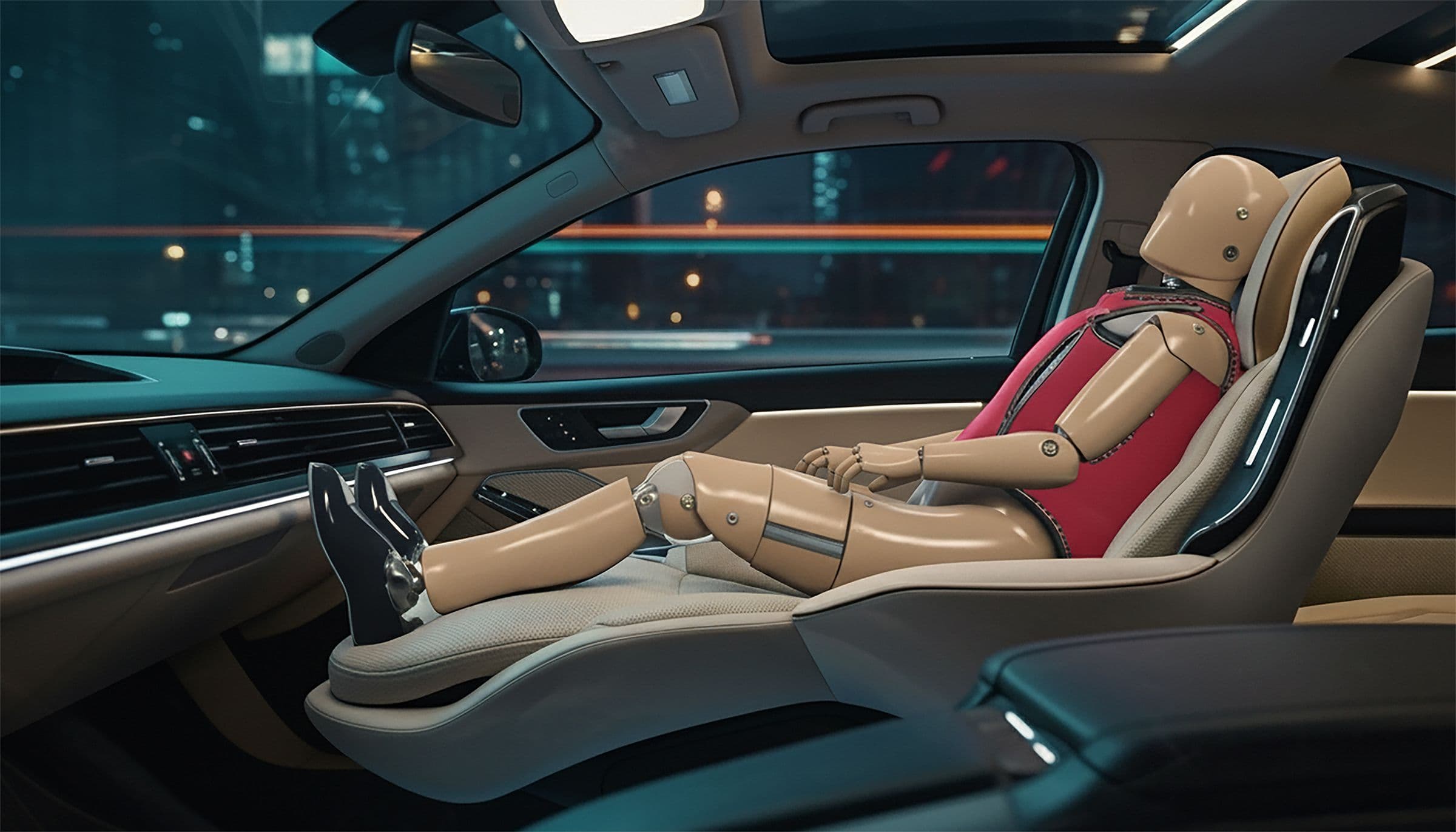
Crash test dummies have sat upright for decades because human drivers sit upright. Autonomous vehicles, however, disrupt that assumption. Passengers in a self-driving car can recline, sleep or swivel their seats, creating radically different body positions at the moment of impact. This shift is forcing government agencies to rethink the fundamentals of vehicle safety testing.
Why Reclining Changes Crash Dynamics
A seat belt works optimally when a passenger sits with their back against the seat and feet flat on the floor. When a person lies flat, the lap belt can ride up onto the abdomen instead of staying across the pelvis. In a frontal collision, this mispositioning increases the chance of internal organ damage and spinal compression fractures. The head also whips forward farther, raising the risk of concussion or neck injury.
Traditional crash test dummies are built only for upright postures. Researchers have begun developing new dummy variants that simulate reclined positions, but the process is slow. Automakers, meanwhile, face pressure to deploy robotaxis with lounge-like interiors sooner than regulations might adapt.
The Industry Slowdown on Standards
Standard-setting bodies have historically taken years to revise vehicle safety rules. The shift to autonomous driving has accelerated the timeline, yet formal proposals remain in early stages in both the United States and Europe. Some manufacturers argue that advanced sensor-based restraint systems can compensate for unusual passenger positions by adjusting airbag deployment force. Critics counter that software alone cannot fix fundamental physics.
Why This Matters
The outcome will directly affect millions of future ride-hailing users and private autonomous vehicle buyers. If regulations move too slowly, early robotaxi fleets may operate with outdated safety validation. If they move too quickly or too strictly, they could delay deployment and increase vehicle costs. The question extends beyond engineering: it determines who bears liability when a passenger chooses an unregulated posture inside a car controlled by software. Governments now face the challenge of rewriting physical safety rules for a world where the driver is absent.
Regulators in Europe are already drafting proposals that require autonomous vehicles to prevent passengers from reclining beyond a certain threshold while the car moves. Similar ideas remain under study in the United States. The tension between comfort expectations and crash protection will define the next generation of vehicle design.