Senior Editor: Alan Agbele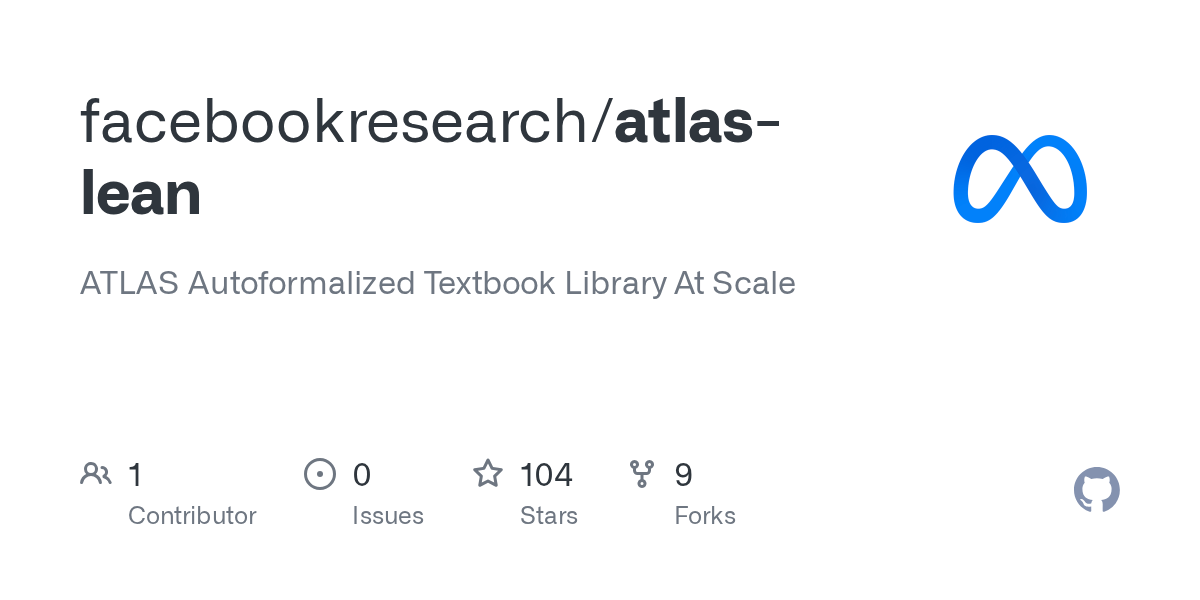
A team of researchers from MIT, Columbia University and others has released ATLAS, an open source dataset designed to help artificial intelligence systems master rigorous mathematical reasoning. The library contains over 320,000 mathematical statements, each automatically translated into a formal language that computers can verify.
Why This Matters
Current AI models often struggle with precise logic and multi-step mathematical proofs. They can generate plausible text but lack the ability to verify their own reasoning. A dataset like ATLAS could accelerate progress toward AI systems that not only produce answers but also check their internal logic. This has implications for fields like scientific discovery, software verification and automated theorem proving, where accuracy matters more than fluency.
From Natural Language to Formal Proof
ATLAS stands for Autoformalized Textbook Library At Scale. The dataset draws from textbooks, lecture notes and online resources. Its key innovation is the use of automated translation, or autoformalization, to convert plain English mathematical statements into Lean 4, a proof assistant language that machines can read and verify.
Previous formal math libraries required extensive human effort to write. The Lean mathematical library, known as Mathlib, took years of community work. ATLAS shows that automated methods can produce usable formal data at a fraction of the cost.
The researchers used Large Language Models, specifically GPT-4, to generate the initial translations. They then applied a multistage filtering pipeline to catch errors and ensure quality. The final dataset includes theorems, definitions and exercises across subjects like calculus, linear algebra, number theory and real analysis.
Benchmarking Performance Gains
The team tested ATLAS by training machine learning models on a subset of the dataset. Models trained on ATLAS showed measurable improvements on standard math benchmarks compared to models trained on informal text alone. The formal structure helped models learn correct reasoning patterns.
In one experiment, a model trained on ATLAS achieved higher accuracy on the MiniF2F benchmark, a challenging set of formal competition problems. The results suggest that training on autoformalized data can improve both formal and informal reasoning capability.
The dataset is available for free under a permissive license. Researchers can use it to train new AI models, study autoformalization techniques or extend formal mathematics coverage.
ATLAS represents a step toward a long standing goal in artificial intelligence: building systems that understand and manipulate formal knowledge as reliably as they process natural language.