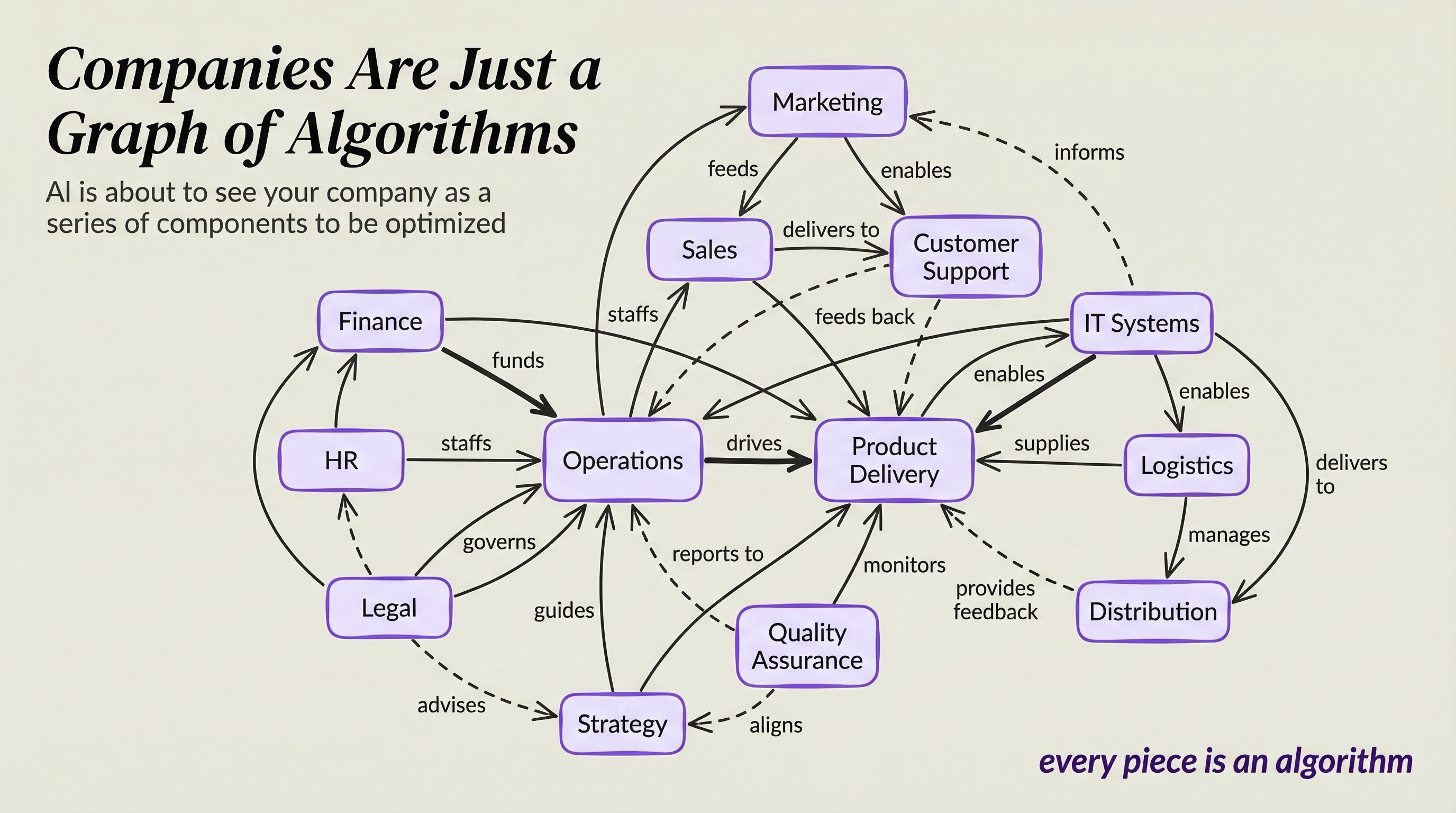
Companies have long been described as machines, organisms or ecosystems. But a growing number of thinkers argue that the most useful metaphor for modern business is a graph of algorithms. Each algorithm is a decision point, a process or a data flow. Together they form a dynamic network that shapes strategy, operations and value creation.
The Algorithmic View of Organization
The core idea is simple. Every company runs on routines. Hiring, pricing, supply chain management and customer support all follow repeatable steps. Those steps form nodes in a graph. Edges represent the flow of information, materials or decisions. This framing turns abstract management concepts into something engineers and data scientists can model.
For example, a sales pipeline is an algorithm. Lead qualification, follow-up timing and discount approval are all steps. When mapped as a graph, inefficiencies become obvious. A node that creates a bottleneck or an edge that introduces delay stands out immediately.
Why This Matters
This perspective matters because it unlocks new ways to improve performance. If a company is a graph of algorithms, then improving the company means optimizing the graph. Automation becomes a process of replacing human nodes with machine ones. AI can analyze the entire graph and suggest reconfigurations that would be invisible to a human manager.
It also changes how we think about scaling. Traditional management adds layers. An algorithmic graph suggests adding redundant paths or parallel nodes instead. This can increase resilience and speed without the bloat of hierarchy.
For employees, the algorithmic view can feel unsettling. It reduces roles to functions. But it also clarifies purpose. Each person becomes a specialized algorithm with clear inputs and outputs. That clarity can reduce ambiguity and improve satisfaction if handled transparently.
Implications for AI Integration
The graph of algorithms model is especially powerful in the age of AI. Large language models and decision systems can automate entire subgraphs. But the key is understanding which nodes are truly human-dependent and which are not.
Companies that adopt this lens can accelerate their AI adoption. They can prioritize automation where the algorithm is mature and predictable. They can also identify where human judgment remains essential. The graph provides a map for gradual, surgical automation rather than wholesale replacement.
This is not just theory. Several startups are already building tools to model organizations as algorithm graphs. They sell software that helps companies visualize their processes as connected nodes. Early adopters report faster process improvement cycles and more confident automation decisions.
The graph view also exposes hidden dependencies. A company might think it has a diverse supply chain, but the algorithmic graph may reveal a single point of failure. This insight is valuable for risk management.
Critics argue that the metaphor is too reductive. Human creativity, culture and trust cannot be captured in edges and nodes. That is true. But the graph is not meant to replace those elements. It is a tool for seeing structure more clearly so that culture can operate on a sound foundation.
The conversation is just beginning. Executives, engineers and researchers are debating how far the analogy holds. What is clear is that the algorithmic view offers a fresh way to think about business transformation in an era of rapid automation.