Senior Editor: Alan Agbele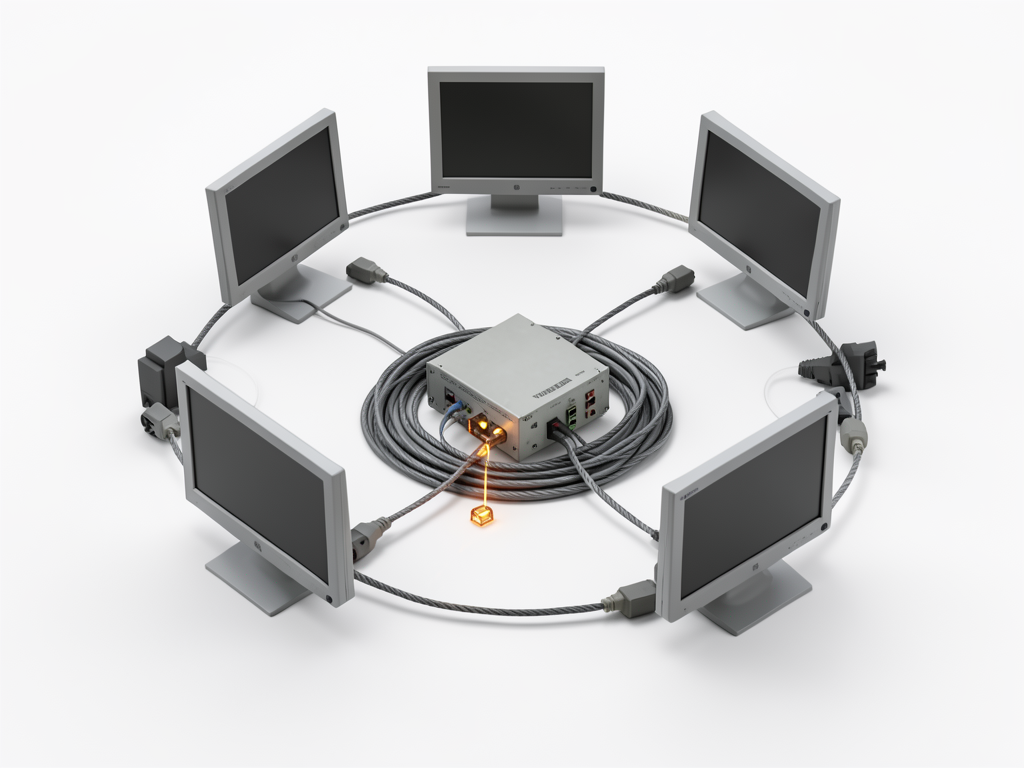
For much of the 1980s and early 1990s, the most important question in corporate networking was not whether to connect computers, but which standard would carry the traffic. IBM's Token Ring was a serious contender, and for a time it looked like the safer bet.
How Token Ring Actually Worked
Token Ring organized computers in a logical circle. A small data frame, the token, traveled from one machine to the next. A device could send data only when it held the token, then released it for the next station.
That design eliminated the collisions that plagued early Ethernet. Under heavy load, Token Ring could deliver more consistent throughput because every station waited its turn rather than competing for the same wire.
IBM popularized the technology through its Systems Network Architecture ecosystem. The company positioned Token Ring as a reliable, manageable option for large organizations that needed predictable performance.
Why Determinism Mattered
Deterministic access gave network managers a clear advantage. They could calculate worst-case delays and plan capacity with confidence. Ethernet, by contrast, used a contention-based method that became less efficient as more devices joined the network.
For banks, airlines and government agencies running time-sensitive transactions, that predictability was not a luxury. It was a requirement.
The Battle With Ethernet
Ethernet, developed at Xerox PARC and later standardized by the Institute of Electrical and Electronics Engineers, took a different approach. It let devices transmit whenever the line was free and used collision detection to recover from conflicts.
Early Ethernet was cheaper to install and easier to extend. As speeds climbed from 10 megabits per second to 100 megabits per second, those advantages became decisive.
By the late 1990s, the market had made its choice. Token Ring installations declined as companies migrated to Ethernet-based local area networks.
Why This Matters
The Token Ring story is not just nostalgia for network engineers. It shows how technical superiority in one dimension can lose to cost, openness and momentum in another.
Organizations that built their infrastructure around IBM's standard faced expensive migrations. Network managers had to retrain staff, replace adapters and redesign cabling. Those switching costs are a warning for anyone betting on a proprietary platform today.
The same pattern appears in modern technology markets. A closed ecosystem can dominate for years, then collapse when an open alternative becomes good enough and cheap enough.
Token Ring also shaped how engineers think about network design. The shift from shared media to switched links, which Ethernet embraced, became the foundation for the internet-era networks that followed.
What You Need to Know
Token Ring was never a failure of engineering. It was a failure of market timing and ecosystem strategy. IBM delivered a working, reliable product, but it could not match the pace of Ethernet innovation or the breadth of vendor support.
For readers encountering the term in old documentation or certification exams, the key takeaway is simple. Token Ring used a token-passing protocol on a ring topology, while Ethernet used carrier sense multiple access with collision detection on a bus or star topology.
That distinction explains why one standard faded into history and the other became the backbone of modern connectivity.