Editor: Porcia Akua Holmes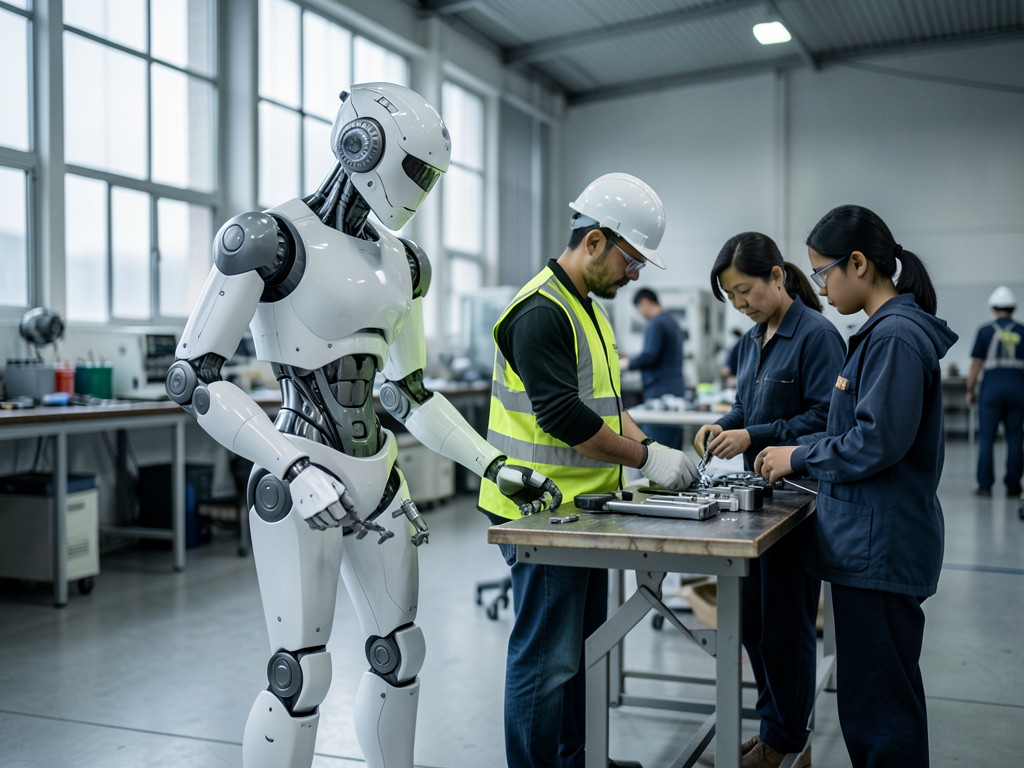
South Korea has opened its factory floors to humanoid robots, approving a regulatory exemption that allows the machines to operate alongside human workers without the physical barriers that have long defined industrial automation.
The approval, announced on October 13 by the country's industry ministry, runs through South Korea's regulatory sandbox program. That framework lets companies test emerging technologies under temporary relief from existing safety requirements.
Why South Korea Is Relaxing Robot Safety Rules
Industrial robots have historically been kept behind fences for a simple reason. A robotic arm moving at speed cannot reliably detect a person in its path, so physical separation became the default safety strategy worldwide.
Humanoid robots change that equation. Their design assumes shared spaces with people, using sensors, vision systems and force-limiting joints to avoid collisions. South Korea's exemption acknowledges that the old fencing model may no longer fit the technology.
The country has strong incentives to move first. It ranks among the most robot-dense manufacturing economies on earth, and its government has made robotics a strategic industrial priority. Relaxing safety barriers could accelerate deployment across automotive, electronics and logistics plants.
What the Exemption Actually Changes
The regulatory sandbox does not rewrite South Korea's safety laws. It grants temporary relief so companies can run real-world trials and generate data that regulators can later use to shape permanent rules.
That distinction matters. Companies gain room to test humanoid systems in live production environments, but they still carry responsibility for worker safety during those trials. The arrangement is designed to produce evidence, not blanket permission.
For robot makers, the approval lowers a major barrier. Certification and fencing requirements have slowed humanoid deployment in factories, because each installation needs site-specific safety validation.
For workers, the change raises questions about training, oversight and liability. A humanoid robot sharing a workstation with a person creates new categories of risk that traditional safety codes were not written to address.
Why This Matters
The decision positions South Korea as an early mover in rewriting industrial safety rules for humanoid robotics. If trials succeed, other manufacturing economies will face pressure to follow, because their own robot suppliers will demand comparable access to factory floors.
Robot developers gain a live testing ground in a country with deep manufacturing infrastructure. That advantage could shorten development cycles and give South Korean and international vendors earlier feedback on real production conditions.
Workers and unions, however, will watch closely. The exemption shifts the burden of proof onto robot makers to demonstrate that shared human-robot workspaces are safe at industrial speed and scale.
Regulators elsewhere will study the results. Any serious incident during the trials could slow humanoid adoption globally, while clean data could accelerate it across Asia, Europe and North America.
The Bigger Automation Race Behind the Approval
Humanoid robots have attracted heavy investment from technology companies and startups alike, drawn by the promise of machines that can operate in environments built for people rather than specially designed for automation.
Factories represent the first serious commercial test. Unlike warehouses with predictable layouts, manufacturing floors involve tools, machinery and workers moving in close proximity, which makes safety validation far harder.
South Korea's move reflects a broader regulatory trend. Governments are experimenting with sandbox frameworks to keep pace with technologies that outrun existing rulebooks, from autonomous vehicles to advanced AI systems.
The outcome of these factory trials will shape how quickly humanoid robots move from demonstration videos to daily production lines. South Korea has now volunteered to be the test case.