Editor: Porcia Akua Holmes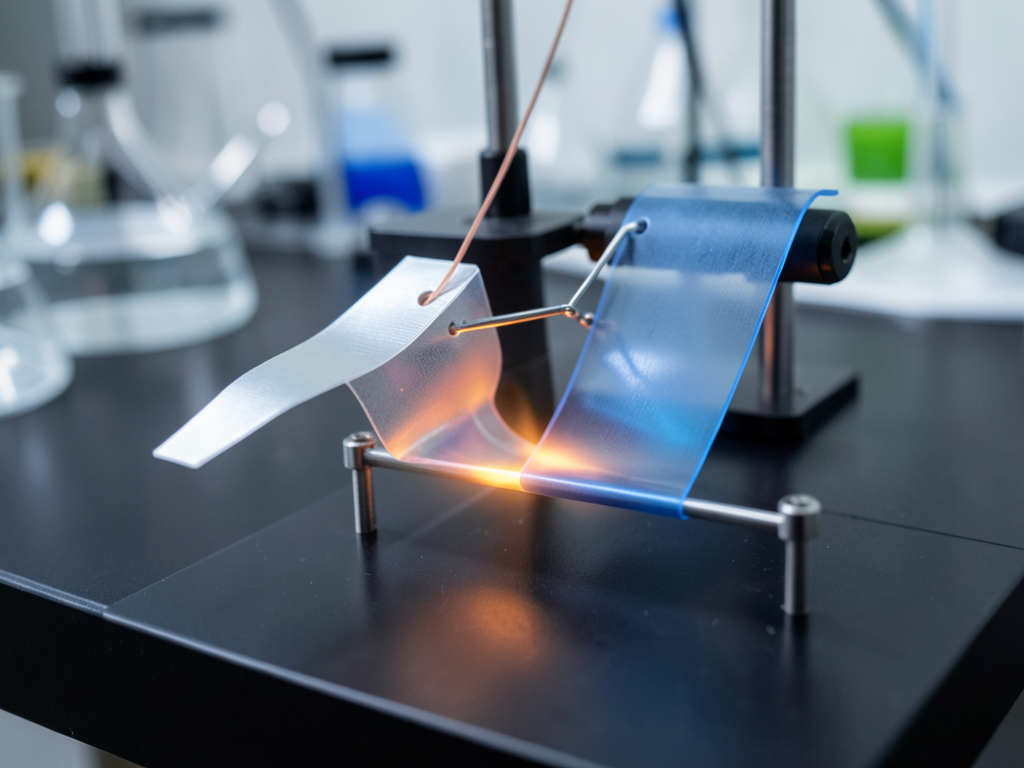
Scientists in Germany and Japan have demonstrated a solid-state cooling system that requires no electric motor, using heat alone to generate the mechanical work needed for refrigeration. The device relies on two ultra-thin shape-memory alloy films that work together to create a self-powered cooling cycle. This proof of concept opens a potential pathway for data centers to recycle processor exhaust heat into cooling.
How the Motorless Cooler Works
The prototype combines two shape-memory alloy films with different roles. A 22-micrometer TiNi actuator film recovers its original shape when heated, generating a force-to-displacement ratio of 14.5 N/mm. This contraction stretches a 26.5-micrometer TiNiFe refrigerant film, loading it with mechanical stress. When the heat source is removed, the TiNi actuator relaxes, releasing the TiNiFe film. The release triggers a reversible phase transition in the refrigerant, causing it to absorb heat and cool down.
In laboratory tests using Joule heating of the actuator to 86°C, the device achieved a 12.9 K temperature span across the refrigerant film and a 4.0 K span across the assembled cooler. When the researchers replaced the resistance heating with an external 130°C heat source, the prototype still maintained a 2.2 K device-level temperature span, proving that an external thermal source can drive the cycle.
Advantages Over Traditional Cooling
Conventional vapor-compression refrigeration relies on electrically driven compressors and refrigerants with high global warming potential. Solid-state alternatives like thermoelectric coolers are compact but reach only 10% to 15% of the theoretical efficiency limit. Elastocaloric cooling using shape-memory alloys offers higher potential efficiency, but existing designs typically require motors, hydraulics, or electromechanical actuators to repeatedly load and unload the refrigerant. The KIT-Tsukuba design removes these components entirely. Instead, the heat source itself provides the actuation: heating the TiNi film produces the mechanical force, and cooling the film allows the cycle to repeat.
Why This Matters
This innovation could transform energy use in data centers, where processors generate enormous amounts of waste heat. Future systems might capture exhaust heat to power cooling, reducing electricity consumption for both computing and thermal management. The prototype, however, is still an early-stage laboratory experiment. Its current cooling power is only 2.09 milliwatts at zero temperature lift, far from practical application. The proof of concept, though, demonstrates that motorless, heat-driven refrigeration is physically possible. Scaling the thin-film design and improving heat transfer will be necessary before it can recycle processor heat into usable cooling.