Editor: Porcia Akua Holmes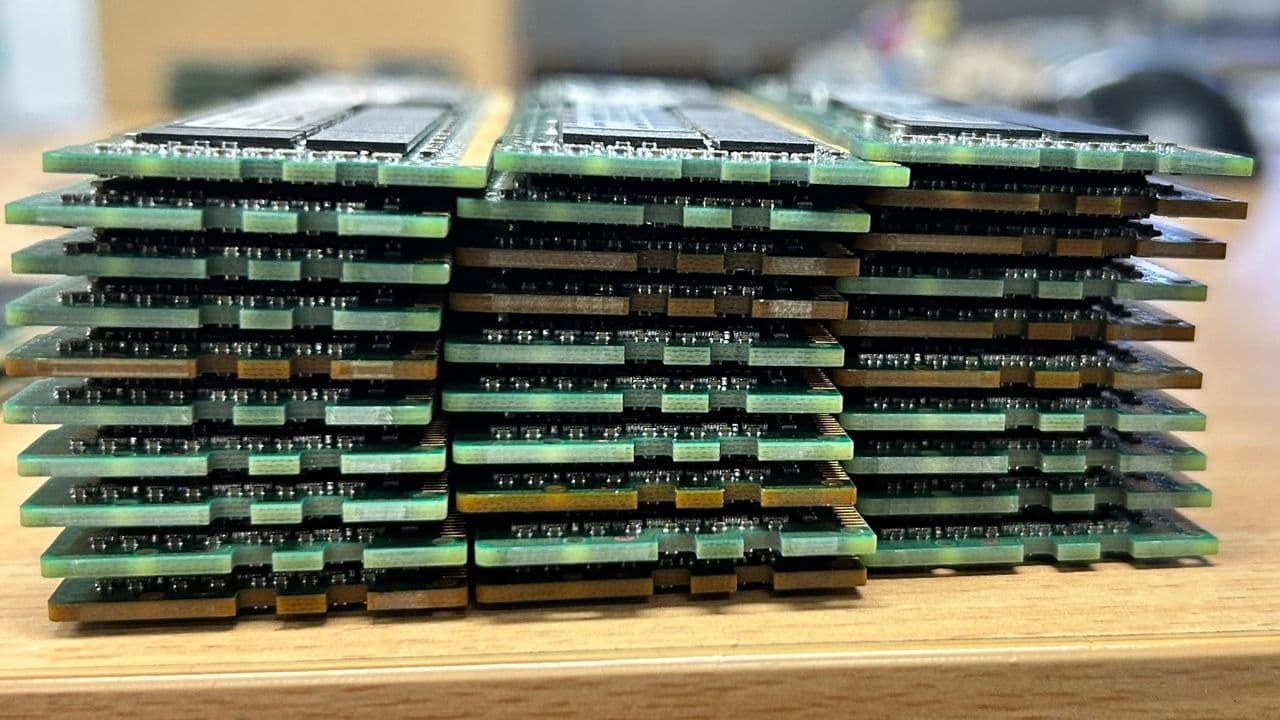
A Reddit user has stumbled upon roughly $12,000 worth of DDR4 memory sitting unused in a garage, but the treasure comes with a catch that many PC enthusiasts may not anticipate. VastOption8705 posted images of 30 Samsung 64GB DDR4-2666 sticks to the LinusTechTips subreddit, recounting how an old server from work ended up at home. The stack totals 1,920 gigabytes of RAM, yet nearly all of it remains incompatible with consumer desktop motherboards.
The Server Memory Trade-Off
Enterprise-grade memory offers reliability features rarely seen in consumer products. ECC RAM detects and corrects single-bit errors, making it essential for data centers where uptime matters. Registered DIMMs add a hardware buffer between the module and the memory controller, allowing more sticks per channel and larger total capacities. These advantages come at the cost of compatibility. A standard DDR4 socket can accept unregistered unbuffered DIMMs (UDIMMs) without issue, but RDIMMs require a server or workstation platform that specifically supports registered signaling.
VastOption8705’s haul illustrates this divide clearly. The 64GB sticks, while individually worth hundreds of dollars on the secondary market, serve almost no purpose in a home gaming rig. Reselling them to datacenter operators or small businesses running older servers is the only practical path to recover value. The initial $12,000 estimate assumes a per-stick price near $400, though current U.S. listings more often fetch $350 to $425. If VastOption8705 lives in Australia, as local references suggest, the local Australian dollar valuation lowers the equivalent figure to roughly $7,200 USD.
Enterprise Pricing Versus Consumer Reality
The Reddit post captures a growing trend: companies retiring servers loaded with high-capacity DDR4 memory and allowing employees to keep the hardware. This practice saves organizations recycling fees and avoids data destruction paperwork. For employees like VastOption8705, it can feel like hitting a jackpot. Yet the resale value depends heavily on finding the right buyer. A single 64GB DDR4 ECC stick commands good money in the used enterprise market, but bulk sellers rarely achieve top-dollar prices due to oversupply from datacenter upgrades.
Tech enthusiasts watching from the sidelines should temper expectations. A drawer filled with older DDR3 modules or SDRAM carries negligible value today. The 30 DDR4 sticks found here represent a narrow window of opportunity tied to the current transition toward DDR5 in server infrastructure. Once DDR5 becomes dominant, even this massive stack will lose its premium.
Why This Matters
This incident highlights fundamental barriers between enterprise and consumer hardware ecosystems. As artificial intelligence workloads accelerate memory density demands, server surplus will continue flooding secondhand channels. Hobbyists drawn by bargain prices must learn to distinguish between genuinely useful parts and technically impressive paperweights. The practical implications extend beyond individual buyers: recyclers gain revenue from salvaged modules, cloud operators benefit from liquidating old inventory, and manufacturers profit from selling replacement components. Meanwhile, the average PC builder gains nothing from the existence of vast stacks of incompatible RAM unless they build a complete server platform around it.
The find underscores a persistent lesson in hardware markets. Compatibility matters more than capacity alone. Without the proper host system, a memory bank worth five figures becomes little more than an expensive ornament in a garage.