Senior Editor: Alan Agbele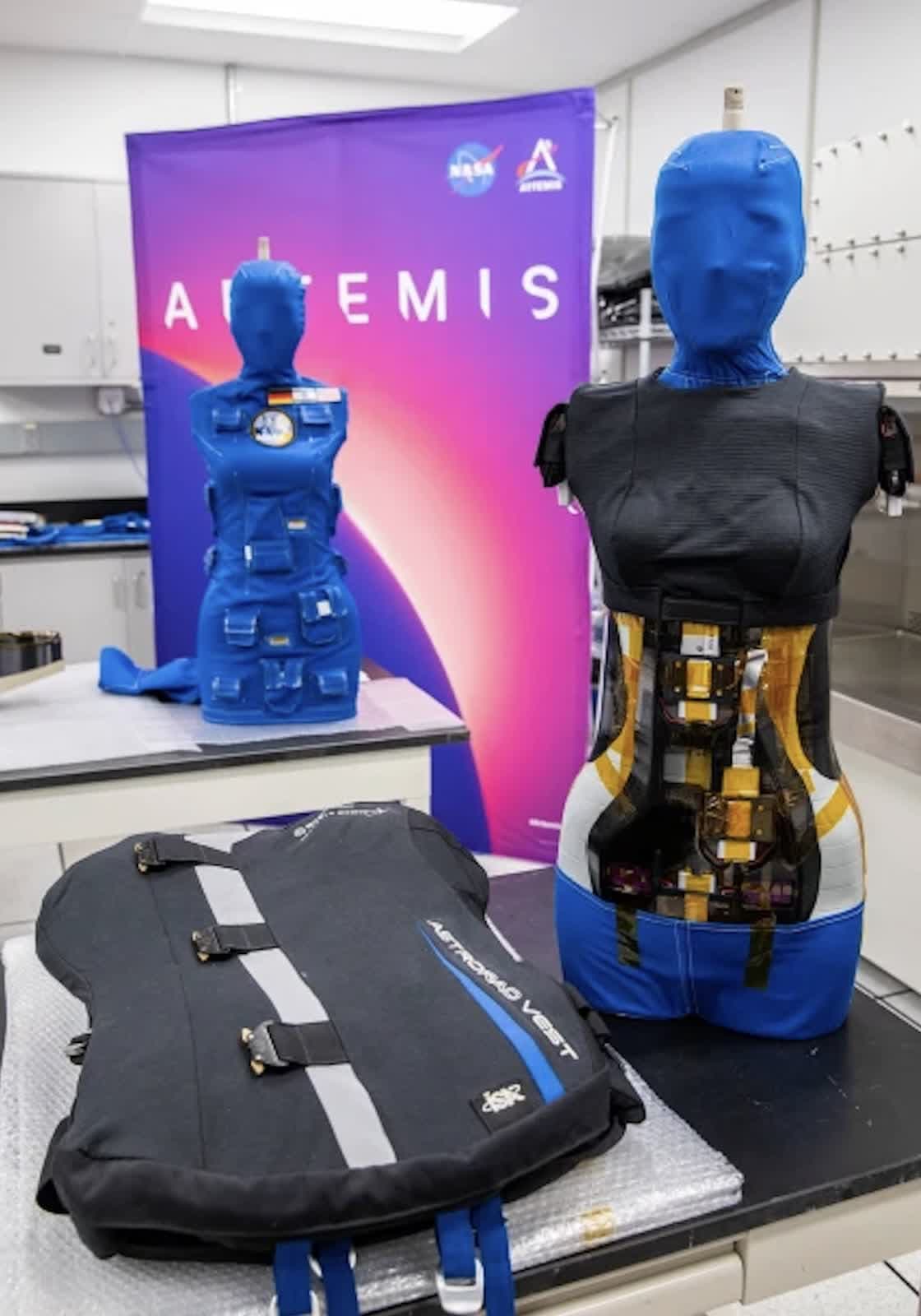
A radiation shield worn like a vest could reduce an astronaut's exposure during a major solar storm by 60 percent, according to data from a NASA experiment that flew around the moon in 2022. The AstroRad vest was carried aboard the uncrewed Orion capsule during the Artemis I mission, strapped onto a female manikin named Zohar. Zohar contained thousands of radiation sensors, allowing researchers to measure exactly how much particle flux the vest blocked.
How NASA Tested the Vest
Researchers placed one manikin named Zohar inside the AstroRad vest before launch. A second manikin, Helga, flew without any vest. Both manikins were equipped with high-resolution dosimeters that recorded radiation doses across their bodies throughout the 25-day mission. The key finding: Zohar received roughly 60 percent less radiation from solar particle events compared with Helga.
Why Solar Storms Are a Growing Concern
The Artemis program aims to return humans to the moon for extended stays. Unlike the International Space Station, which sits within Earth's protective magnetosphere, lunar missions will face full solar radiation. A large solar flare or coronal mass ejection could deliver a dangerous dose in hours. Until now, astronauts had only the hull of their spacecraft for protection. A wearable vest adds a layer of defense that can be worn during spacewalks or when sheltering in a storm shelter is not possible.
Why This Matters
The success of the AstroRad test changes the risk calculation for deep space exploration. Space agencies can now consider lightweight, wearable shielding as part of their radiation mitigation strategy. For the Artemis moon landings and eventual missions to Mars, this vest could reduce the cumulative dose astronauts receive, lowering their lifetime cancer risk. It also opens the door to more flexible mission planning. Crews no longer need to rely solely on heavy passive shielding or expensive active systems. The AstroRad vest, if adopted, could become standard equipment on every deep space vehicle. The data from Zohar and Helga provides the evidence base that will drive those decisions forward.
What Comes Next
Further analysis of the Artemis I radiation data is ongoing. NASA and the vest's developers are likely to refine the design based on the detailed dose maps collected by the manikins. The next step will involve human testing aboard the station or during future Artemis flights. If the vest performs as expected on live crew members, it may become a mandatory part of the astronaut's kit for all deep space missions.