Editor: Porcia Akua Holmes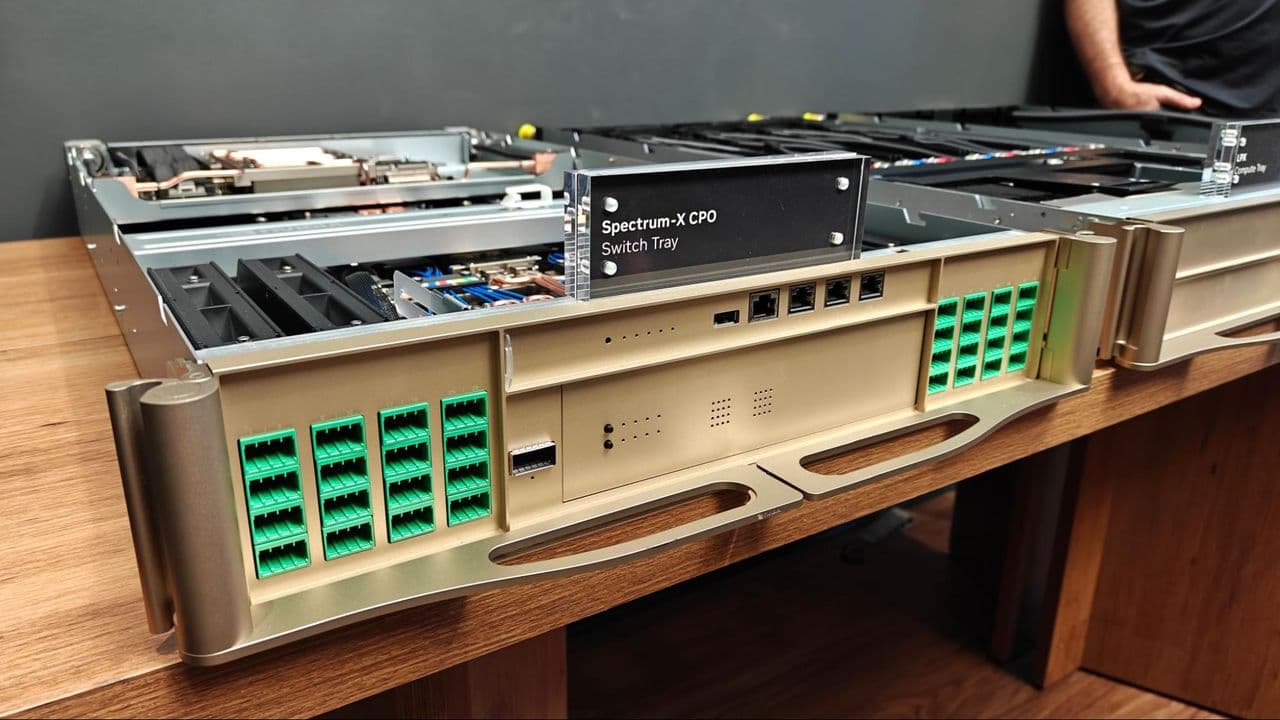
The race to shrink power and latency in data center interconnects has created an opening for near-packaged optics (NPO) as a workable middle ground. Industry analysts at SemiAnalysis argue that NPO will see sustained volume through the end of the decade as true co-packaged optics (CPO) struggles with yield and reliability issues. In an August analysis, SemiAnalysis described NPO as an interim architecture that solves the most pressing problems of full CPO while retaining most of its power advantages.
How NPO Splits the Difference
A front-panel pluggable transceiver sits 15 to 30 centimeters of copper trace away from the switch ASIC, with the digital signal processor (DSP) consuming 6 to 8 watts per 800-gigabit module. CPO eliminates the DSP by mounting the optical engine directly on the same package substrate as the ASIC, cutting distance to millimeters. Broadcom reports CPO reduced optics power by 70% for its Tomahawk switches. Nvidia says per-link power at 1.6T falls from 30 watts to 9 watts with co-packaging.
NPO keeps the optical engine on a separate substrate mounted beside the ASIC, close enough to drop the DSP but socketed so the module can be swapped in the field. That design preserves serviceability while still slashing power. Linear pluggable optics (LPO), another interim approach, removes the DSP but leaves the optics on the faceplate, cutting power to 7 to 8.5 watts per 800-gigabit port at the cost of reach and interoperability.
Yield and Serviceability: The CPO Bottleneck
A soldered CPO substrate cannot be reworked because removing a reflowed engine requires temperatures of 220°C to 260°C near the switch ASIC, damaging submicron fiber alignment. One failed engine can scrap the entire assembly. SemiAnalysis calculated that for a 32-engine package at 95% per-engine yield, compound yield drops to roughly 19%. That math prompted the firm to push its CPO volume expectations to 2027 for scale-out networks and 2028 or 2029 for full production, a call that knocked 17% off Applied Optoelectronics stock and about 8% off Lumentum in a single session.
GlobalSemiResearch countered that the calculation freezes yields at a single snapshot and ignores binning and spare engines built into Nvidia’s Spectrum-X design. Meta presented reliability results at OFC 2026 showing CPO can beat pluggable failure rates. Broadcom said its CPO systems logged more than 1 million cumulative 400-gigabit-equivalent port-hours in Meta testing without a single link flap. Still, the yield concern has made many operators reluctant to commit fully to CPO.
Why This Matters
The practical choice between NPO and CPO will shape how hyperscale data centers and AI operators manage bandwidth growth over the next five years. If CPO yields remain low, the industry will lean on NPO to meet the 1.6T and 3.2T port speeds that Nvidia and Broadcom are pushing. That means fiber alignment and socket standards become critical, and a standards group formed by six connector and optics firms at OFC 2026 is already defining a common socket for NPO devices. For companies deploying AI clusters today, NPO offers a power-efficient, serviceable link that can be swapped without taking down a rack. The bet is that CPO will eventually scale, but NPO buys time without the risk of scrapping expensive ASICs.
Products and Roadmaps
Nvidia’s Quantum-X Photonics InfiniBand switch, now in production, carries 144 ports of 800G across 18 silicon photonics engines mounted on detachable optical sub-assemblies, with 18 removable external laser modules. Nvidia calls this CPO, but the detachable engines match the serviceability profile SemiAnalysis assigns to NPO. The Ethernet counterpart, Spectrum-X Photonics, is due in the second half of this year with up to 512 ports of 800G.
Broadcom is running both architectures, showing a 3.2T VCSEL-based NPO product line at OFC 2026 while also shipping co-packaged Tomahawk switches. The company’s dual approach underscores the uncertainty: NPO is shipping today, while CPO waits for better yields and reliability data. As SemiAnalysis noted, volume for NPO silicon photonics products will extend until the end of the decade, giving the industry a bridge technology that keeps data centers running while CPO matures.