Senior Editor: Alan Agbele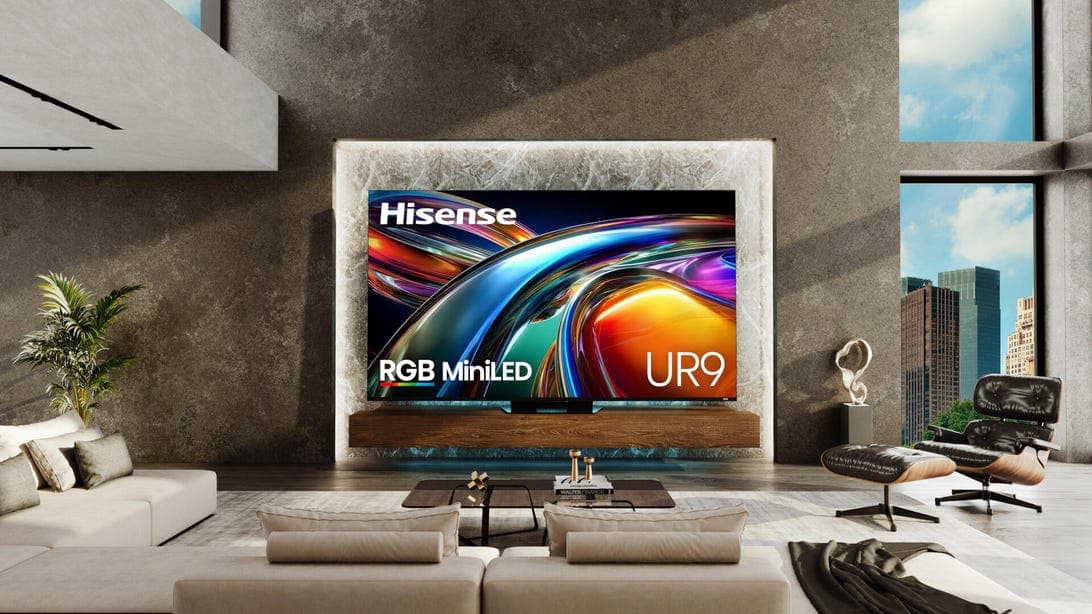
Hisense has started selling its new UR8 television, a model that uses RGB Mini-LED backlighting instead of the standard white LED approach. The TV hits shelves with a starting price of $1,300.
The UR8 is part of a shift toward RGB backlight technology. Most current Mini-LED TVs use white LEDs with color filters. The RGB version uses red, green and blue LEDs directly, which can produce a wider color gamut and more precise brightness control.
How RGB Changes the Picture
Traditional Mini-LED TVs rely on a layer of white LEDs behind the LCD panel. Color is created by passing that white light through color filters. This process wastes some energy and can limit color purity.
RGB Mini-LED eliminates the color filter step. Each LED emits its own red, green or blue light. This allows the TV to mix colors more accurately and achieve higher peak brightness without oversaturating hues.
Hisense claims the UR8 delivers a color volume that rivals high-end OLED displays. The technology also reduces blooming, the halo effect around bright objects on dark backgrounds, by offering finer dimming zones.
Why This Matters
For buyers, this means a noticeable improvement in picture quality at a price lower than premium OLED or QD-OLED sets. The UR8 targets the upper midrange market, competing against models from Samsung, Sony and TCL.
The TV supports Dolby Vision, HDR10+ and HDMI 2.1, making it suitable for gaming and streaming. It also includes a 120Hz panel for smoother motion.
Hisense has not disclosed the exact number of dimming zones, but the company says the UR8 offers enough local dimming to handle high-contrast scenes effectively.
Pricing and Availability
The UR8 is available now in 65-inch and 75-inch sizes. The 65-inch model starts at $1,300, while the 75-inch version costs $1,800. Both sizes ship with a standard remote and support for major voice assistants.
Hisense plans to expand the RGB Mini-LED lineup later this year, including a larger 85-inch option. The company also aims to bring the technology to lower price points in future models.