Editor: Porcia Akua Holmes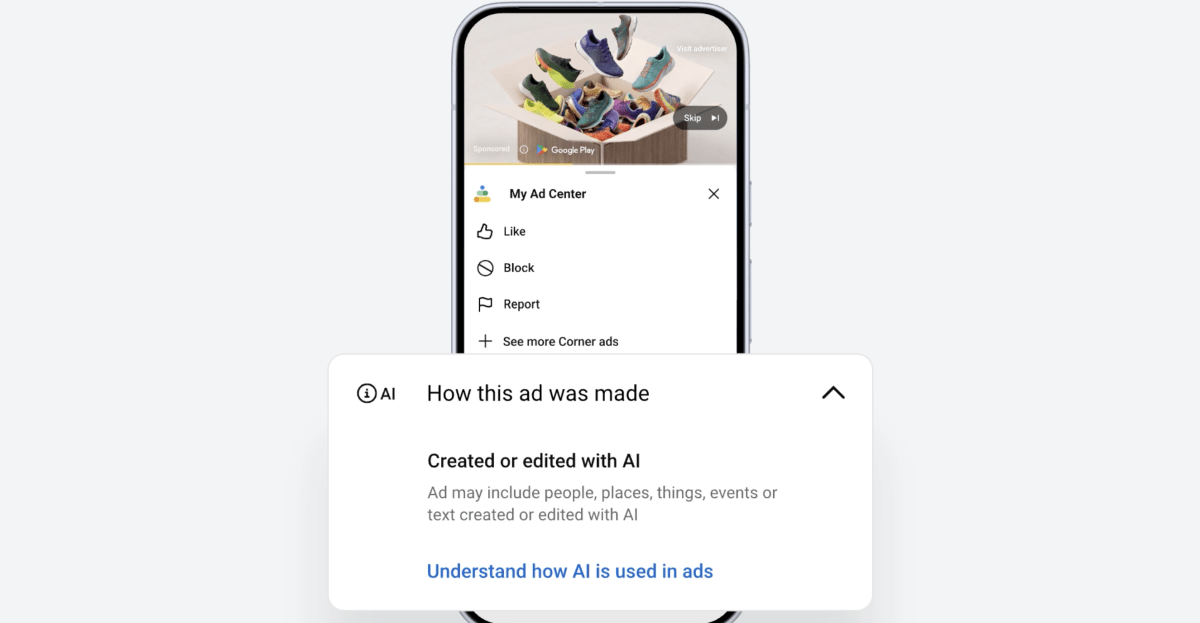
Google will now disclose which advertisements on its platforms are created or edited with artificial intelligence, a move aimed at increasing transparency in the rapidly expanding AI advertising market. The new label appears in the company's My Ad Center, accessible from ads on Google Search, Google Discover and YouTube.
How the AI Disclosure Label Works
Google's system categorizes AI involvement in two ways. For ads generated or edited using Google's own AI advertising tools, the company will automatically append the label. For ads created elsewhere with third-party AI, advertisers must manually check a box in the ad creation interface.
Users encounter the label by clicking the three dots or the info button on any ad across Google's properties. This opens the My Ad Center panel, where a new section titled "created or edited with AI" appears under the "how this ad was made" tab. The same panel allows users to block or report ads.
Setting a Precedent for the Industry
Google's move places it among the first major platforms to standardize AI disclosure in advertising. Other social media companies, including Meta, have implemented similar labels for AI-generated content on their feeds, but the scope and automatic enforcement vary widely. Google's decision to cover both owned and third-party AI tools sets a benchmark that regulators may reference.
The policy also pressures advertisers to establish internal workflows for tracking AI usage. For brands that rely heavily on generative AI for creative production, the manual labeling requirement introduces a compliance step that could affect campaign timelines. Google has not announced penalties for noncompliance, but the transparency shift signals that enforcement is likely to tighten.
Why This Matters
Consumer trust in digital advertising hinges on knowing whether content is human-made or AI-generated. Without clear labels, viewers cannot distinguish between authentic endorsements and synthetic creations. Google's policy addresses this gap, but the reliance on self-reporting for non-Google tools creates a risk of underreporting.
Regulators in the European Union and the United States are crafting rules that would mandate such disclosures. Google's proactive labeling system may serve as a template for these regulations, potentially reducing the burden of new compliance requirements. Advertisers who fail to adopt transparent practices now could face reputational and legal consequences later. The broader effect is a market shift where AI transparency becomes a standard expectation, not a voluntary add-on.