Editor: Porcia Akua Holmes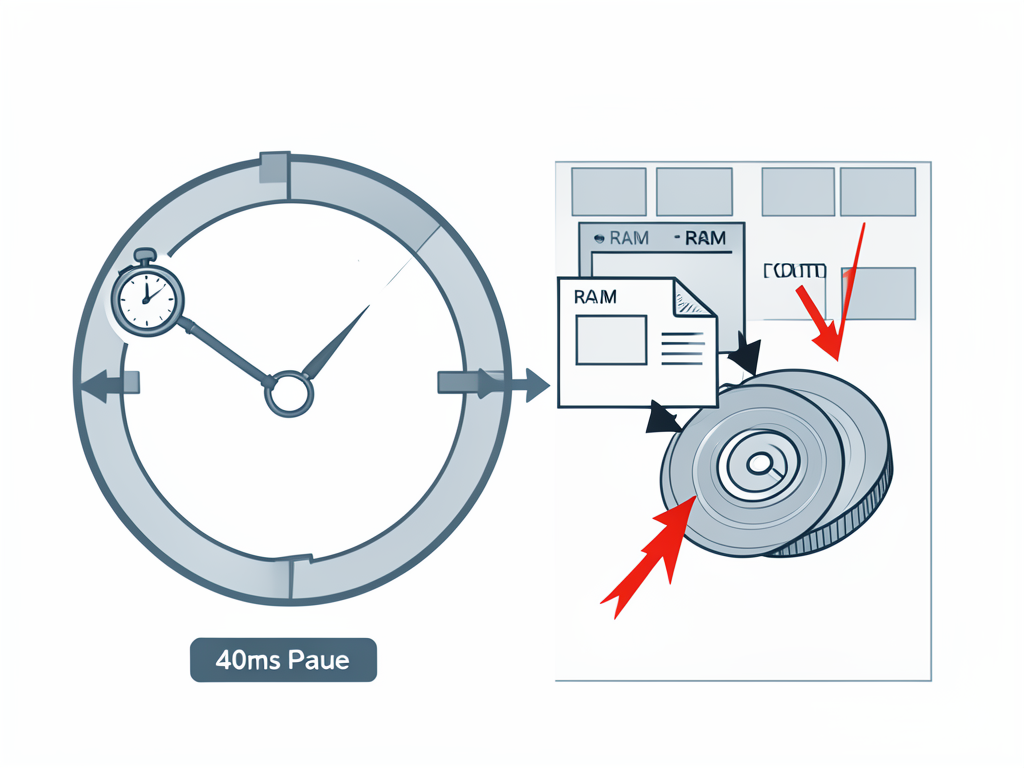
A single memory swap operation caused the Go garbage collector to pause for 40 milliseconds, a scenario that developers now see as a cautionary tale about runtime performance in constrained systems. The incident, documented by a Go developer on Hacker News, exposes how operating system swapping can turn a normally microsecond-level garbage collector pause into a significant latency spike.
Garbage Collection and Swap Overhead
The Go runtime uses a concurrent garbage collector designed to keep pause times under 500 microseconds in most cases. The collector works by tracing reachable objects while the program continues to run, but it must briefly stop the world at two points: to begin the mark phase and to perform sweep termination. During these stop-the-world windows, the collector accesses memory that may not be in physical RAM if the system is under memory pressure.
The 40ms Incident
The developer reported that a simple workload exhibited a 40ms garbage collector pause. Investigation revealed that the operating system had swapped out a portion of the heap to disk. When the Go runtime attempted to read that memory during the stop-the-world phase, the read triggered a page fault. The system then had to load the data back from the swap file, a process that took tens of milliseconds. The pause was not caused by the garbage collector itself but by the underlying memory subsystem.
Why This Matters
For developers running Go services in cloud environments or containers, the presence of swap can silently degrade performance. Many orchestration platforms, including Kubernetes, configure swap off by default, but custom deployments or developer machines may have it enabled. A single 40ms pause can break latency SLAs for real-time systems, trading platforms or API gateways. The incident also underscores a broader truth: garbage collector behavior cannot be analyzed in isolation from the hardware and operating system layer. Memory pressure, swap usage and page cache states all directly influence runtime guarantees.
Lessons for Developers
Teams can mitigate the risk of swap-induced pauses through several approaches:
Each option comes with trade-offs. Disabling swap may cause out-of-memory kills under heavy load. Tuning GOGC increases CPU usage. The right choice depends on workload characteristics and tolerance for latency versus throughput.
Broader Performance Implications
The 40ms pause is a reminder that garbage collected languages remain sensitive to memory hierarchy latency. While Go's concurrent collector is a significant improvement over older stop-the-world designs, it cannot overcome physical I/O delays. Developers who profile garbage collection in isolation may miss the real bottleneck. Profiling should include operating system metrics such as major page faults, swap usage and memory pressure to get a complete picture.