Editor: Porcia Akua Holmes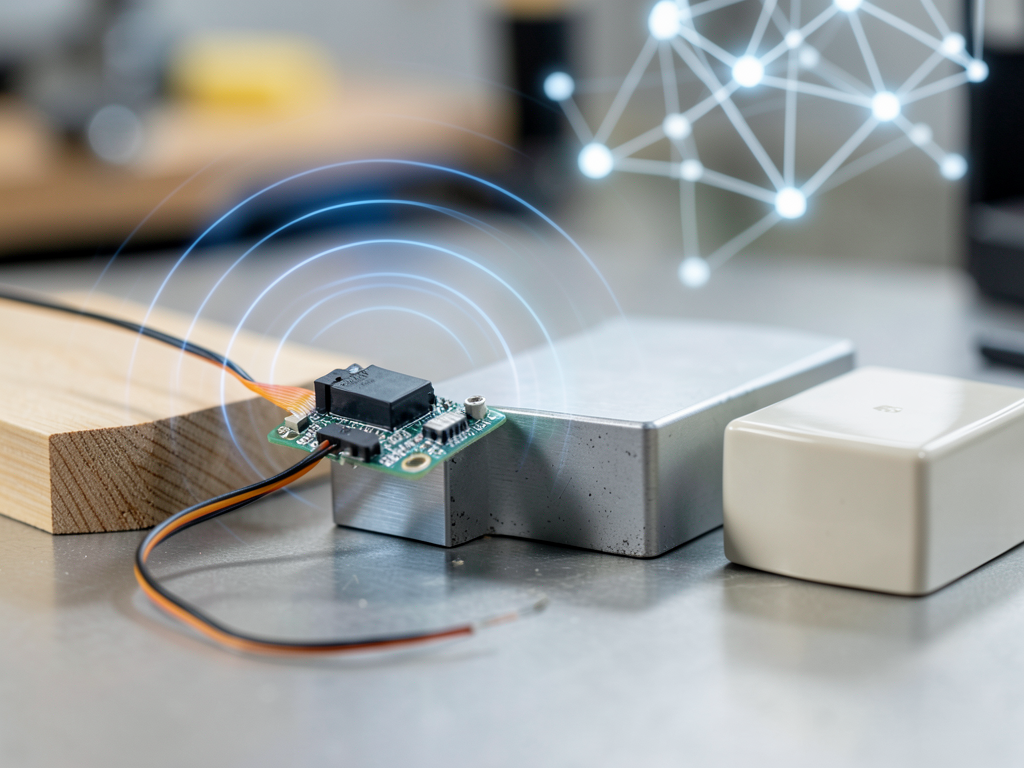
A software engineer has built a functional material classification system using millimeter-wave radar technology, demonstrating that sophisticated object identification is possible with off-the-shelf components. The project uses radio frequency reflections to distinguish between materials such as wood, metal and plastic without physical contact.
How MmWave Material Classification Works
The core principle behind this build relies on the fact that different materials reflect radio waves differently based on their dielectric constant and surface roughness. When a mmWave pulse strikes wood versus aluminum, the amplitude phase and polarization of the return signal change measurably.
The system processes these subtle variations through a trained neural network that maps raw radar signatures to specific material categories. Training data was collected by pointing the sensor at known samples across multiple angles and distances creating a robust dataset for real-world conditions.
- Hardware: Texas Instruments IWR6843ISK single-chip mmWave sensor operating at frequencies around 60 GHz
- Software stack: Python-based processing pipeline using TensorFlow for model training and inference
- Sensing range: Effective detection up to approximately two meters depending on target size and composition
Practical Applications Beyond Hobby Projects
The ability to identify materials remotely opens doors in several industries including recycling automation where sorting plastics metals and glass remains labor-intensive even today. Industrial quality control could also benefit from non-contact verification of product composition during manufacturing.
The builder noted potential use cases in autonomous navigation systems where knowing whether an obstacle is rigid metal or soft vegetation changes collision avoidance strategy significantly.
Why This Matters
The significance here extends beyond one person's workshop experiment. As mmWave sensors become cheaper they will likely appear in more consumer devices ranging from smart home appliances to delivery drones. A future smartphone might tell you whether your water bottle is stainless steel or plastic just by waving it near the device.
The open-source nature of this project means other developers can replicate improve upon or adapt the work without starting from scratch which accelerates innovation across robotics logistics and environmental monitoring sectors.