Senior Editor: Alan Agbele
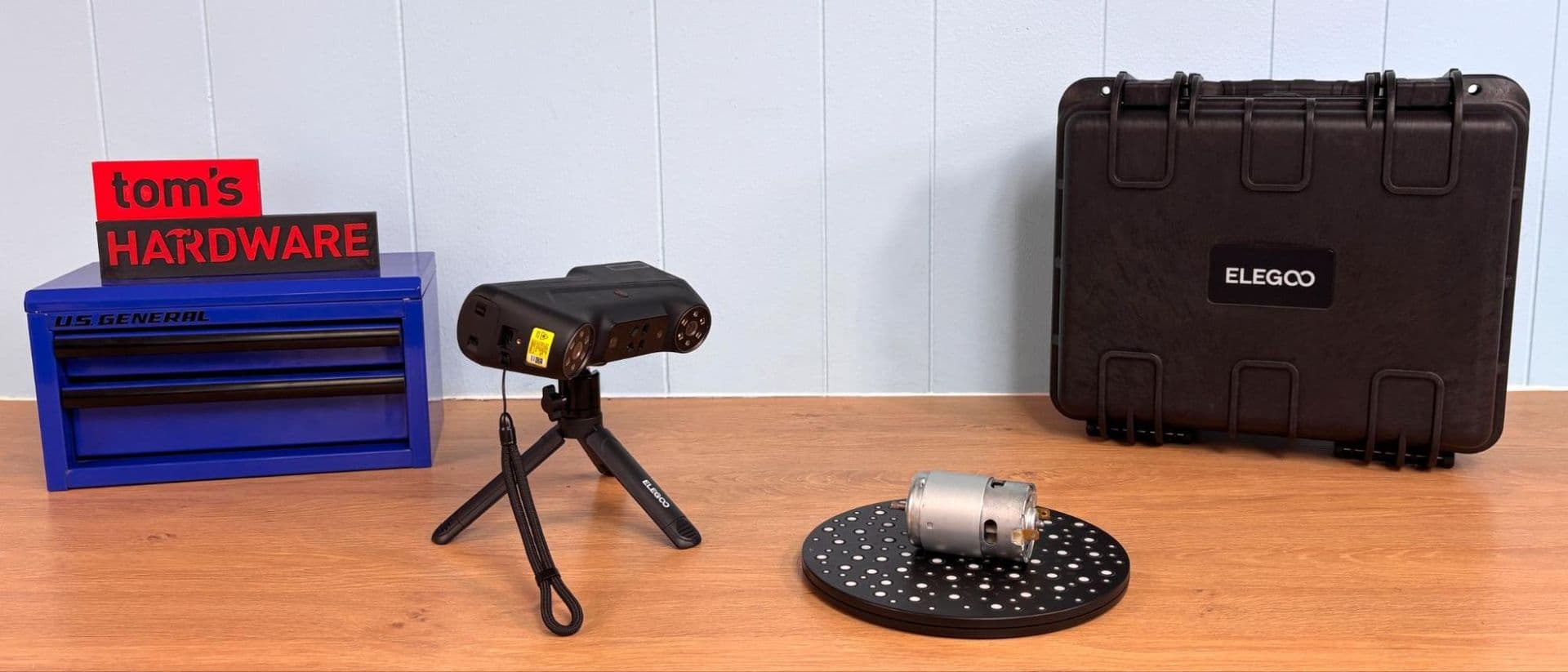
Elegoo has entered the 3D scanner market with the M1 Ultra, a $1,599 device that undercuts many professional-grade scanners while offering five scanning modes and a built-in 3-inch color touch screen. The company, best known for its resin 3D printers, is betting that its manufacturing scale can bring structured-light and laser scanning to a broader audience.
A Scanner Built for Field and Studio Work
The M1 Ultra weighs 511 grams with its battery installed and features a rubber grip below the screen for handheld use. Its 3-inch touch screen handles parameter setting, scan start and stop, and live monitoring. When a scan is initiated from the scanner itself, the touch screen takes precedence over any tethered computer.
Elegoo includes a hard travel case with padded interior, a glass calibration board, a spare rechargeable battery, NIR filters and a USB-C cable. A lens cleaning cloth and marker dots round out the package. The absence of a turntable is a notable gap for users who plan to scan small objects, since that accessory typically adds cost and complexity.
Two Scanning Technologies in One Device
The M1 Ultra combines blue laser scanning with NIR infrared binocular structured light, a pairing that lets users choose between high-detail laser capture and faster, more forgiving structured-light scans. The laser mode supports single, 7-line and 34-line patterns, while the NIR mode relies on near-infrared light that is less affected by ambient illumination.
Accuracy is rated at up to 0.02 mm in laser mode and up to 0.05 mm per meter in NIR mode. Working distance ranges from 200 mm to 600 mm for laser scanning and from 170 mm to 1,200 mm for NIR, giving users more room to capture larger objects without repositioning. The minimum scan volume is 5 x 5 x 5 mm in laser mode.
$1,599
Current scanner price
0.02 mm
Laser mode accuracy
100 fps
Max standalone scan speed
The Hidden Cost of Processing Power
Elegoo positions the M1 Ultra as a standalone scanner, but it cannot process scans without a fairly high-end PC or Mac. Users must tether the device via USB-C or connect over Wi-Fi, and the wired connection delivers the fastest data transfer. In testing, the scanner maintained a connection from about five feet away in a harsh RF environment, though range beyond that was not verified.
This dependency creates a practical barrier. Buyers who do not already own a capable computer must factor that cost into their budget, which can add several hundred dollars to the total investment. The M1 Ultra's value proposition therefore depends heavily on the user's existing hardware.
Why This Matters
Elegoo's entry into 3D scanning signals a broader shift: the company is leveraging its consumer manufacturing base to challenge established players like Shining 3D and Creality at a lower price point. For small businesses, independent designers and educators, the M1 Ultra lowers the barrier to professional-grade scanning without requiring a five-figure equipment budget.
The real test will be software. Hardware specifications are easy to match, but scan processing, alignment and mesh cleanup workflows are where incumbents have invested years of development. If Elegoo can deliver a reliable software experience, the M1 Ultra could pressure competitors to cut prices or bundle more features. If not, the scanner risks becoming a capable but frustrating tool that leaves users longing for the polish of more established ecosystems.
For now, the M1 Ultra represents a credible first effort. Its dual-mode scanning, touch screen and spare battery address real pain points in the field. The missing turntable and PC dependency, however, remind buyers that this is still a first-generation product from a new entrant.