Editor: Porcia Akua Holmes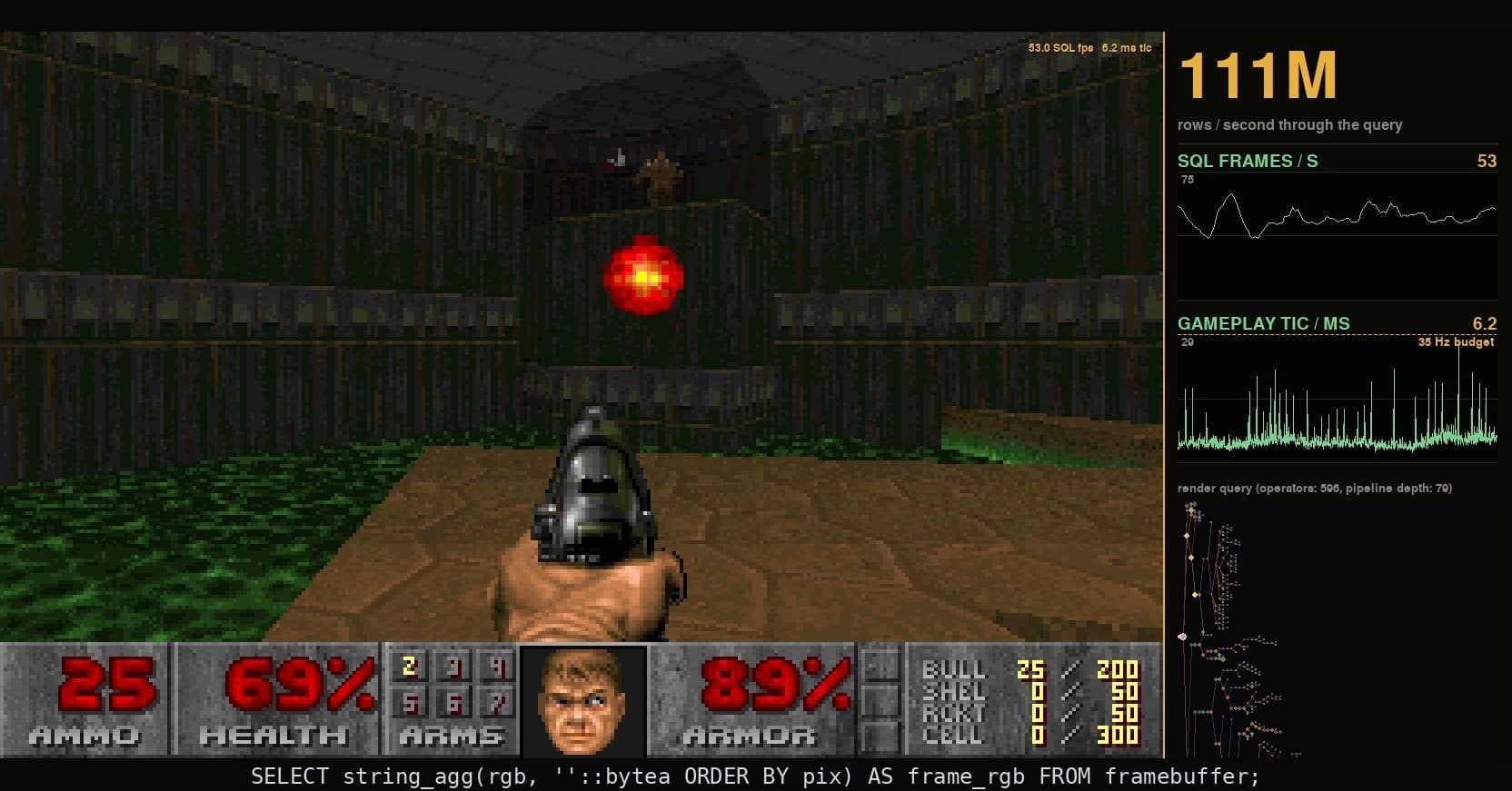
A developer has successfully ported the iconic 1993 first-person shooter Doom to run entirely on a SQL database backend. The project proves that game logic, graphics and user input can all be processed through database queries, expanding what developers consider possible with relational database systems.
The Port in Perspective
Doom by id Software has been ported to more devices and platforms than almost any other video game. The game’s relatively simple engine and open source release in 1997 allowed developers to experiment freely. A SQL port, however, stands apart because it reimagines the entire runtime environment inside a database management system.
Unlike other ports that rely on traditional programming languages or emulation, this version translates every frame of gameplay into SQL operations. The player sees the game rendered through a database client, and each action generates a transaction that updates the game state. This approach turns the database into both the computing engine and the interface.
How the SQL Engine Runs Doom
The port replaces conventional game loops with SQL stored procedures and triggers. Graphics rendering, collision detection and enemy AI all execute as database queries. The developer engineered a state machine that runs inside the database server, with input captured through a client that sends SQL commands.
Performance is significantly slower than native Doom, but the project was never intended as a playable game. Its purpose is to demonstrate creative engineering and the expressive power of SQL when pushed beyond its typical use cases.
Why This Matters
This project matters because it redefines the boundary between application and database. For decades, developers have treated databases as passive storage layers. A SQL-based Doom port shows that databases can act as active computing environments capable of real-time interaction.
The implications extend beyond gaming. Enterprise systems often rely on heavy application layers between users and databases. If a SQL database can run a shooter game, it might also handle more complex business logic directly, reducing infrastructure costs and simplifying architectures. Database vendors like Oracle and Microsoft may take note as the line between database and application continues to blur.
For the software development community, the project reinforces a valuable lesson: the most creative technical demonstrations often come from ignoring conventional boundaries. Doom has already inspired countless engineers to think differently about hardware and software. Now it challenges them to rethink what a database can do.