Senior Editor: Alan Agbele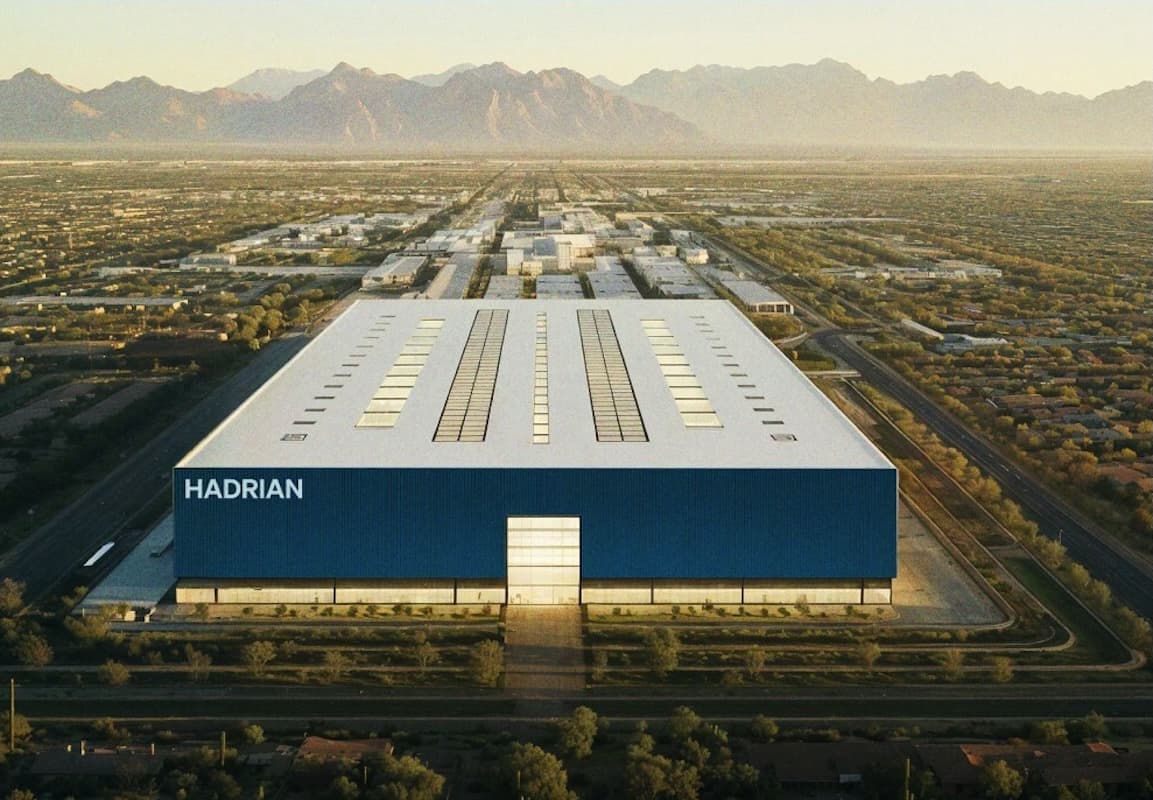
The defense technology sector saw one of its largest funding rounds to date as Hadrian secured $1.37 billion in Series D financing at an $8 billion valuation. The round positions the company among the most valuable private defense startups in the United States.
The Largest Defense Tech Round of the Year
Hadrian's Series D raise dwarfs most recent venture deals in the defense sector. The round was led by several prominent institutional investors, though the company did not disclose individual participants. The total haul brings Hadrian's lifetime funding to more than $1.8 billion.
The defense tech startup, however, is not a typical software company. It builds autonomous factories designed to manufacture metal and composite parts for military platforms including submarines, fighter jets and ground vehicles. The production approach combines computer vision, robotics and real-time quality control to reduce lead times from months to weeks.
How Hadrian's Automated Factories Work
At the heart of Hadrian's model is a network of highly automated manufacturing cells. Each cell can switch between different part geometries without manual retooling, allowing rapid scaling for urgent defense orders. Key capabilities include:
The system is designed to meet the U.S. Department of Defense's stringent quality standards while offering a faster alternative to traditional foundries and sheet-metal shops. Hadrian currently operates two production facilities and plans to open three more within the next 18 months.
Why This Matters
The influx of venture capital into Hadrian signals a broader shift in how the Pentagon sources its hardware. For decades, the military relied on a handful of large prime contractors with multi-year production cycles. Hadrian and similar startups offer a more agile model that could accelerate procurement for urgent missions.
The implications extend beyond speed. Automated factories reduce reliance on overseas suppliers for critical components, addressing supply chain vulnerabilities exposed by the war in Ukraine. If Hadrian can scale its output reliably, it may reshape the competitive dynamics of the defense industrial base and force traditional manufacturers to accelerate their own automation investments.
What Comes Next for Hadrian
With the fresh capital, Hadrian plans to double its factory floor space and expand its engineering workforce. The company also aims to develop new alloys and composite materials tailored to additive and subtractive manufacturing. Leadership expects to produce parts for next-generation programs including the Navy's Columbia-class submarine and the Air Force's Next-Generation Air Dominance fighter.
Investors, meanwhile, are watching whether Hadrian can deliver on its promise of consistent quality at high volume. The startup's ability to win long-term contracts with the Pentagon will determine whether the $8 billion valuation proves justified. Early signs are positive: Hadrian already holds multiple sole-source agreements with defense primes for specialized components.