Senior Editor: Alan Agbele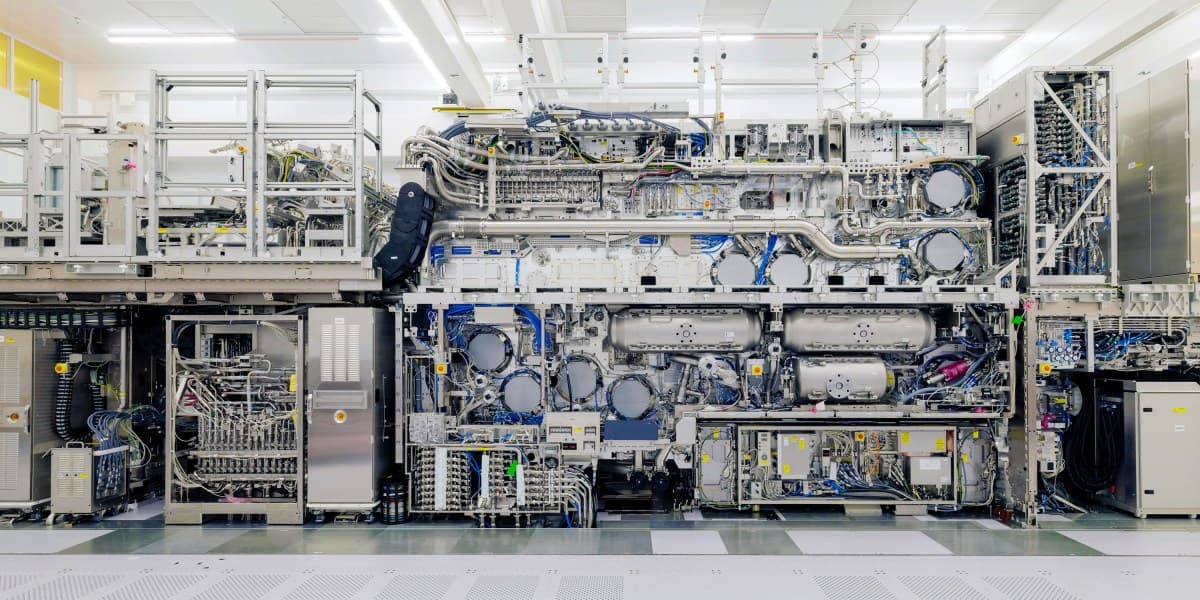
In a groundbreaking advancement for the semiconductor industry, Dutch company ASML has begun deliveries of its cutting-edge lithography machine, priced at a staggering $400 million per unit. This state-of-the-art device, capable of etching circuitry just eight nanometers wide, about the width of 40 silicon atoms, marks a critical juncture for an industry grappling with an exploding demand for artificial intelligence processors. As the production capabilities of chipmakers expand, ASML's technology will play a pivotal role in shaping the future of computing.
A New Milestone in Lithography
ASML's latest tool, called a high-NA EUV lithography system, represents the most significant leap in chipmaking since the company introduced EUV technology nearly a decade ago. The machine weighs more than 150 tons, stands as tall as a double-decker bus, and relies on thousands of cables, tubes, and pressurized tanks. Inside, a laser fires tens of thousands of times per second at tiny droplets of tin to generate extreme-ultraviolet radiation. That light then reflects off a series of mirrors positioned with atomic precision to project circuit patterns onto silicon wafers.
The leap in resolution from 13 nanometers to eight nanometers allows chipmakers to pack transistors more densely, boosting performance and energy efficiency. TSMC, the dominant chip manufacturer, is expected to use these machines to produce the most advanced processors for AI training and inference.
Why This Matters
The high-NA EUV machine arrives as AI companies like OpenAI and Anthropic accelerate construction of server farms that require ever more powerful chips. Without tools that can shrink transistor sizes, the semiconductor industry would struggle to keep pace with the doubling of computational demands roughly every two years known as Moore's Law.
ASML controls about 90% of the global lithography market, and its machines are essential for any company that wants to produce leading-edge processors. That near-monopoly, combined with TSMC's dominance in manufacturing, creates a chokepoint in the global chip supply chain. Countries that lack access to these machines, either due to cost or export restrictions, face severe disadvantages in AI development and national security.
Geopolitical and Competitive Pressures
ASML's monopoly has drawn scrutiny from governments worried about supply chain security. The United States pressured the Netherlands to block exports of ASML's high-end machines to China in 2019, a policy that remains in effect. Chinese firms have responded by pouring billions into domestic lithography research, but they remain years behind ASML's technology.
Startups such as Substrate, based in the US, aim to build cheaper and smaller lithography systems. Substrate's CEO James Proud argues that the current arrangement leaves the US dangerously reliant on overseas suppliers. However, replicating the precision and throughput of ASML's machines requires massive capital and decades of optical engineering expertise. For now, ASML's engineers expect the high-NA EUV system to keep the AI industry supplied with advanced chips for at least the next decade. The company's CTO Marco Pieters said the technology has only scratched the surface of what AI chips can achieve. Whether competitors can eventually crack the lithography code remains an open question, but the near future belongs to the Dutch giant and its $400 million behemoths.