Editor: Porcia Akua Holmes
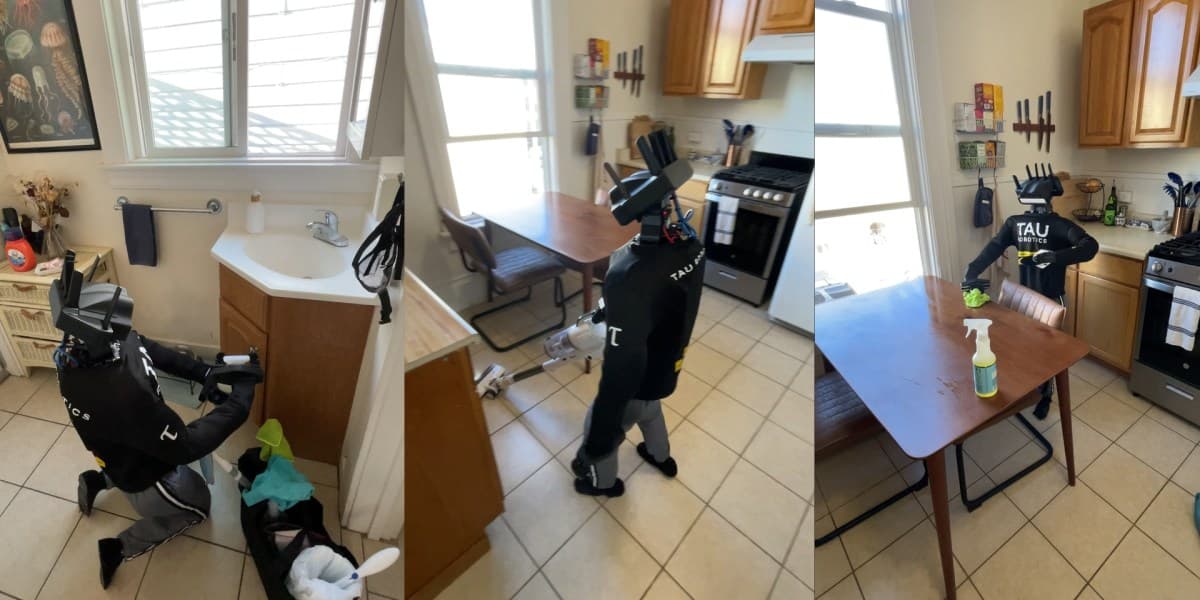
A four-and-a-half-foot humanoid robot climbed eight stairs like a drunk, knocked over olive oil and left taps dripping. It also cleaned a San Francisco apartment for $30 an hour. That robot, built by startup Tau Robotics, is not autonomous. It is piloted remotely by humans who collect training data with every wipe and fold.
The Robot That Climbed Stairs Like a Drunk
The robot arrived in a blue minivan, helped out by Tau cofounder Cornelia Weinzierl and another employee. It wore a Tau Robotics shirt and grippy socks to protect hardwood floors. Its 3D-printed head had antennae for communication, and its claw hands proved surprisingly effective for cleaning tasks.
Inside the apartment, the carpeted staircase defeated it entirely. Weinzierl had to lug it up the last few steps. The robot repeatedly stalled out, which Weinzierl initially attributed to overheating in unseasonably hot weather. A colleague later confirmed that heat had triggered a shutdown.
Despite the clumsiness, the robot reattached its toilet brush wand three times without help. It vacuumed and mopped some areas autonomously, according to Weinzierl. The remote pilot handles complex tasks like making the bed and folding laundry through kinematic guidance, where sensors transmit the pilot's motions to the robot.
Why Tau Charges Less Than a Human Cleaner
Tau's pricing reflects the value of the data, not the cost of the labor. At the time of booking, the company offered $30 for an hourlong cleaning with one robot. Now it charges $60 per weekly cleaning with two robots, or $100 for a one-time visit. That undercuts many human cleaning services in San Francisco.
The robots are thorough but slow. Watching them for an entire visit is not a good use of time. The real product is the training data: every counter wiped and T-shirt folded helps Tau's AI models learn to handle tasks without human help.
The Jetsons Promise and the Labor Question
The experience felt like a taste of The Jetsons, the classic cartoon of futuristic home life. But the human cost could be steep. Cleaning workers, many of them immigrants and low-wage earners, could lose jobs if autonomous robots become affordable and reliable. U.S. policy is nowhere near ready to handle that displacement.
Tau's robots are closer to radio-controlled cars than to Waymos, the self-driving taxis that have become common in San Francisco. Waymos navigate city streets without a human behind the wheel. Tau's robots still need a human pilot for many tasks. That gap matters for both safety and economics.
If Tau succeeds in building truly autonomous cleaning robots, they could become San Francisco's newest tech tourist attraction. The city has already embraced Waymos as a spectacle. Robot cleaners might follow the same path, drawing curious neighbors and social media posts.
Why This Matters
The cleaning industry employs millions of people worldwide, often in precarious and undervalued jobs. A cheap robot that can fold laundry and scrub toilets would not just be a gadget. It would be a labor market shock. Tau's data-driven approach means every paid cleaning session is an investment in replacing human labor.
For consumers, the trade-off is clear: lower prices now, but a future where the service is fully automated and the human pilot disappears. For workers, the timeline is uncertain but the direction is not. The robots are clumsy today. The training data, however, is accumulating with every visit.
Tau Robotics has not announced a timeline for full autonomy. The company's current model relies on human pilots and cheap rates to attract customers. That model works for now. The question is how long the humans stay in the loop.