Editor: Porcia Akua Holmes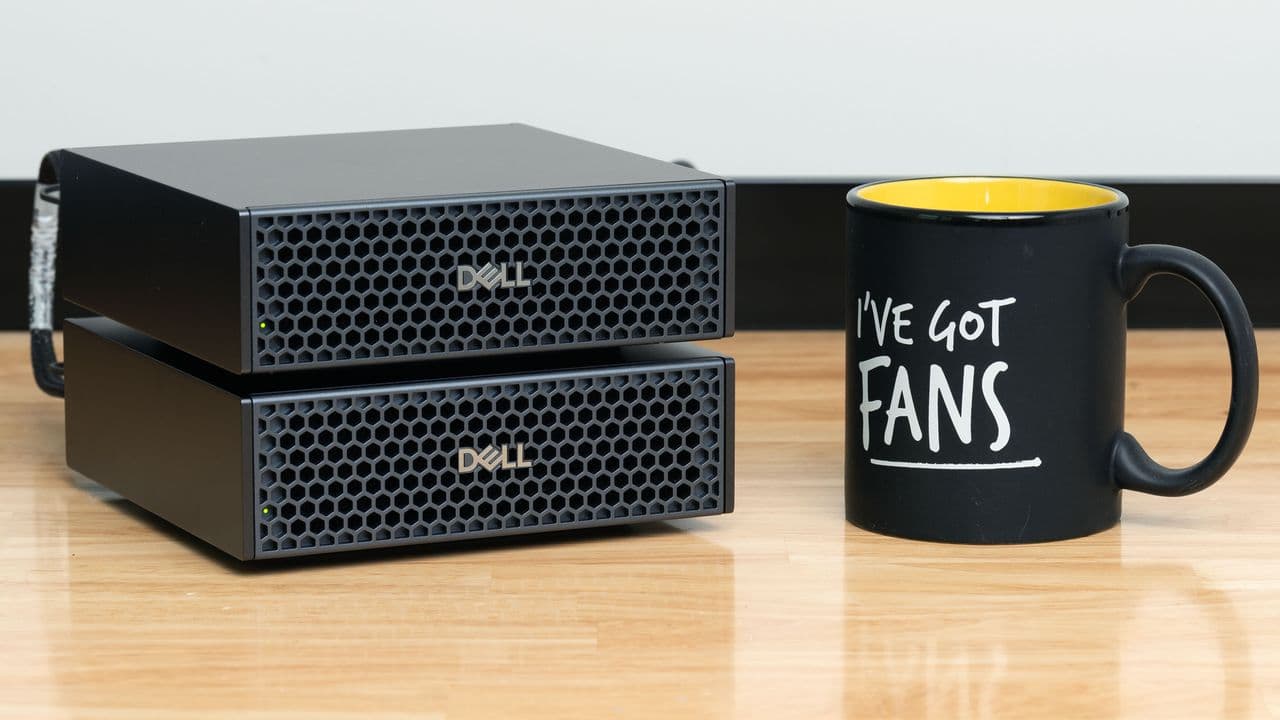
Local AI enthusiasts who need large memory pools for running advanced language models now have a compelling alternative to expensive multi-GPU servers. By linking two Dell Pro Max GB10 systems, users can build a local AI cluster with 256GB of RAM for roughly $12,600, a fraction of what a comparable GPU server would cost. Dell's Pro Max with Nvidia GB10 leverages Nvidia's built-in ConnectX-7 networking to enable scale-out clustering out of the box.
Networking and RDMA Architecture
Nvidia designed the GB10 platform to be cluster-ready from the start. The integrated ConnectX-7 NIC supports high-speed RDMA over Ethernet, allowing multiple GB10 systems to share memory and distribute model inference across the network. Our testing used a pair of Dell Pro Max units connected with QSFP cables. The cluster's 256GB RAM pool can hold models that would not fit into a single 128GB system, enabling experimentation with larger architectures typically reserved for data centers.
Cost Comparison With Traditional GPU Servers
A traditional GPU server with 128GB of VRAM requires a Threadripper Pro or Epyc CPU, a costly motherboard, high-speed DDR5 memory, and four discrete Nvidia GPUs such as the RTX Pro 6000. That build easily exceeds $20,000, and power draw can surpass 1,800 watts. The Dell Pro Max GB10 cluster, by contrast, stays under 560 watts total and runs quietly. Each Pro Max with a 4TB SSD costs $6,332 at the time of writing. The only extra expense is a QSFP cable to link the two systems.
Why This Matters
This approach challenges the assumption that serious local AI work requires a server-grade GPU rig. The ability to cluster consumer-grade but AI-optimized systems like the Dell Pro Max GB10 opens access to large open models for individual developers and small teams. As models continue to grow, scale-out networking will become essential for home labs, and Nvidia's RDMA implementation makes that practical without custom cabling or specialized knowledge. Dell's design improves on the DGX Spark template with a visible power LED and easier-to-clean grilles. But the real value is in the cluster: a cost-effective, low-noise entry point into big memory pools for local AI inference.