 Senior Editor: Alan Agbele
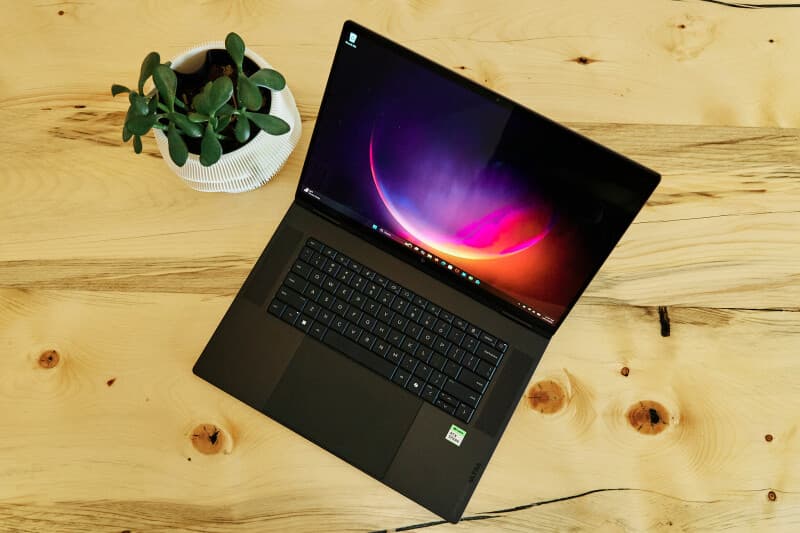
Nvidia's RTX Spark platform has arrived in partner notebooks, and the first benchmark results confirm what the spec sheet promised: this is the fastest Windows hardware for running AI models locally. The catch is equally clear. Prices start around $2,600 and climb past $6,000 for top configurations.
The Hardware Behind the Hype
The OmniBook Ultra 16 is HP's take on the RTX Spark platform, and it is built like a premium machine. The chassis is milled from aluminum and weighs 4.89 pounds. A 2880x1800 OLED touchscreen with a 16:10 aspect ratio dominates the lid, and the hinge design keeps exhaust vents clear of the display.
Under the hood sits the N1X chip, which combines a MediaTek-derived CPU chiplet with Nvidia's Blackwell GPU using NVLink Fusion interconnect. The review unit packs 20 CPU cores and 6,144 CUDA cores, the same GPU core count as Nvidia's RTX 5070 but with access to far more memory.
Memory bandwidth has been boosted to around 300 GB/s, up from the 273 GB/s found in the DGX Spark. That increase matters for AI inference, where faster memory translates directly to quicker token generation.
Benchmark Performance and Real-World AI Workloads
In a series of AI benchmarks, the OmniBook Ultra proved hard to beat among Windows notebooks for local AI tasks. The 128 GB of unified memory allows it to run large models that would choke on systems with less RAM. This opens the door to agentic AI workflows that can operate locally rather than relying on cloud APIs.
Microsoft is betting that the future of Windows lies in Copilot+ PCs capable of running a mix of local and remote models, routing prompts between them based on complexity. The RTX Spark platform fits squarely into that vision.
For developers accustomed to Apple's ecosystem, the RTX Spark offers an alternative with Nvidia's CUDA stack, which remains the dominant framework for AI development. AMD's ROCm, while improving, still lags in compatibility and tooling.
Who Should Consider RTX Spark and Who Should Wait
The RTX Spark is not for everyone. At $2,600 and up, it competes with high-end MacBook Pros and premium Windows workstations. For users who primarily run cloud-based AI services, the premium is hard to justify.
However, for AI researchers, creative professionals and developers who need to run large models locally, the combination of CUDA support and massive unified memory is compelling. The ability to work offline and keep sensitive data on-device is a significant advantage.
Buyers should also weigh the trade-offs. The OmniBook Ultra lacks a full-size SD card slot, offering only MicroSD. The keyboard uses a traditional mechanism rather than chiclet keys, which is a matter of preference. And while the speakers are excellent for a Windows notebook, they cannot match the MacBook Pro's audio quality.
Why This Matters
The RTX Spark platform signals Nvidia's push into the PC market as a first-class AI compute provider, not just a supplier of discrete GPUs. If Microsoft's vision of hybrid local-cloud AI takes hold, the demand for notebooks with serious on-device inference capabilities will grow.
For now, the high price limits adoption to a niche audience. But as competition from AMD and Apple intensifies, and as more AI workloads demand local processing, the RTX Spark could become the blueprint for future Windows machines. The real question is whether buyers will pay a premium for local AI today or wait for prices to fall.


