Editor: Porcia Akua Holmes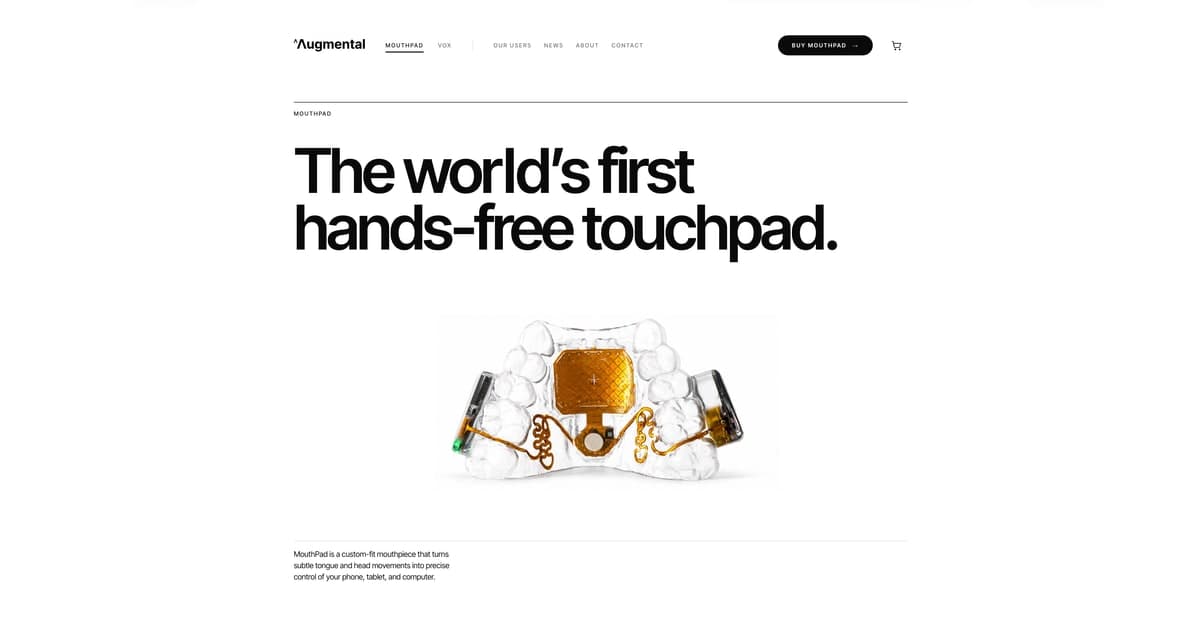
A new wearable device called the MouthPad is redefining hands-free interaction by turning the tongue into a touchpad. The system was developed by San Francisco based Augmental. It sits inside the mouth and allows users to control smartphones, computers and other digital devices through subtle tongue gestures. The technology opens up new possibilities for accessibility and hands-free computing.
How the Tongue-Controlled Touchpad Works
The MouthPad resembles a dental appliance and contains multiple pressure sensors that track tongue contact points. Users swipe, tap or press with their tongue against the roof of the mouth to execute commands. The system pairs via Bluetooth to any host device and appears as a standard touchpad or mouse.
The device requires no calibration for most users and learns individual tongue patterns over time. This adaptive approach improves accuracy and reduces unintended inputs.
Accessibility Implications
For individuals with spinal cord injuries, motor neuron diseases or other conditions that limit hand function, the MouthPad offers a direct way to interact with digital environments. Current assistive tools like sip-and-puff systems or eye trackers can be cumbersome or expensive. The tongue-controlled touchpad provides a more intuitive and discreet alternative.
The technology also has potential for general consumers. Gamers, surgeons or factory workers who need hands-free control in specific scenarios could benefit from the system. Researchers are exploring additional applications in virtual reality and smart home control.
Why This Matters
The MouthPad shifts the paradigm for assistive input devices. Traditional alternatives often require visible hardware or dedicated mounting systems. This tongue-controlled touchpad integrates seamlessly into daily life and can be used in public without drawing attention. For the millions of people who rely on assistive technology to work, communicate and access information, a device that is both effective and socially unobtrusive represents a significant quality-of-life improvement.
From a market perspective, the MouthPad signals growing demand for non-traditional interaction methods. As wearable computing expands, input methods that leave the hands free will become increasingly valuable. The success of this device could accelerate development of other oral or facial gesture controls across consumer electronics.
What It Means for the Industry
The MouthPad enters a space dominated by eye tracking and voice commands. While those technologies have matured, they have limitations. Voice control is impractical in quiet environments; eye trackers can fatigue users over extended periods. The tongue-controlled touchpad fills a gap by offering a silent, fatigue-resistant input channel that does not require the user to speak or move their head.
Major tech companies have invested in hands-free interfaces, but few have explored oral control. The MouthPad could influence future roadmaps for accessibility settings in operating systems and inspire new wearable form factors. If the device gains traction, competitors may develop similar products or integrate tongue control into existing platforms.
Mouthpad has been tested by several assistive technology organizations with positive feedback. It's available for sale on the company's Web site.