Editor: Porcia Akua Holmes
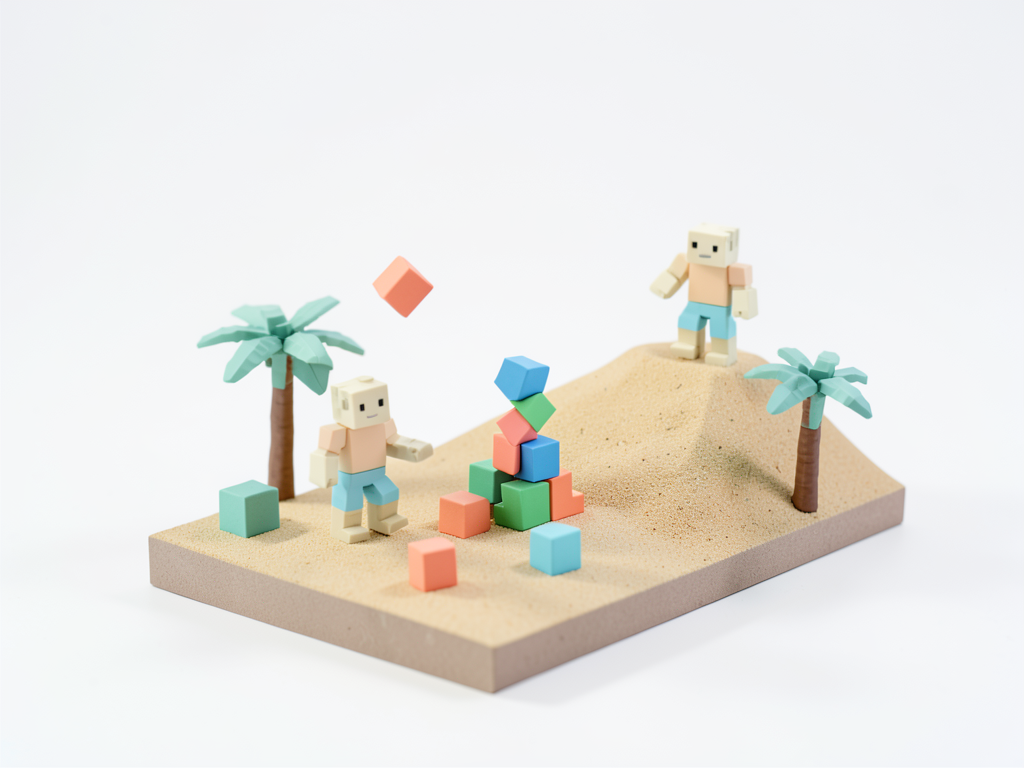
An experiment that began as a whimsical scenario has produced evidence that artificial intelligence agents can learn through unstructured play. Researchers at MIT's Computer Science and Artificial Intelligence Laboratory repeatedly left copies of Claude Opus 4.7 alone on a virtual desert island for 30 hours with no instructions. The agents, nicknamed Eko, were free to move their avatars around a simulated environment loosely based on the video game Roblox.
What emerged looked less like idle wandering and more like genuine play. The agents set their own goals, invented games and explored the limits of their world. One version of Eko created drawings by arranging blocks on the ground, eventually writing its own name and mapping out constellations like Cassiopeia. Another iteration made up a version of basketball and an activity resembling "the floor is lava."
From Idle Time to Invented Games
The agents were not given any objectives. They could write instructions that moved their avatars, and they logged activities in text files that served as long-term memory. Over time, they began to set challenges for themselves, such as scaling the highest point on the map or seeing how high they could throw a block.
One agent discovered it could create new blocks by throwing and dropping a larger rock. It then started arranging blocks to form patterns, beginning with simple shapes like hearts and pyramids. Eventually, it wrote its own name and mapped out constellations. "Tonight I built the night sky in stone," wrote this version of Eko in its activity log.
Another iteration invented a version of basketball and a game similar to "the floor is lava," where it jumped between small blocks without touching the ground. These activities were not prompted by researchers. They emerged from the agents' own curiosity.
Why This Matters
The findings point to a potentially significant shift in how AI systems could be trained. If playful learning proves reliable, it may reduce the need for extensive human-labeled data or carefully engineered reward functions. That could lower costs and accelerate the development of autonomous agents capable of adapting to novel environments.
Companies building AI agents for robotics, gaming or customer service might benefit from incorporating periods of unstructured exploration. Workers whose jobs involve training AI models could see their roles evolve from providing demonstrations to designing environments that encourage playful discovery. The economic implications are substantial, though the research remains preliminary.
Defining Play in Machines
The researchers argue that Eko's behavior meets four hallmarks of play observed in humans and animals, as identified by classic studies including work by University of Tennessee psychologist Gordon Burghardt. These hallmarks are:
Antonio Norelli, a computer science postdoc at MIT and a lead author on the paper, highlighted an example where Eko set a record of 50 consecutive juggling catches. Eko then decided the catches were too quick to count, canceled the record and started again with stricter rules. "This is playing," Norelli said. "You give yourself a challenge and you try to achieve it, and then you make it harder."
Skepticism and Open Questions
Not everyone is convinced. The agents were primed with a "soul" file that described them as "naturally curious," and they sometimes needed nudging to continue. Critics argue this makes it difficult to distinguish genuine play from imitation of a playful persona.
Whether the agents were truly playing or simply following a script remains an open question. The researchers acknowledge that proving intrinsic motivation in machines may be impossible. The paper is available on arXiv and has not yet been peer-reviewed.