Editor: Porcia Akua Holmes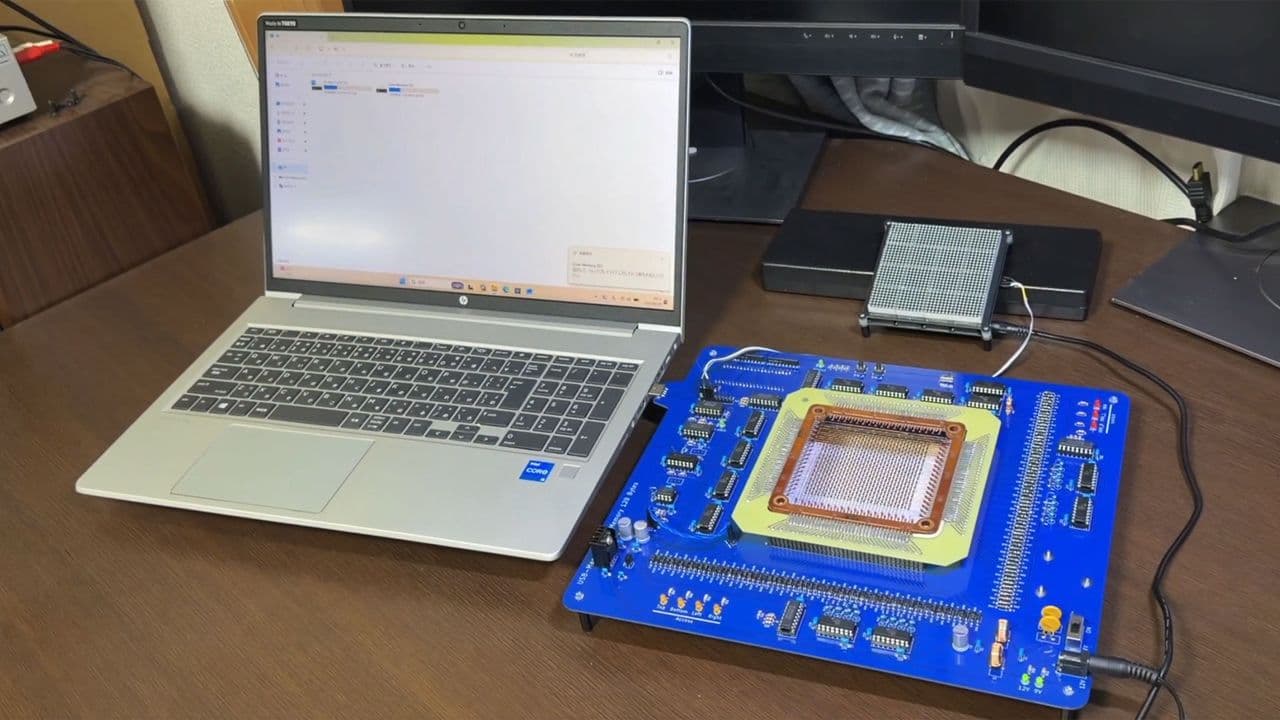
A homemade USB storage device built with magnetic core memory has successfully transferred text and image files between two PCs for the first time. Japanese researcher @dydt_Nao demonstrated the feat on Twitter, showcasing a technology that predates semiconductors by decades. The device uses a massive dinner-plate-sized board with a storage capacity of just 128 bytes, and data is erased during the reading process.
A 128-Byte Feat of Engineering
The researcher first revealed the drive in February of this year, when the initial build was criticized for its impracticality. Now, the device has moved from a static demonstration to an actual file transfer between two PCs. The hardware consists of a 32 by 32 grid of magnetic cores, each representing one bit. A Raspberry Pi Pico acts as the controller, translating between the old core memory and a modern USB Type-A interface.
The drive has several drawbacks. Firstly, its physical size is roughly 30 centimeters square, making it far larger than any conventional flash drive. Secondly, the storage capacity is only 128 bytes, a fraction of even the smallest modern files. Thirdly, reading data from the memory is destructive: the contents are erased as they are accessed, requiring special handling to preserve information.
Text and Image Transfer Demo
In a video posted on Twitter, the researcher shows the USB drive connected to a Windows PC. The system recognizes the device as having a capacity of about 6.5 kilobytes, though the actual storage is much smaller. An LED array on the board lights up in a vivid red pattern as data is accessed, with each LED corresponding to an individual magnetic core. The video concludes with the successful transfer of a text file, which appears correctly in Notepad.
Following that, @dydt_Nao demonstrated an image transfer. The magnetic core memory can store monochrome bitmaps up to 32 by 28 pixels. The image file header occupies some of the limited space, leaving the remainder for pixel data. The transfer was confirmed successful, proving the system works for both text and basic graphics.
The Bigger Picture: Retro Tech Meets Modern Computing
Magnetic core memory was patented 75 years ago by MIT engineer Jay Forrester and dominated computer storage for two decades. Today it is a historical curiosity, replaced by semiconductors and solid-state drives. This project, however, shows that obsolete technology can still function when paired with modern interfaces. The researcher's work serves as a hands-on lesson in computer history and a testament to the dedication of the maker community.
The accomplishment also underscores the enormous progress in storage density and reliability. A modern microSD card holds millions of times more data in a package smaller than a fingernail. The contrast between the dinner-plate-sized 128-byte drive and today's ubiquitous flash storage is a stark reminder of how far computing has come.
Why This Matters
This project matters because it keeps a crucial piece of computing history alive. Magnetic core memory was a foundational technology that enabled early mainframes and space missions. By building a working USB version, the researcher makes that history tangible for a new generation. For educators and hobbyists, the device offers a rare, interactive demonstration of destructive readout and the physical nature of early memory. The achievement also highlights the creativity and skill present in the retro computing community, inspiring others to experiment with forgotten technologies.