Editor: Porcia Akua Holmes
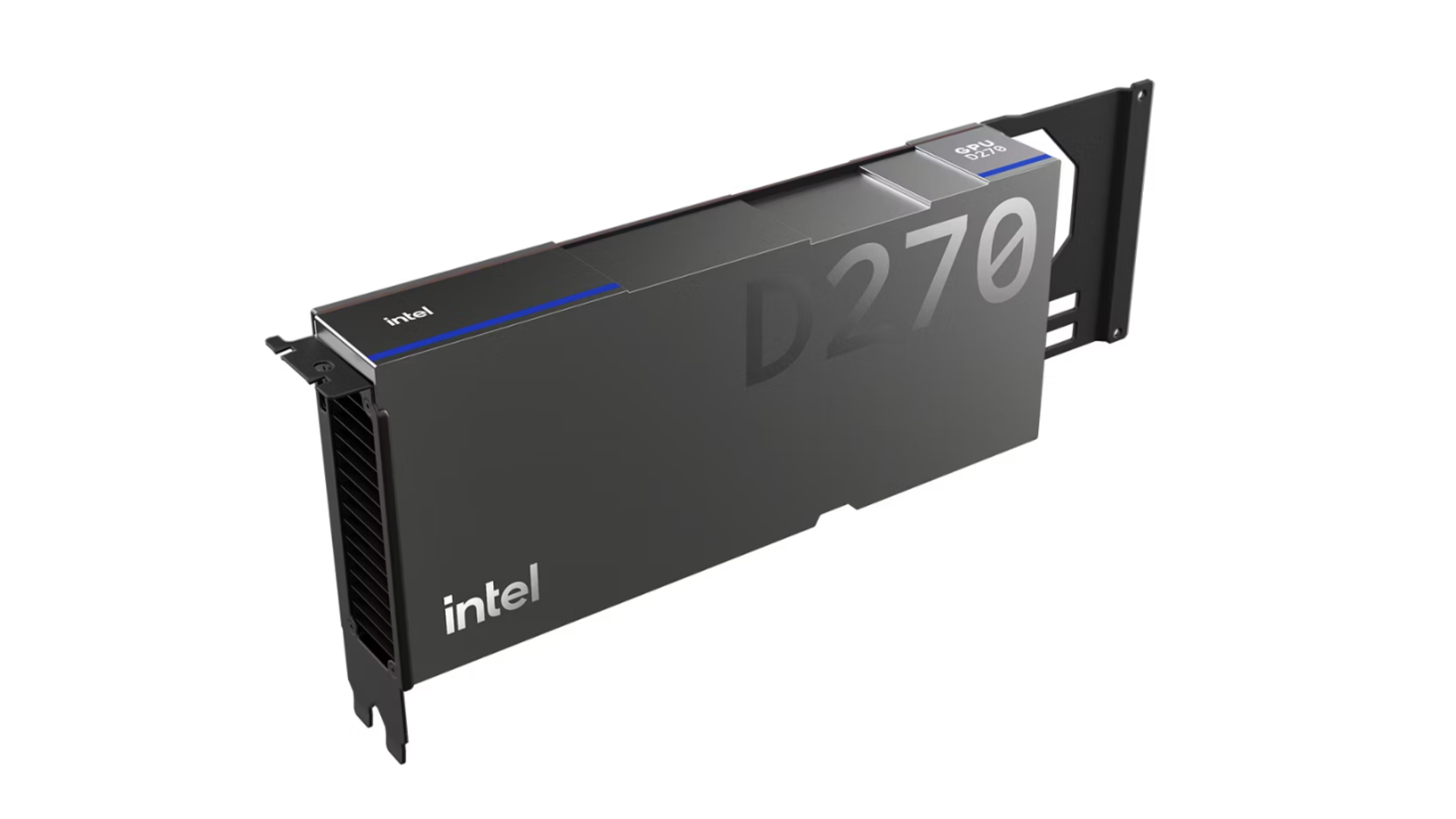
Intel has quietly claimed the top spot in GPU memory capacity with a new accelerator that carries more onboard storage than many laptops. The chipmaker introduced the Intel GPU D-series at the Open Compute Project Global Summit, revealing a card that holds up to 480GB of LPDDR5X memory.
That figure eclipses Nvidia's Blackwell Ultra B300, which offers 288GB of HBM3e memory. The D-series, previously known by its Crescent Island codename, is designed specifically for AI inference rather than gaming or traditional graphics rendering.
A Memory Strategy Unlike Conventional GPUs
Intel's decision to use LPDDR5X instead of GDDR7 marks a sharp departure from typical graphics card design. GDDR7 is the memory standard associated with modern gaming GPUs, offering high bandwidth for rendering. LPDDR5X, by contrast, appears in laptops and other power-sensitive devices where efficiency matters more than raw speed.
This configuration suggests Intel is optimizing for capacity and power draw rather than peak bandwidth. The D-series delivers 1.5TB/s of memory bandwidth and 1.3 petaflops of FP8 compute. Those figures position it for inference tasks where large models must remain resident in memory.
Anil Nanduri, vice president of AI Products & GTM at Intel Data Center Group, framed the strategy around cost and practicality. "Inference is becoming the defining AI workload, and enterprises need infrastructure that delivers the right performance at the right cost," he said. "With Intel GPU D-series, we're focused on making high-capacity inference practical to deploy and economical to scale."
Designed to Fit Existing Data Centers
The D-series arrives with a 350W power envelope and a standard PCIe form factor. It supports air cooling and maintains software compatibility across Intel's GPU platforms. These choices aim to simplify deployment without requiring specialized cooling or new rack infrastructure.
Intel also plans to pair the accelerator with its Xeon processors. In this arrangement, CPUs coordinate tasks, manage data movement and handle workloads that do not need GPU acceleration. The approach reflects AI systems increasingly built around multiple stages, including retrieval, reasoning, orchestration and external tools.
Nicolas Dubé, corporate vice president of Data Center Systems and Solutions Group at Intel, emphasized flexibility for open models. "Open models are expanding the options enterprises have for deploying AI," he said. "To realize their full potential, organizations need infrastructure that can match different workloads with the right intelligence, right compute resources and right economics."
Why This Matters
Intel's move reshapes the competitive landscape for AI infrastructure. Nvidia has dominated the data center GPU market with its high-bandwidth HBM memory, but the D-series offers an alternative path. By prioritizing capacity over raw speed, Intel could attract enterprises that need to run massive models without replacing their entire cooling and power setups.
The choice of LPDDR5X also hints at a broader industry shift. As AI inference grows more prevalent, the metrics that define a good accelerator may change. Bandwidth and compute still matter, but the ability to hold enormous models in memory at low power could become equally important. Intel is betting that this trade-off will appeal to cloud providers and businesses scaling AI services.
For Nvidia, the D-series represents a direct challenge to its memory leadership. The company's Blackwell Ultra B300 remains a powerful option, but Intel's 480GB card sets a new ceiling. How Nvidia responds, whether through denser HBM stacks or new architectures, will shape the next generation of AI hardware.
Intel has not revealed retail pricing or a specific launch date. That leaves room for speculation about how aggressively the company will push the D-series into a market where Nvidia holds significant mindshare. The success of this gamble will depend on real-world performance, software maturity and customer adoption.