Senior Editor: Alan Agbele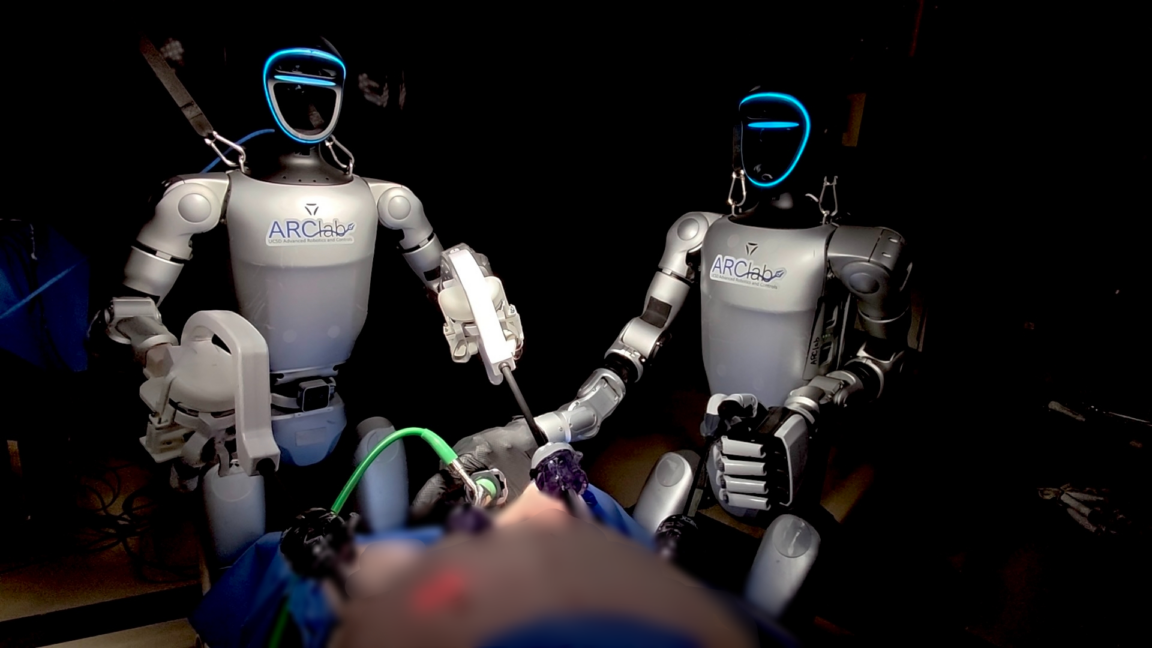
Surgeons have successfully teleoperated humanoid robots to remove gallbladders from live pigs in a world-first preclinical trial. The procedure, published in the journal Nature, demonstrated that skilled surgeons can control humanoid machines from a distance to perform minimally invasive operations. Researchers at the University of California San Diego led the experiment.
How the Teleoperated Surgery Worked
Unlike earlier surgical robots that operate through large dedicated arms, the Humanoid system uses a full-bodied humanoid robot that mimics the surgeon's movements in real time. The surgeon sits at a console and controls the robot's hands and arms remotely. In the preclinical trial, the robots completed two gallbladder removals on live pigs using minimally invasive techniques.
Shanglei Liu, an assistant professor of surgery at the University of California San Diego School of Medicine, said the system is markedly cheaper and smaller than existing options. "It's a fraction of the cost and it takes a fraction of the space in an operating room," Liu said in an interview with UC San Diego Today. The compact design, he noted, makes it easy to deploy in locations that lack the resources for traditional surgical robots.
Advantages Over Existing Systems
Current surgical robots such as the da Vinci system require dedicated operating rooms, specialized equipment and millions of dollars in investment. The Humanoid approach offers several practical benefits:
Why This Matters
The implications extend beyond a single preclinical trial. For large segments of the world, access to robotic surgery is limited by cost and infrastructure. This teleoperated humanoid system could democratize that access by removing the need for expensive dedicated hardware. Rural hospitals that cannot afford a traditional surgical robot might eventually rely on humanoid machines controlled by expert surgeons hundreds of miles away. Military applications could allow battlefield surgeons to operate on soldiers from secure command centers. Space agencies, including NASA, have expressed interest in telesurgery for long-duration missions. The technology remains in early testing, but the potential to reshape global surgical care is substantial. The next challenge will be proving safety and efficacy in human patients.