Senior Editor: Alan Agbele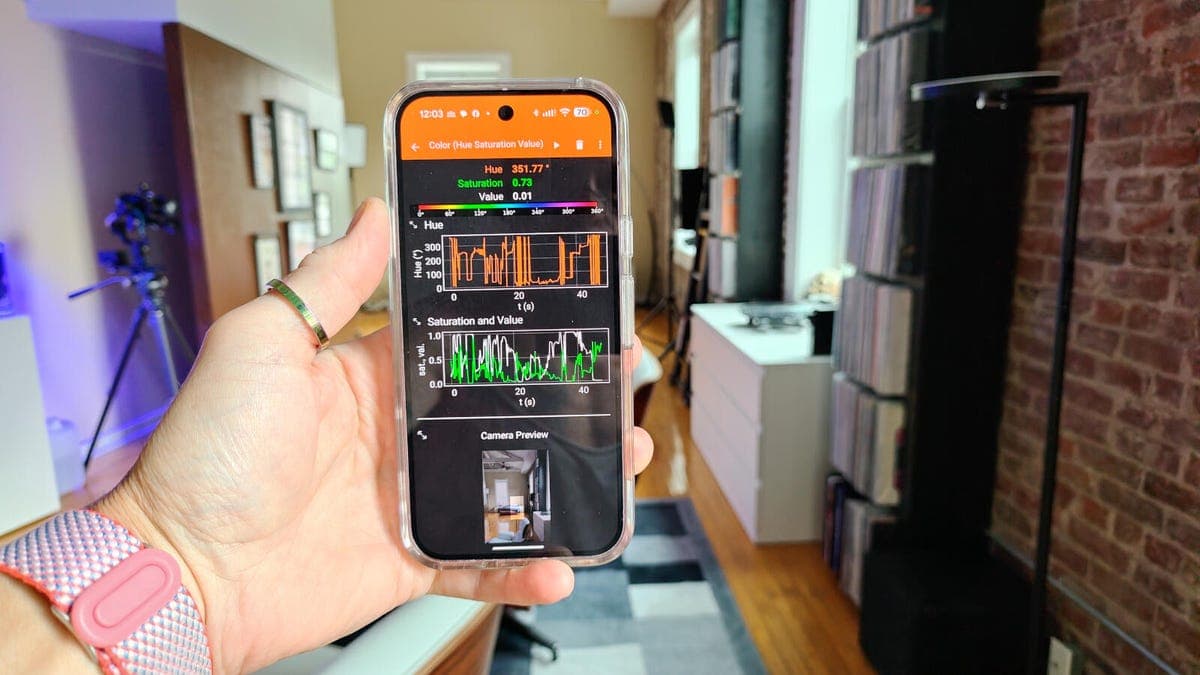
An Android app called Phyphox is turning smartphone sensors into a portable science kit with more than 35 built-in experiments. The free tool uses the phone’s accelerometer, magnetometer, gyroscope and microphone to measure acceleration, magnetic fields, sound frequencies and more. It puts lab-grade analysis into the pocket of anyone with a compatible device.
What Phyphox Does
Phyphox stands for Physical Phone Experiments. Developed by researchers at RWTH Aachen University, the app guides users through experiments that would normally require dedicated hardware. Examples include measuring the speed of sound with two phones, analyzing pendulum motion with the accelerometer, and mapping magnetic field strength with the magnetometer. Each experiment provides real-time graphs and raw data export.
The app eliminates the need for separate scientific tools such as oscilloscopes, stopwatches or force sensors. Because the smartphone already contains the sensors, the phone becomes the instrument. Phyphox simply makes those sensors accessible through a clean interface designed for education.
Why This Matters
This development lowers the barrier to hands-on science education. Students in under-resourced classrooms can now perform experiments that require expensive equipment. Teachers can assign physics or biology experiments that students complete with their own phones. The app also supports remote learning by allowing students to share sensor data over the internet for collaborative projects. For citizen scientists, Phyphox provides a tool to collect real-world data for environmental monitoring or community research. The implications stretch beyond the classroom to anyone curious about measuring the physical world.
The Trend Behind the App
Phyphox is part of a broader movement toward using smartphones as scientific instruments. Other projects like Science Journal and iNaturalist show similar ambition. The shift reflects the fact that modern smartphones pack sensors once reserved for specialized equipment. An accelerometer in a $200 phone can now detect micro-g forces. A microphone can sample sound at frequencies that rival USB oscilloscopes. This democratization of measurement tools enables experiments that were previously impractical or costly. The app’s open-source nature also allows developers to create custom experiments, expanding its utility beyond the prebuilt 35 tools.
Phyphox does have limits. Sensor accuracy depends on the phone model. Environmental factors can introduce noise. And not all experiments are suitable for precise scientific research. But for educational and hobbyist purposes, the app provides a remarkable entry point into experimental physics.