Editor: Porcia Akua Holmes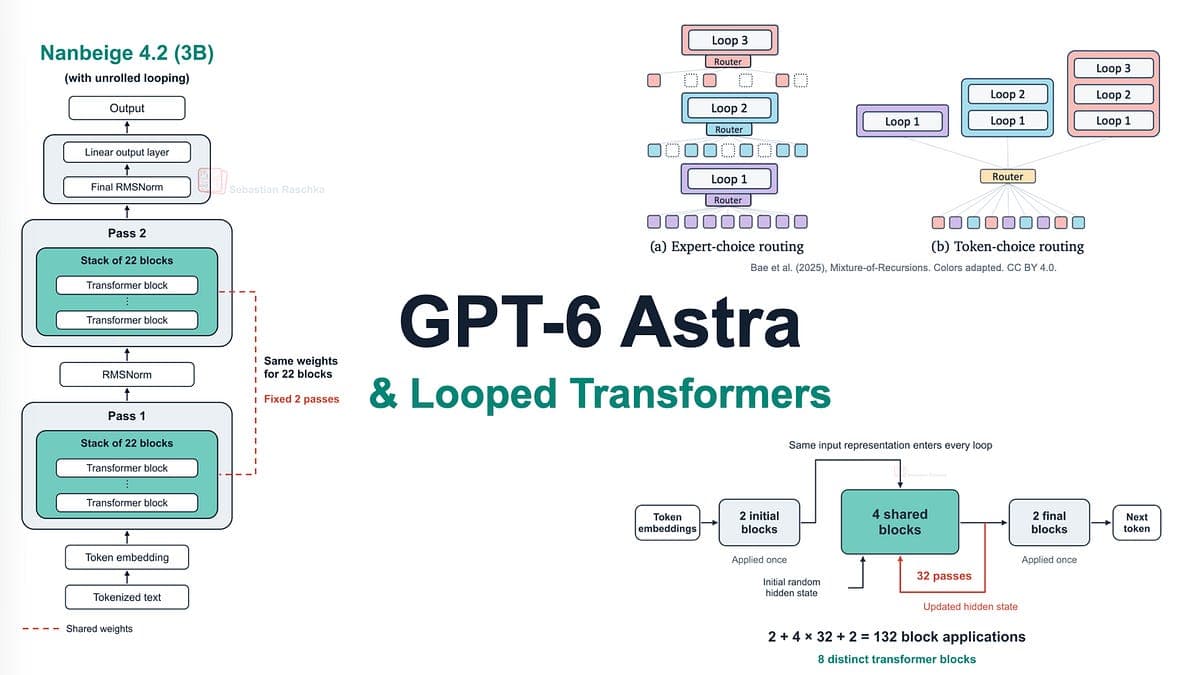
A groundbreaking shift in transformer design is emerging from recent AI research. The new architecture, called Looped Transformers, forms the backbone of the GPT-6 Astra model. This approach introduces hidden reasoning layers that allow the model to perform deeper computations without expanding its parameter size.
The Looped Transformer Breakthrough
Conventional transformers stack layers to increase reasoning power. Each additional layer adds parameters and computational cost. Looped Transformers break this pattern by reusing the same set of layers multiple times in a controlled loop. The output of each pass feeds back into the input, allowing the model to iterate on its own reasoning internally.
Researchers have applied this concept to GPT-6 Astra, creating what they call hidden reasoning. The model can silently refine its internal state over several cycles before producing a final answer. This process stays invisible to the user but yields higher accuracy on tasks requiring multi-step logic.
How Hidden Reasoning Works
Hidden reasoning relies on a gating mechanism that decides when to stop looping. The model learns to balance iteration depth against output quality. Early tests show that GPT-6 Astra with looped transformers matches the performance of much larger models on benchmarks for arithmetic, commonsense reasoning and code generation.
The key advantage lies in parameter efficiency. A looped transformer with 10 billion parameters can simulate the depth of a 50 billion parameter model. This compression reduces memory requirements and speeds up inference, making advanced reasoning accessible on smaller hardware.
Key Features of the Looped Architecture
Why This Matters
Hidden reasoning via Looped Transformers could reshape how AI companies approach model scaling. Instead of building ever larger models, developers can achieve deeper reasoning by reusing existing resources. This shift directly lowers the carbon footprint and capital expense of training and inference.
For businesses deploying GPT-6 Astra, the practical impact includes lower latency and reduced cloud costs. Smaller organizations can potentially run sophisticated models on their own servers. Regulators may also take notice because more efficient models reduce the energy demand of AI infrastructure.
The hidden reasoning paradigm also raises questions about interpretability. If a model loops internally before answering, its final output hides intermediate steps. Researchers will need new tools to probe these internal dynamics and ensure safety.
Note: The information above is based on publicly discussed research directions. No official release date for GPT-6 Astra has been announced.