Editor: Porcia Akua Holmes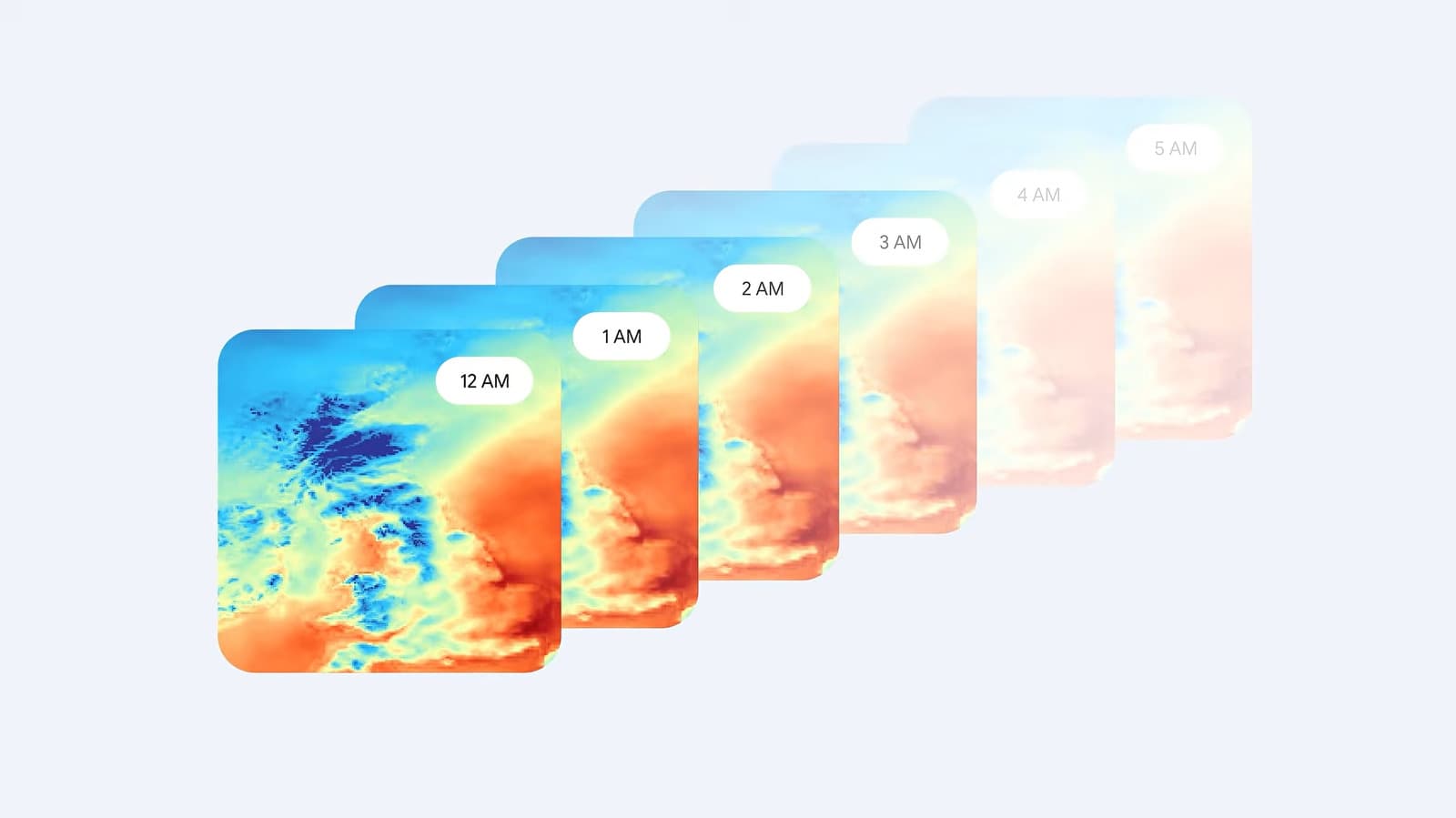
Google has launched a new AI weather model called WeatherNext that processes live satellite data to produce higher-resolution forecasts. The system is designed to improve the accuracy of precipitation predictions and other critical weather variables by tapping into real-time observational feeds rather than relying solely on historical training data. This approach represents a notable departure from conventional numerical weather prediction models, which often operate on fixed input cycles.
Live Data Integration Raises Forecast Resolution
Traditional weather models typically assimilate observations at fixed intervals, often every few hours, and rely on physics-based equations to simulate atmospheric behavior. WeatherNext, by contrast, continuously streams satellite data into its neural network, allowing it to update predictions as new information arrives. The result is a model that can produce forecasts with higher spatial resolution, meaning it can identify weather patterns over smaller geographic areas such as individual counties or neighborhoods.
The system builds on Google’s earlier work in AI-driven weather prediction but adds the live data dimension. Early results suggest improvements in predicting the timing and location of rain, snow and severe storms, though the model has not yet been deployed in operational settings.
Key Features of WeatherNext
Why This Matters
The arrival of a live-data AI weather model has direct consequences for industries sensitive to short-term weather shifts. Emergency managers could receive more precise warnings for flash floods and tornadoes. Farmers may gain better timing for planting and spraying operations. Airlines and logistics companies could optimize routing around storms with greater confidence.
Yet the model also raises questions about data accessibility and computational cost. Running a real-time AI system at high resolution requires significant processing power, potentially limiting use to well-funded organizations. Additionally, the model’s reliance on satellite feeds means any gaps in coverage could degrade its performance in regions with sparse observation networks. These tradeoffs highlight the gap between promising research and operational deployment.
The Competitive Landscape
WeatherNext enters a field already crowded with AI weather models from companies such as Huawei, Nvidia and DeepMind. Each competitor uses a different architectural approach: some focus on training on reanalysis data, while others emphasize speed. Google’s differentiator is the live satellite feed, which gives WeatherNext the ability to react to current conditions rather than merely forecasting from a static snapshot. This could give it an edge in nowcasting, or forecasting up to six hours ahead, where timeliness is critical.
Independent verification of Google’s claims is still pending, as the model has not been peer reviewed in an operational context. But the direction is clear: weather prediction is moving away from purely physics-based simulation toward a hybrid that blends machine learning with real-time observations. WeatherNext represents one of the most ambitious versions of that hybrid yet.