Editor: Porcia Akua Holmes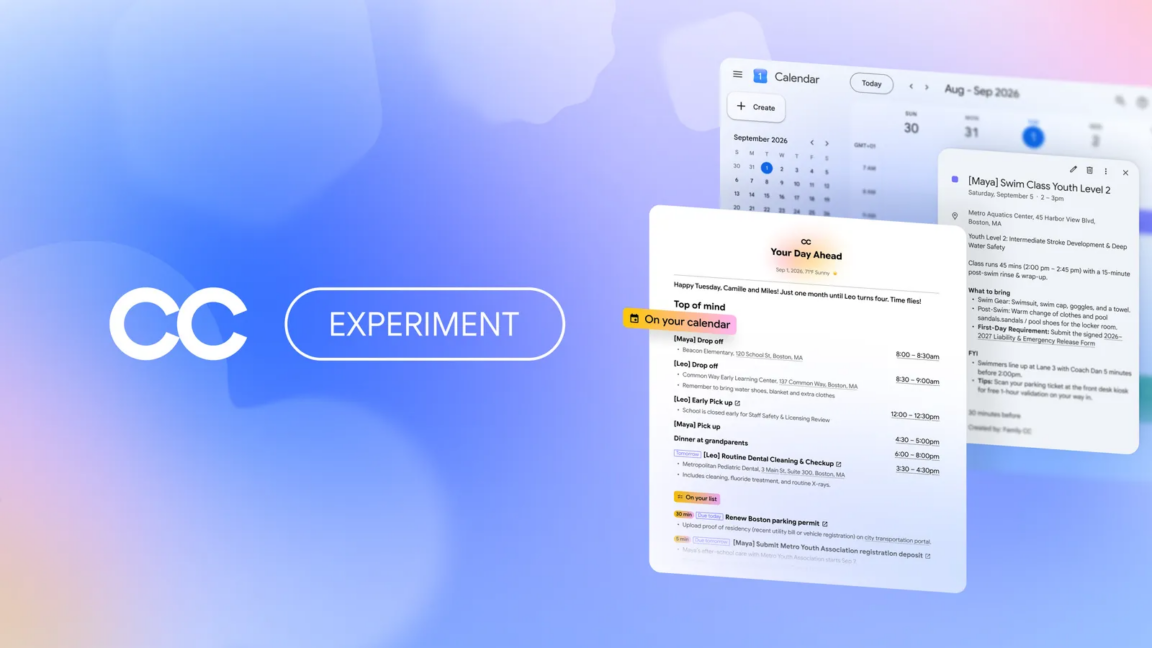
The next frontier in personalized artificial intelligence centers on the household. Google has launched an experimental AI agent inside its Google Labs division, built specifically for families. Dubbed CC, the agent functions as a shared digital assistant for groups of up to six people, pulling in information from across Google’s ecosystem including Google Calendar, Google Drive and Gmail.
A Shared Account Model With Granular Controls
Unlike a standard chatbot that sits inside one user’s session, CC exists as a standalone entity with its own identity inside a family group. Each of up to six participants decides individually what information to surface. For example, parents might designate a school scheduling email address as always visible to CC, while keeping other correspondence private. Family members can push content directly to the agent through email or by sending files into a monitored Google Drive folder. Invitations, receipts, medical reminders and shared lists all become fodder for CC’s contextual awareness.
Privacy by Design in a Multi-User Environment
The architecture reflects a deliberate attempt to balance utility with control. You can invite the agent into specific interactions without granting blanket permissions. If a user opts out, CC simply has no visibility. This selective sharing model matters because family AI tools inevitably touch sensitive domains such as health updates, school communications and financial decisions. Google positions CC as an opt-in experience rather than a passive surveillance layer. Still, the fact that CC runs on Google infrastructure means the company’s servers process all shared data, raising questions about long-term retention and secondary use.
How This Fits Into Google’s Broader Strategy
Google lags behind OpenAI and Anthropic in raw model performance benchmarks, but the company holds an asset rivals cannot easily replicate: decades of structured user data across apps millions of people already rely on daily. CC illustrates how Google intends to weaponize that ecosystem advantage. Rather than building a general-purpose assistant, the company is creating context-aware agents that live inside relationships — in this case, the family unit. The success of CC could determine whether Google turns its sprawling suite of productivity tools into a competitive moat for consumer AI adoption.
Why This Matters
The shift toward group-level AI agents changes the calculus for every major platform. If CC gains traction, it pressures Apple to accelerate its own family-sharing intelligence features and forces Amazon to rethink Alexa’s single-user paradigm. For the millions of households already embedded in the Google ecosystem, CC offers a way to automate coordination without switching tools. The real test is whether families trust an automated account enough to feed it their most sensitive logistics. Google is betting that convenience — paired with granular permission controls — will overcome lingering privacy skepticism.