Editor: Porcia Akua Holmes
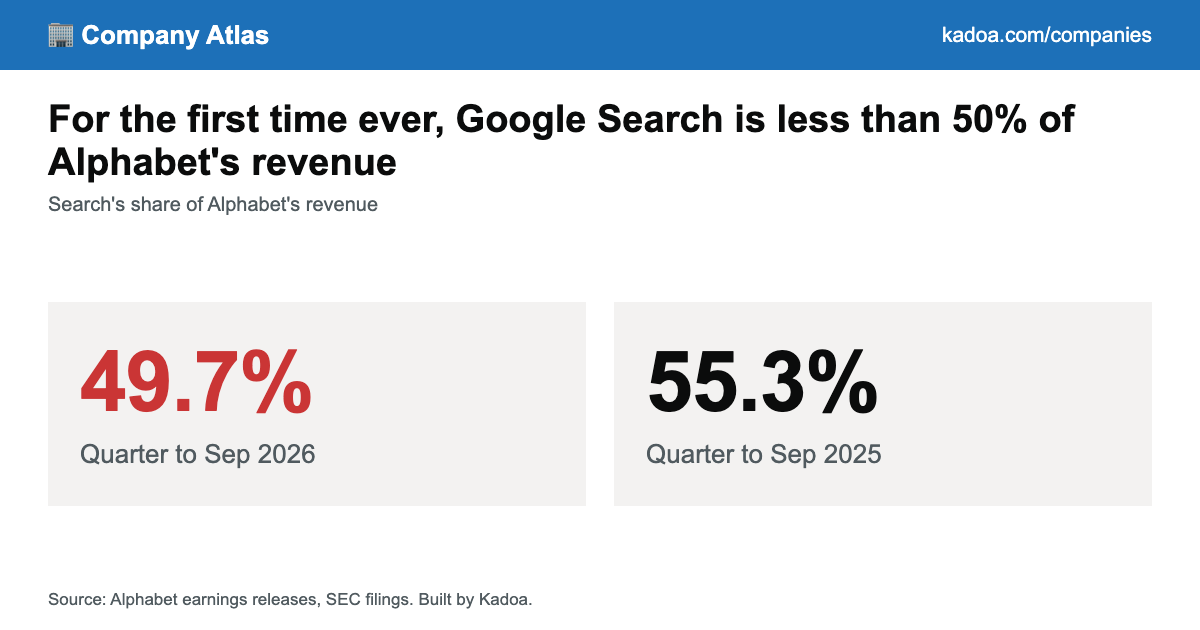
Google Search has slipped below half of Alphabet's total revenue for the first time, a threshold that reframes how the company earns money and how investors will value it. The shift is not a sudden collapse in search advertising. It is the result of faster growth elsewhere inside Alphabet, particularly in cloud services and AI-related products.
How the Revenue Mix Shifted
Alphabet's revenue base has broadened steadily over the past several years. Google Cloud has grown into a material contributor, and the company's AI investments have begun generating their own revenue streams. Those units are expanding faster than the core search advertising business, which is mature and faces rising competition.
The result is a gradual dilution of search's share rather than an absolute decline. Google Search remains a massive profit engine. Its relative weight inside Alphabet, however, is no longer dominant enough to define the company's financial identity on its own.
Why This Matters
The change directly affects investors who have treated Alphabet as a search advertising company. Portfolio models built around search growth now need to account for cloud margins, AI infrastructure spending and enterprise contracts. That is a different risk profile with different cyclical exposures.
For advertisers, the shift is subtler but real. As Alphabet's revenue becomes more diversified, the company has more room to experiment with search formats and pricing. Advertisers should expect continued changes to how search inventory is packaged and sold.
Competitors also face a new calculus. Rivals that once benchmarked themselves against Google Search now compete against a broader Alphabet that can subsidize products across cloud and AI. That makes head-on competition more expensive.
The Strategic Question Facing Alphabet
Search has historically funded Alphabet's ambitious bets. If search is no longer the majority of revenue, the company must show that its newer businesses can sustain that role. Cloud profitability and AI product monetization become the central tests.
This is not a crisis moment. It is a transition point. Alphabet's challenge is to manage the handoff without weakening the search business that still generates most of its cash.
What to Watch Next
Two signals will determine whether this milestone is a one-quarter anomaly or a permanent shift. The first is the growth rate of Google Cloud relative to search advertising. The second is whether Alphabet discloses more detail about AI-related revenue.
Investors should also watch how Alphabet allocates capital. A more diversified revenue base could justify higher spending on infrastructure and acquisitions. That spending, in turn, will shape margins and competitive positioning.