Senior Editor: Alan Agbele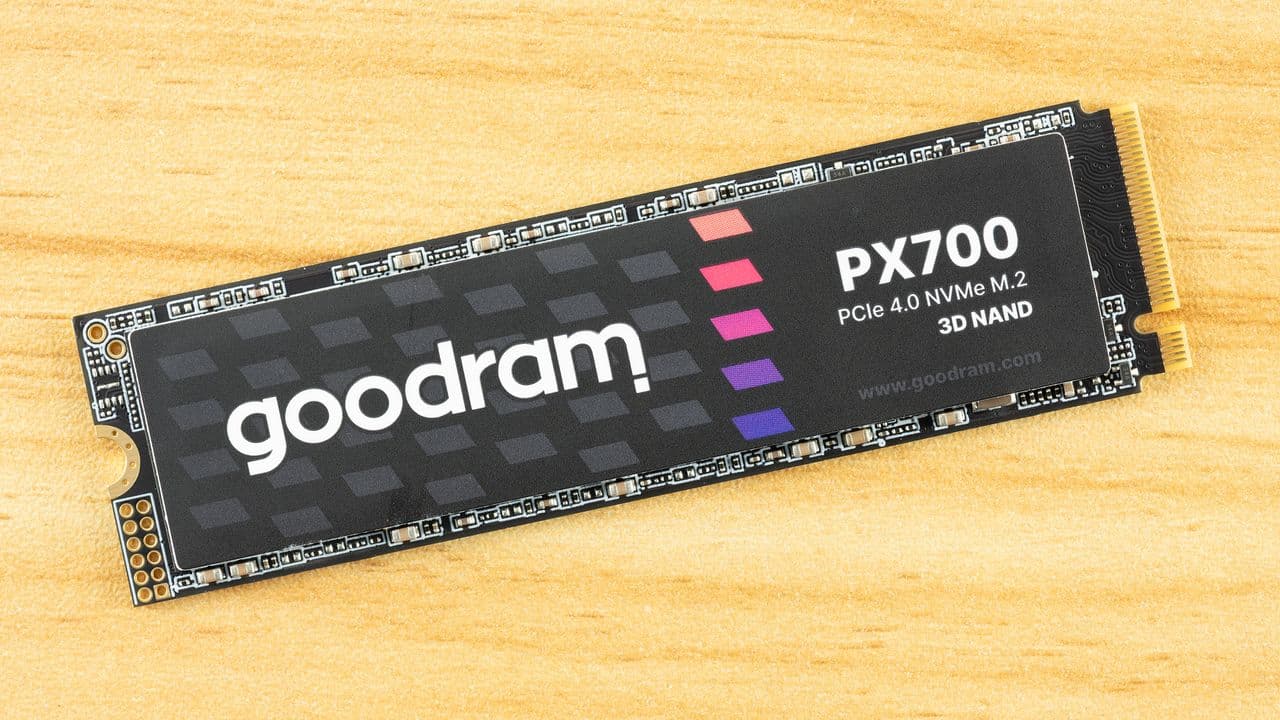
The Goodram PX700 enters a crowded market of budget PCIe 4.0 SSDs, offering competitive performance and power efficiency in a single-sided, cool-running package. Sometimes a drive like this can be overlooked, but testing reveals the PX700 punches above its price class. The Goodram PX700 delivers sequential reads up to 7,400 MB/s and writes up to 6,500 MB/s, making it suitable for gaming, productivity, and everyday use. However, current pricing near $418 for the 2TB model tempers its appeal, as NAND market volatility has inflated costs. This SSD Review examines whether the PX700 merits attention despite its premium price tag.
Performance and Hardware
The PX700 relies on a DRAM-less design with Host Memory Buffer technology, a common approach for budget Gen 4 drives. Controller is the Maxio MAP1602 paired with 232-layer NAND. Goodram does not specify whether the flash is TLC or QLC, but the TBW values (1,200TBW for the 2TB model) suggest QLC. One benefit of QLC is lower production cost, but endurance is lower than TLC. Still, 1,200TBW translates to 0.66 drive writes per day over five years, enough for typical consumer workloads. The single-sided M.2 2280 form factor ensures compatibility with laptops and small desktops. Power efficiency stands out, with the drive running cool even under sustained load.
Pricing and Market Context
Goodram sells the PX700 directly on Amazon, where the 1TB version lists at $348 and the 2TB at $418. These prices are significantly higher than typical budget Gen 4 drives. On AliExpress and other channels, similar hardware can be found for under $300 for 2TB. The high cost likely reflects current NAND oversupply correction and Goodram's smaller scale compared to giants like Samsung or WD. This drive would be a strong recommendation at $300 for 2TB, but at $418 it competes with higher-end options offering faster sustained writes or better software support. Goodram does not provide proprietary SSD management tools, pushing users to third-party utilities.
Why This Matters
For PC builders and upgraders, budget SSDs are crucial for keeping system costs down without sacrificing everyday performance. The Goodram PX700 demonstrates that a lesser-known brand can deliver comparable speed and efficiency to tier-one drives. However, the inflated price undermines its value proposition. If NAND prices drop as expected later this year, the PX700 could become a strong contender. Until then, shoppers should monitor pricing or consider alternative drives from more established competitors. Goodram's history as a European memory assembler suggests reliable support, which matters in a market flooded with no-name sellers on platforms like AliExpress.