Senior Editor: Alan Agbele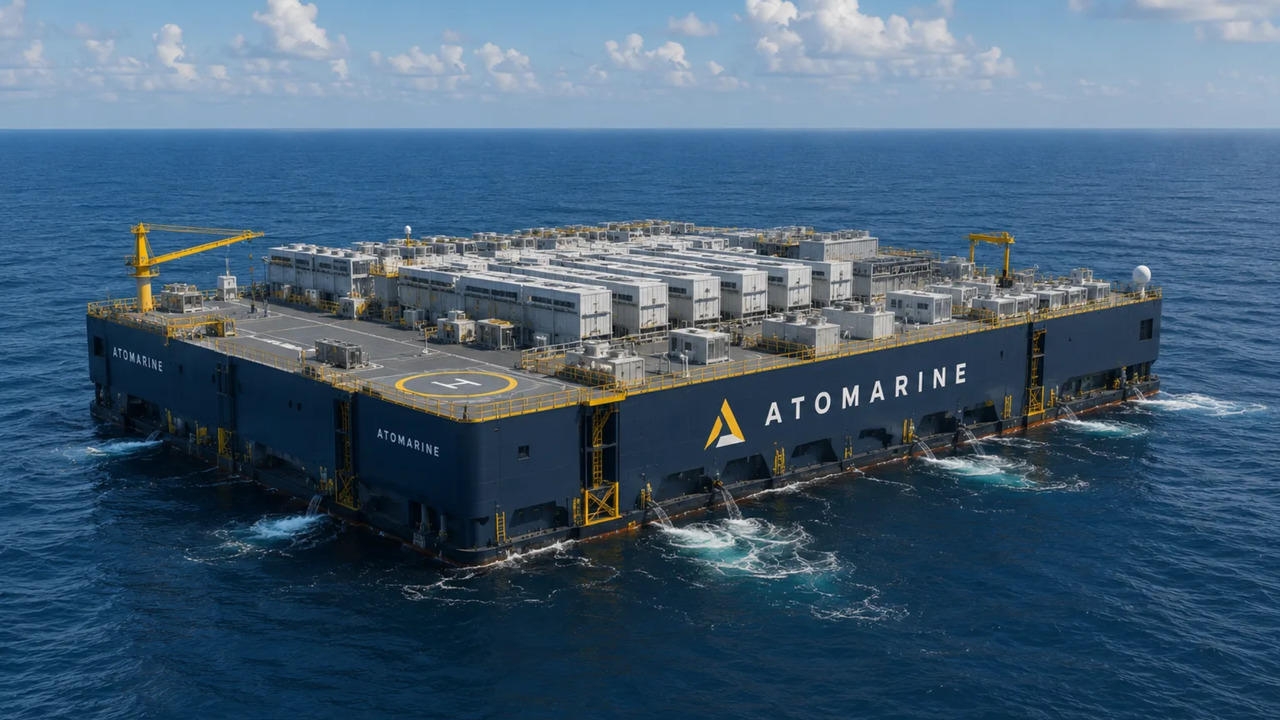
A startup named Atomarine has outlined plans to deploy nuclear-powered data centers on floating barges at sea, aiming to bypass the permitting delays and community opposition that plague land-based facilities across the U.S. The modular units could be deployed far faster than traditional data centers, sidestepping power grid bottlenecks and local resistance that have stalled projects in many states.
The Atomarine Approach
Atomarine builds on a familiar industrial concept: floating barges similar to those used for oil platforms. Each barge would house computing infrastructure, with a power ship moored alongside that initially runs on LNG. Once certified SMRs are ready, operators could swap out the conventional power source for a nuclear one. The modular nature allows the data center to be upgraded or scaled without major reconstruction.
The plan also calls for high-speed connectivity via undersea cables. Without reliable internet, the facility would be isolated, limiting its utility for real-time AI workloads.
Engineering Hurdles and Reliability Questions
While the concept is ambitious, it faces technical and regulatory hurdles. The ocean is unpredictable, and barges must withstand extreme weather. Data servers are sensitive to motion, humidity and salt. Atomarine must redesign standard equipment to survive the marine environment. The U.S. Navy has decades of experience with shipboard nuclear reactors, but civilian SMR certification for floating platforms is untested. There are also questions about the long-term reliability of undersea cable connections for facilities that may be far from shore.
LNG supply chains add complexity. Atomarine proposes that LNG ships deliver fuel for the initial power ships, but this creates logistical dependencies and emissions concerns until nuclear power is adopted.
Why This Matters
Data center demand is soaring due to AI workloads, but land-based projects face growing opposition over noise, water use and grid strain. Floating nuclear data centers could unlock new capacity without competing for scarce land resources. If Atomarine succeeds, it may pressure regulators to accelerate SMR certification for maritime use, reshaping the energy landscape for the industry. The U.S. regulatory framework for floating nuclear reactors will be a critical test case. Failure could reinforce skepticism about offshore data centers, while success could open a new frontier for digital infrastructure.
For now, Atomarine must prove its engineering and secure partnerships for cable laying, barge construction and nuclear licensing. The startup hopes to demonstrate a prototype within a few years, but the path to commercial deployment remains long and uncertain.