Editor: Porcia Akua Holmes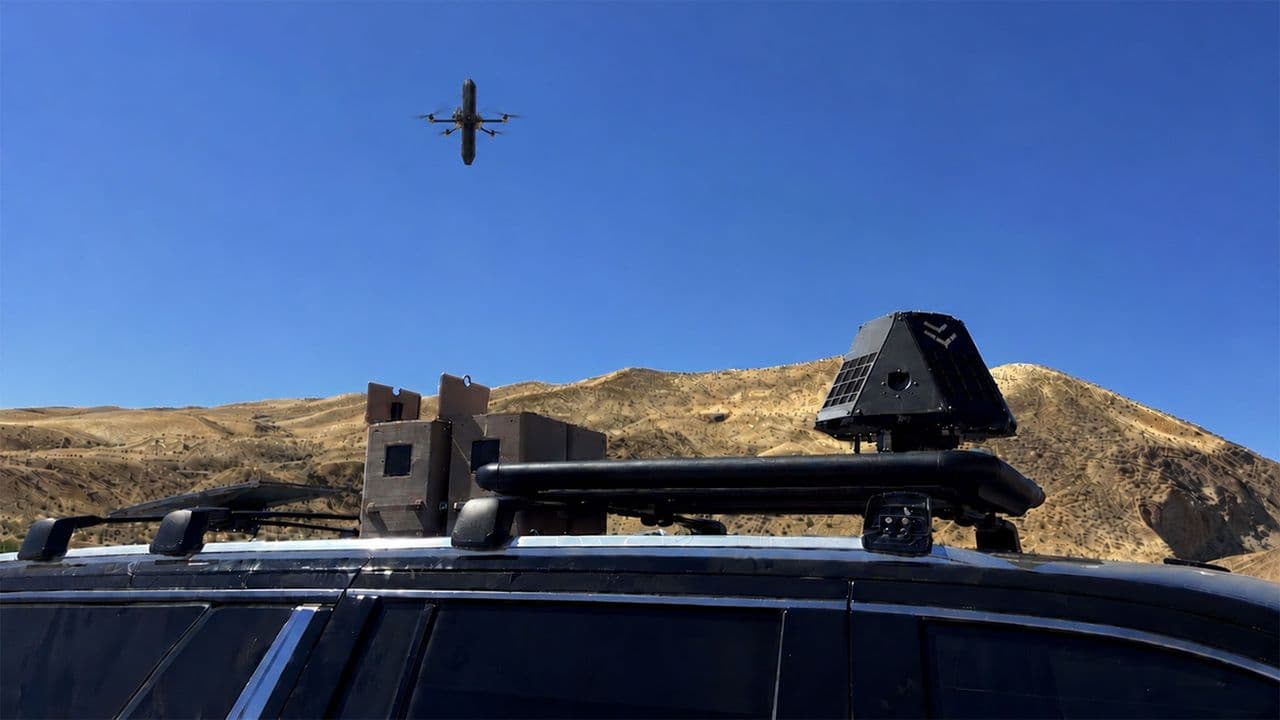
The cost of destroying a first-person-view (FPV) drone has long exceeded the cost of the drone itself. San Francisco-based startup Mara is betting on a new calculus: match the price of attack drones one-for-one with autonomous interceptors small enough to fit in a backpack. The company has raised $7 million in pre-seed funding to produce Spike, a portable counter-drone system that deploys 250-gram Seekers against swarming quadcopters.
A Cost Parity Approach to Counter-Drone Operations
The Spike system consists of three main components: a launcher that holds up to 48 Seekers and reloads in under a minute, the 8.8-ounce Seeker interceptor itself, and the Spotter targeting unit. Spotter fuses electro-optical and acoustic sensors with an optional low-emission W-band radar, enabling detection and tracking of fiber-optic and fully autonomous drones in all weather day or night. Mara says the Seekers respond much faster than a human can react to a 100 mph quadcopter, though a human stays in the loop to set rules of engagement and abort launches.
Each Seeker trades at a cost ratio that directly undercuts the attack drones. Mara claims the interceptor costs 20 times less than the next-cheapest alternative, putting it close to the $1,000 3D-printed interceptors Ukraine builds for larger Shahed-type threats. But Mara targets the much smaller, faster FPV quadcopters that swarm in waves of four to six. CEO Daniel Kofman told Tectonic Defense that FPV crews "always attack four to six at a time in waves, doing pincer strikes in rapid succession or simultaneously." Existing systems like Lockheed Martin's Morfius cost substantially more than Mara's approach.
Why This Matters
The shift to low-cost autonomous interceptors challenges the economics of drone warfare. Militaries relying on expensive layered defenses may find them inadequate against mass swarms of hundred-dollar drones. Mara's system suggests that defense can be cheaper than offense, potentially reducing reliance on million-dollar missiles. The technology also forces a reexamination of autonomous engagement rules. Humans remain in the loop, but response times are far faster than manual control. As FPV drones become the leading cause of Ukrainian combat casualties, the ability to deploy cost-matched interceptors in portable form factors could reshape frontline tactics. The real-world test will come when Spike faces operational swarm attacks without the luxury of controlled testing.
Funding and Future Deployment
Mara joined NATO's DIANA accelerator 2026 cohort and holds cooperative research agreements with three unnamed U.S. defense organizations. The company is running a civilian pilot at a South Korean commercial port. Ground-mounted Spike units are due in customers' hands by the end of 2026, with vehicle-mounted and man-portable variants and scaled production planned for 2027. Ukrainian forces have operated Spotter near the front line, where Mara says it tracked multiple FPV drones from 40 kilometers back. With $7 million in pre-seed funding and a first paid European NATO order, Mara is moving from concept to deployment. They are betting that cheap, portable interceptors can win the cost battle against drones. If the math holds, it could change how wars are fought.
The startup has designed Seekers to be inexpensive enough that losing one to a decoy does not break the budget. This asymmetry is the core insight: make defense disposable and cheap, and the swarm loses its advantage. The coming months will reveal whether Spike can deliver on its promise of a 20x cost advantage in real combat conditions.