Editor: Porcia Akua Holmes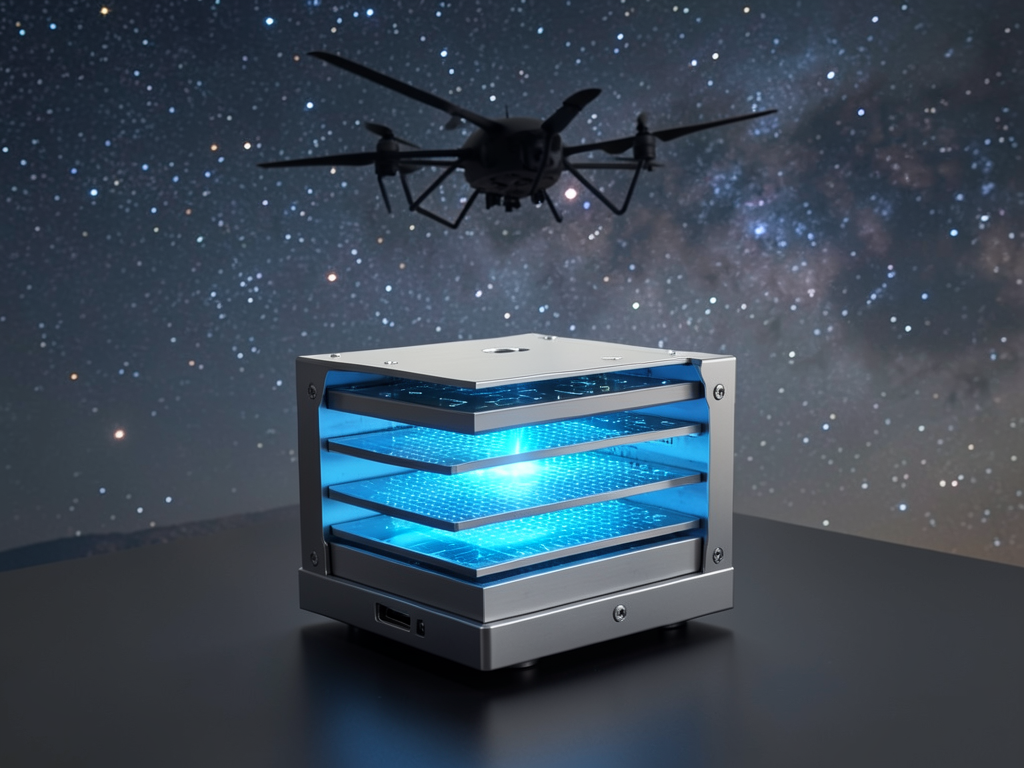
A U.S. defense research agency is funding a new type of compact battery that converts radiation from nuclear waste directly into electricity. The technology could keep drones and satellites running continuously for up to 30 years without recharging or replacement.
The Technology Behind the Tiny Nuclear Cells
Scientists describe the small nuclear waste batteries as solid-state devices that layer radioactive isotope blocks with semiconductors. Unlike conventional chemical cells, these units generate electricity through continuous radiation exposure rather than stored energy. Project Omega’s founder Stafford Sheehan said the company already has small devices running and aims to meet DARPA’s performance target early next year.
The generators rely on Strontium-90, which developers consider less hazardous than the Plutonium-238 used in traditional space missions. Researchers estimate the nation holds over 100,000 metric tons of nuclear waste across 52 reactor sites. Sheehan argues that existing waste provides abundant fuel while unresolved disposal issues continue to generate expensive legal disputes.
Military and the Spiderweb Scenario
Military planners see obvious advantages for drones and other unmanned systems that currently face charging constraints on extended missions. A drone capable of operating for 30 years with continuous onboard power would fundamentally alter assumptions about endurance and logistics. The persistent surveillance capability this enables has been described as a Spiderweb scenario a permanent coverage that could become a nightmare for adversaries.
Several organizations are participating in the Rads to Watts program including Morgan State University, Pacific Northwest National Laboratory, Northrop Grumman, ARA, and Widetronix. The technology must still prove its conversion efficiency, radiation effects, reliability and safe deployment before any field use.
Prototype Timeline and Open Questions
Researchers expect a minimally viable prototype to emerge by early 2027 following testing under increasingly realistic conditions. However, conversion efficiency, radiation effects on electronics, and safe deployment still require extensive evaluation. The $3.37 million DARPA award supports the initial proof-of-concept but further investment will be needed for production-ready systems.
Why This Matters
The success of these compact nuclear batteries would transform military logistics by removing the biggest constraint on drone operations: endurance. For commercial and civilian sectors, it could enable remote sensors and communications equipment in inaccessible areas to run for decades without maintenance. The technology also offers a practical use for nuclear waste, potentially reducing storage costs and legal disputes. Yet safety concerns and regulatory hurdles remain significant barriers before these devices can leave the lab and enter real-world deployment.