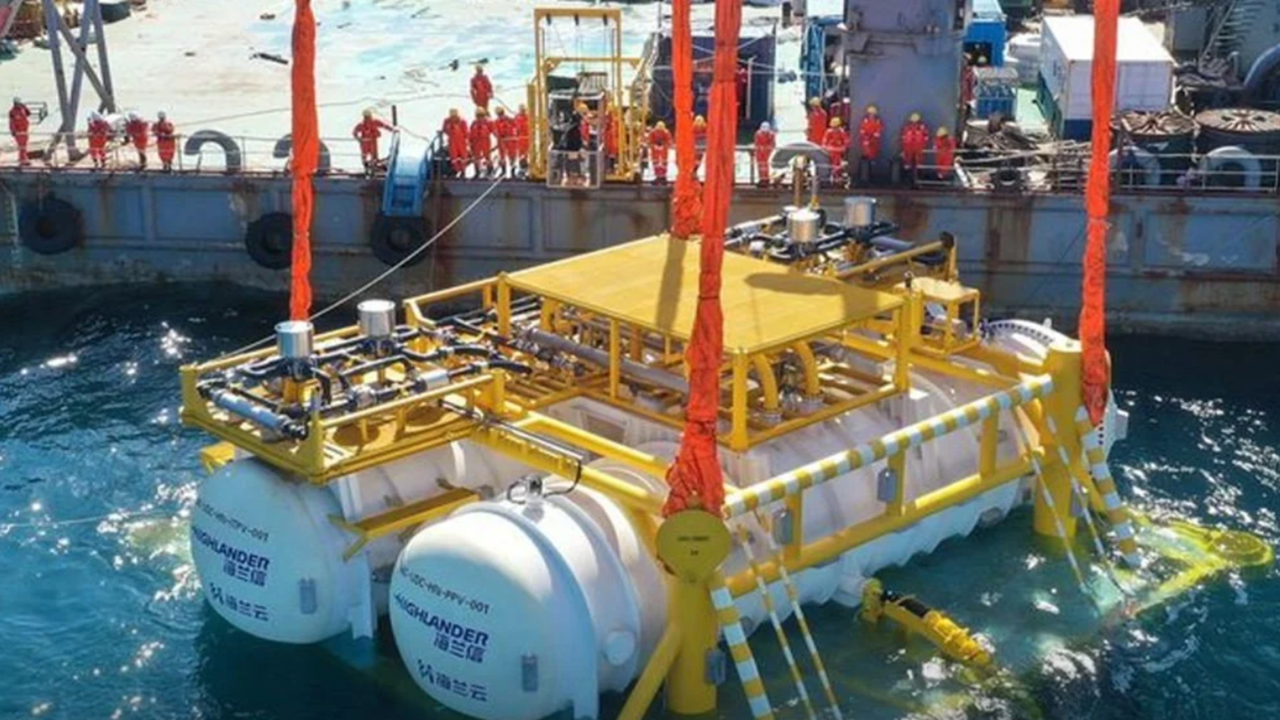
Off the coast of China's Hainan province, a new data center operates beneath the waves. The facility submerged in the South China Sea holds 2,000 servers and is cooled by the surrounding ocean. Offshore wind turbines supply its electricity.
Chinese state-owned telecom company China Telecom developed the project in partnership with the Hainan provincial government. The subsea data center sits in a watertight steel capsule at a depth of 35 meters. Engineers designed it to reduce energy consumption by up to 40% compared with traditional land-based data centers.
World's First Commercial Subsea Data Center
China calls this the world's first commercial underwater data center. The system eliminates the need for large air conditioning units and water pumps used in conventional facilities. Seawater naturally dissipates heat from the servers, while offshore wind provides carbon free electricity.
The location near Hainan takes advantage of strong coastal winds and stable underwater temperatures. The capsule is built to withstand storms and marine conditions. If repairs are needed, the entire module can be lifted to the surface.
China plans to scale the project. Future phases could add more capsules and increase server capacity. The government sees underwater data centers as a strategic asset for handling massive computing loads from AI, cloud services and big data analytics.
Why This Matters
Data centers consume vast amounts of energy and water globally. The International Energy Agency estimates data centers account for about 1% of global electricity demand. Cooling alone can represent a third of a facility's total energy use.
Subsea data centers could change that calculus. By harnessing natural cooling and renewable power, they slash operational costs and carbon emissions. For coastal regions with reliable offshore wind resources, this model offers a replicable template.
The Chinese project also reduces land use pressure. As AI and cloud computing drive explosive demand for computing power, any innovation that improves efficiency matters. If successful, underwater data centers could become a mainstream option for tech companies and governments aiming to meet climate targets.
How It Works: Cooling and Power
The steel capsule is divided into compartments. Each compartment holds servers arranged in racks. Seawater circulates through heat exchangers to absorb warmth from the electronics. The heated water is then released back into the ocean at a controlled temperature to minimize environmental impact.
An offshore wind farm located nearby feeds electricity to the capsule through submarine cables. The system includes battery storage to handle wind variability. In periods of low wind, the facility can draw from the local grid but aims to run primarily on renewable energy.
China Telecom says the pilot phase has been operational for several months without major issues. The company reported stable temperatures and no corrosion problems inside the sealed container. Engineers monitor the system remotely from a control center onshore.