Senior Editor: Alan Agbele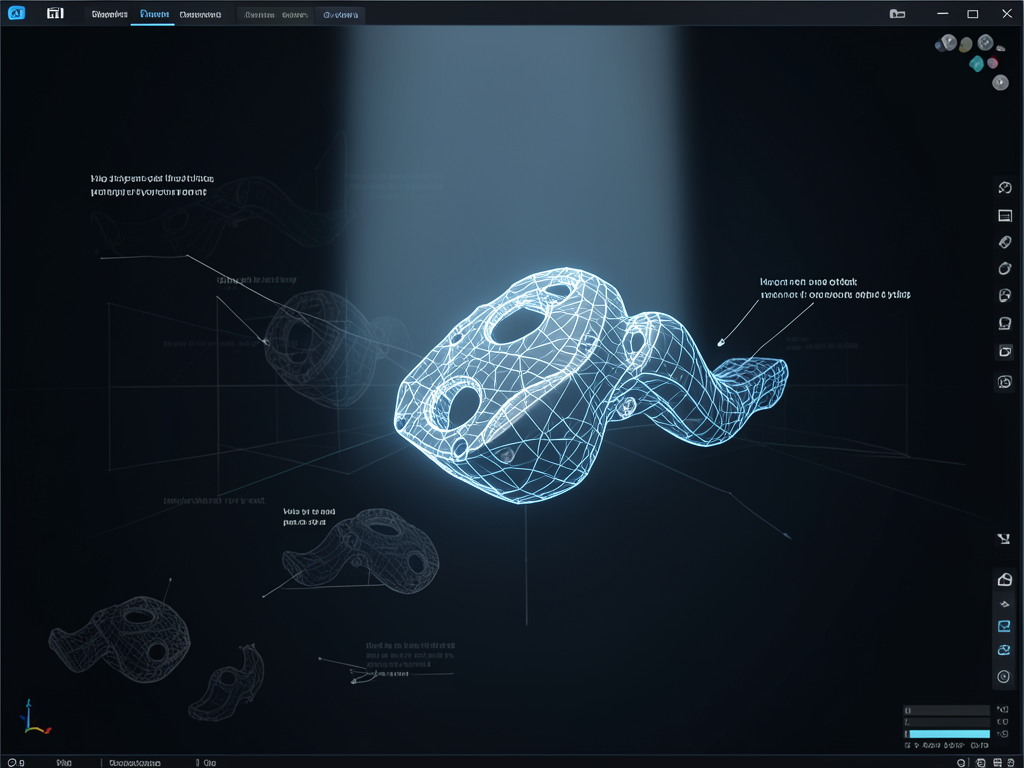
A new tool called Cartesian is entering the 3D modeling space with an artificial intelligence approach that promises to reshape how designers create and iterate on models. The platform, which focuses on generative design capabilities, has already attracted attention from the developer and design communities on Hacker News.
How Cartesian Works
Cartesian applies generative adversarial networks and diffusion models to create 3D meshes that can be directly imported into standard design software. Instead of manually building each face and edge, users describe the desired shape, material or function, and the AI proposes a range of starting geometries. The system learns from a data set of millions of existing 3D models, covering categories from mechanical parts to organic forms.
The platform runs entirely in the browser using WebGPU, lowering the hardware barrier for teams without high-end graphics cards. This approach could make 3D modeling more accessible to small studios and individual creators who currently rely on expensive CAD licenses.
Industry Reaction
Reactions on the Hacker News discussion thread for Cartesian have been mixed but largely constructive. Many commenters praise the speed of iteration, especially for conceptual design phases. Others express concern that AI-generated models may lack the precision required for manufacturing-grade parts. Some users also questioned the licensing of the training data, a recurring issue across generative AI tools.
The Design community, in particular, is watching Cartesian closely. If the tool can reliably produce production-ready geometry, it could disrupt traditional workflows in industries like automotive, consumer electronics and furniture design. Early adopters report that Cartesian works best for early-stage brainstorming, with refinement still needed in dedicated modeling packages.
Why This Matters
The introduction of Cartesian signals a broader shift in computer-aided design toward generative, AI-first tools. For product teams, this means faster concept exploration and lower upfront modeling costs. However, the tradeoff may be reduced control over exact dimensions and surface quality. Engineers and designers will need to adapt their pipelines to incorporate AI-generated meshes as starting points rather than final outputs. The success of Cartesian could push established players like Autodesk and Dassault Systèmes to accelerate their own AI roadmaps.
For the startup itself, the Hacker News traction provides a valuable validation signal. Whether Cartesian can retain users beyond the novelty phase will depend on iterative improvements to model fidelity and integration with existing CAD ecosystems.