Senior Editor: Alan Agbele
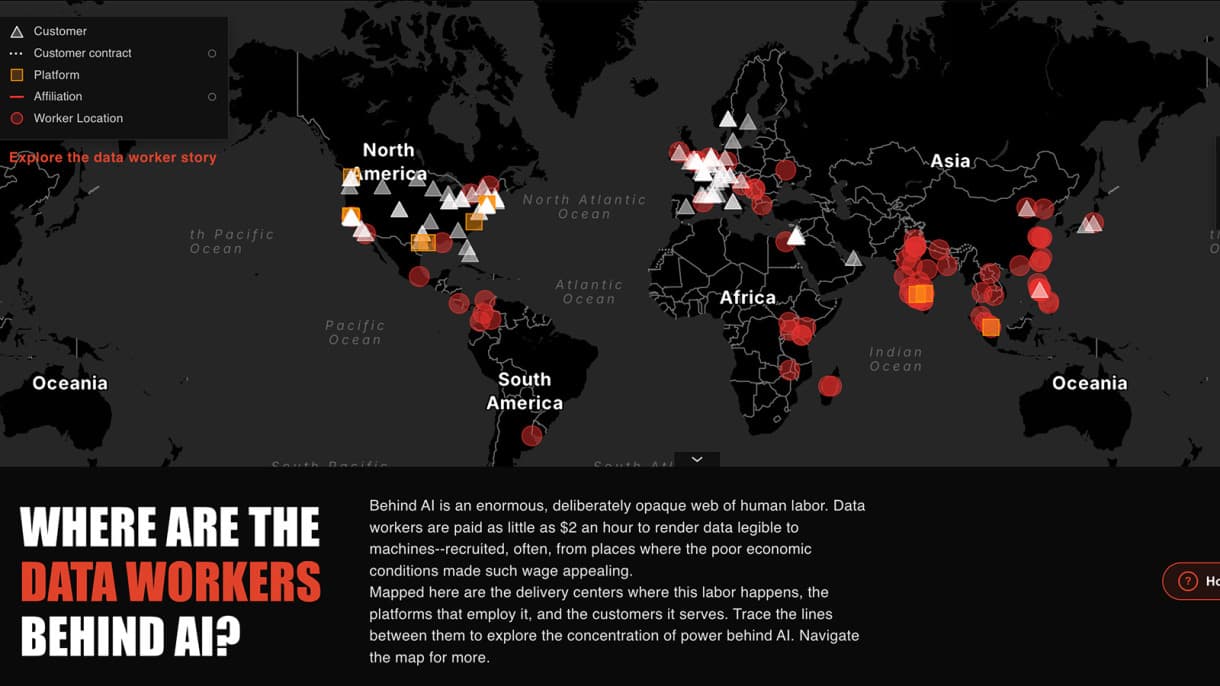
A Brown University student has built a public map of the hidden global labor force that trains and maintains commercial artificial intelligence systems. The project traces how data annotation, content moderation and model evaluation work is distributed across countries, often far from the technology hubs that market the resulting products.
The Invisible Supply Chain Behind AI Models
The map from Brown treats AI development as a global production network rather than a purely technical achievement. It identifies the countries and communities where annotation and moderation tasks are performed, often through third-party contractors.
That framing challenges the common narrative that AI progress comes from algorithms and computing power alone. Human judgment remains essential at nearly every stage of model training and deployment.
Each of these tasks requires human attention that cannot yet be fully automated. The Brown project makes that dependency visible at a global scale.
Why This Matters
The hidden labor map matters most to the workers themselves. Annotation and moderation jobs are often precarious, low-paid and psychologically demanding, yet they sit at the foundation of products sold by the world's largest technology companies.
For AI developers, the project raises uncomfortable questions about supply chain transparency. Companies that publish model cards and safety reports rarely disclose where human training data comes from or how those workers are treated.
Regulators are beginning to take notice. As AI governance frameworks emerge in the United States and Europe, labor conditions in the data supply chain could become a compliance issue rather than an ethical afterthought.
What the Map Reveals About Global AI Dependence
The Brown project shows that AI capability is concentrated in a handful of countries while the labor supporting it is spread across many others. That asymmetry creates leverage and vulnerability at the same time.
Outsourcing firms in Kenya, India and the Philippines have become critical nodes in the AI economy. Their workers absorb the repetitive and emotionally taxing tasks that make commercial models usable.
This arrangement keeps costs low for developers. It also means that disruptions, labor disputes or regulatory changes in those regions could ripple through the entire AI industry.
The Research Gap in AI Labor Studies
Academic and journalistic attention to AI labor has grown, but reliable data remains scarce. Most companies do not publish detailed workforce figures for their data operations.
The Brown student's mapping effort fills part of that gap by aggregating public information into a single view. It offers researchers, policymakers and journalists a starting point for deeper investigation.
Independent projects like this one are likely to become more common as scrutiny of AI supply chains intensifies. The question is whether industry disclosure will keep pace with public interest.