Senior Editor: Alan Agbele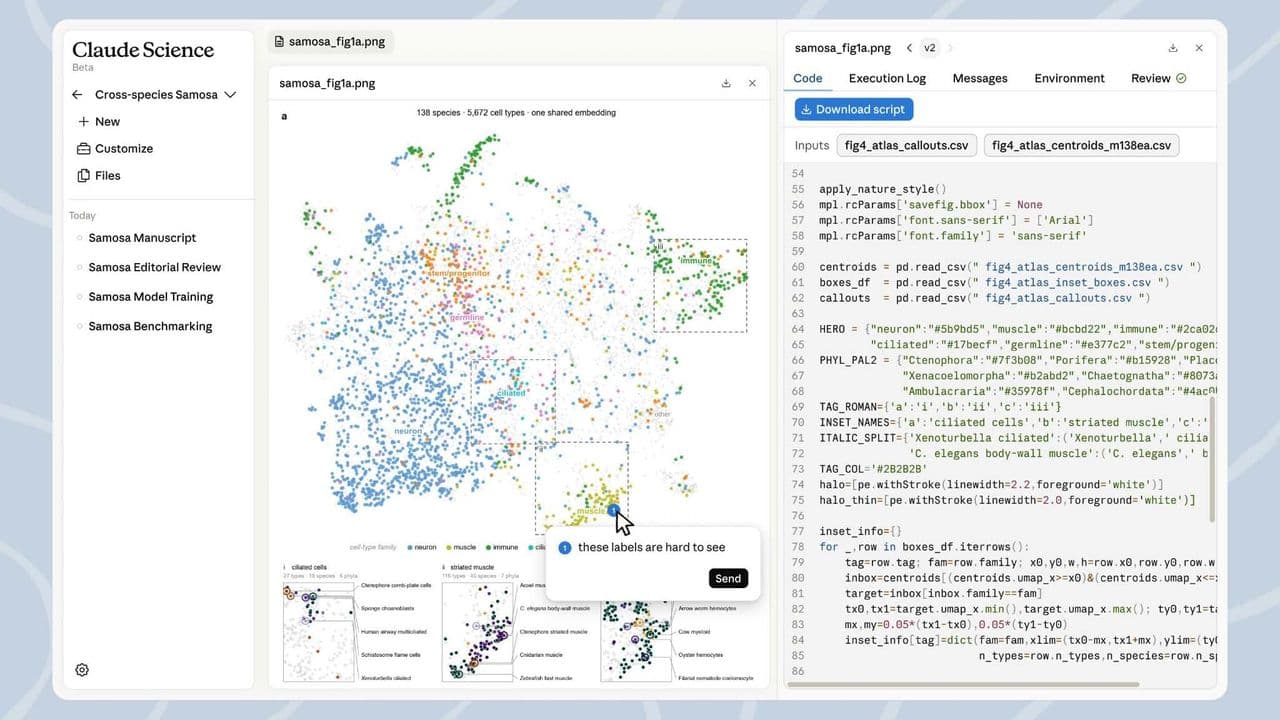
Anthropic has released Claude Science, a beta AI workbench designed to consolidate the fragmented tools scientists use daily into a single environment. The platform targets inefficiencies in research workflows rather than pushing model capabilities further.
The Fragmentation Problem
Scientists currently juggle multiple tools for literature review, data analysis, figure generation and publication. This fragmented workflow slows research and increases error risk. Claude Science aims to replace this patchwork with one interface.
For full auditability, Claude Science includes source code, message history and plain-language explanations inside AI-generated outputs. This lets scientists review and verify each step.
How Claude Science Works
The platform runs on a lab's own infrastructure, including enterprise laptops, Linux boxes or HPC login nodes. Anthropic emphasizes that large or sensitive datasets never leave the systems they already reside on. Only the context needed for each step is sent to Claude.
Claude Science is available in beta for macOS and Linux to Pro, Max, Team and Enterprise subscribers. The company also committed up to $30,000 in computing credits for 50 selected projects.
Science as AI's Next Frontier
Early testers have used Claude Science for single-cell RNA sequencing analysis, CRISPR screen design, protein structure prediction and cheminformatics. Users include Manifold Bio, Allen Institute neuroscientist Jerome Lecoq, and UCSF Brain Tumor Center epidemiologist Stephen Francis.
This launch follows OpenAI's introduction of Prism, an AI-native workspace for scientists that launched with GPT-5.2. Both companies are now targeting sectors with specialized tools instead of simply upgrading model capabilities. Until now finance and legal were major focuses for Anthropic and OpenAI. Scientific research represents the next stage.
Why This Matters
Claude Science directly addresses a key barrier to AI adoption in research: workflow fragmentation. By unifying tools on private infrastructure, it could dramatically accelerate scientific discovery while maintaining data security. For researchers, this means less time managing disparate tools and more time on actual science. For the AI industry, it signals a shift toward purpose-built applications that solve real-world problems rather than chasing benchmark scores.