 Senior Editor: Alan Agbele
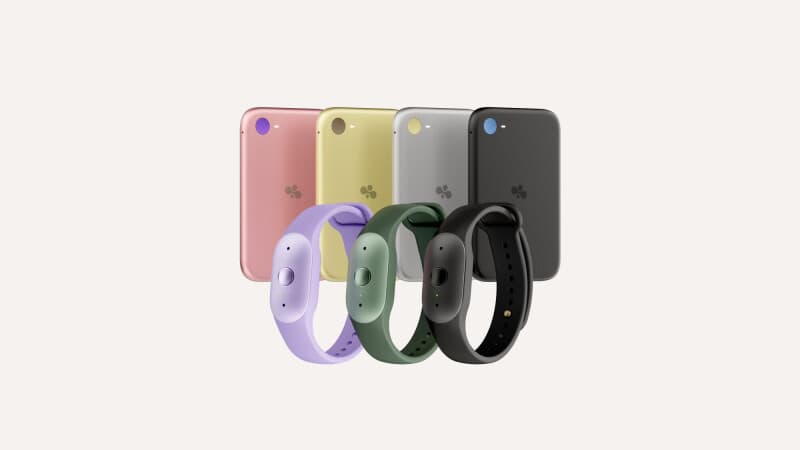
Amazon is pushing wearable AI from the wrist to the pocket with two new always-listening devices from Bee, the startup it acquired last year. The products, Bee Frontier and Bee Eclipse, are built to record, summarize and mine everyday conversations for reminders and recommendations.
Two Form Factors, One Always-On Microphone
Bee Frontier is designed to be worn like a watch or fitness tracker, though its circular housing gives it the look of a doorbell strapped to the wrist. Bee Eclipse is a slim, credit-card-sized slab that attaches magnetically to the back of a phone.
Both devices share a single control button and a visible light that signals when the microphone is active and the AI is summarizing. The hardware is deliberately minimal, pushing interaction toward the companion app rather than the device itself.
Battery life differs sharply between the two. Frontier carries an IP67 water-resistance rating and up to seven days of use, while Eclipse is rated for more than 21 days on a single charge. Both recharge over USB-C.
From Conversation Capture to Commerce
The real product is not the hardware but the pipeline behind it. Bee devices convert speech into summaries, to-dos and reminders, then surface recurring themes and suggest goals or actions based on what the user discusses.
That data now flows into Amazon's broader ecosystem. Bee connects to Alexa+, allowing users to ask the assistant for a meeting summary, and to Amazon.com, which can generate personalized shopping recommendations from what the wearable has overheard.
Amazon frames the privacy model as a safeguard. Audio is processed into insights in real time and not stored, the company says, while transcripts are encrypted and restricted to the user. The distinction matters because the value of the device depends on retaining context, not raw recordings.
The Wearable AI Market Finds a Deep-Pocketed Buyer
Amazon's move lands in a crowded and unproven category. Humane's AI Pin and the Rabbit R1 both promised ambient AI assistance and both drew criticism for unreliable performance and unclear utility.
Bee's advantage is distribution. Amazon can bundle the devices with Alexa+ and route their output into Amazon.com, giving the hardware a commercial purpose that standalone startups have struggled to demonstrate.
The $300 million acquisition price, reported at the time of the deal, signals that Amazon views conversational context as a strategic asset rather than a novelty. The company is effectively buying a sensor layer for its assistant and its store.
Why This Matters
The launch reframes wearable AI as a data acquisition strategy rather than a gadget category. Every conversation a Bee device summarizes becomes context that can sharpen Alexa+ responses and feed Amazon.com recommendations, tying ambient computing directly to retail revenue.
Privacy advocates and regulators will scrutinize the arrangement closely. Consent becomes complicated when a device worn by one person records the speech of everyone nearby, and the line between a personal memory aid and a shopping funnel is thin.
Competitors face a harder road. Startups building similar devices must now compete against a company that owns the assistant, the marketplace and the cloud infrastructure behind the summaries. For consumers, the question is whether convenience justifies letting a retailer listen in.


