Senior Editor: Alan Agbele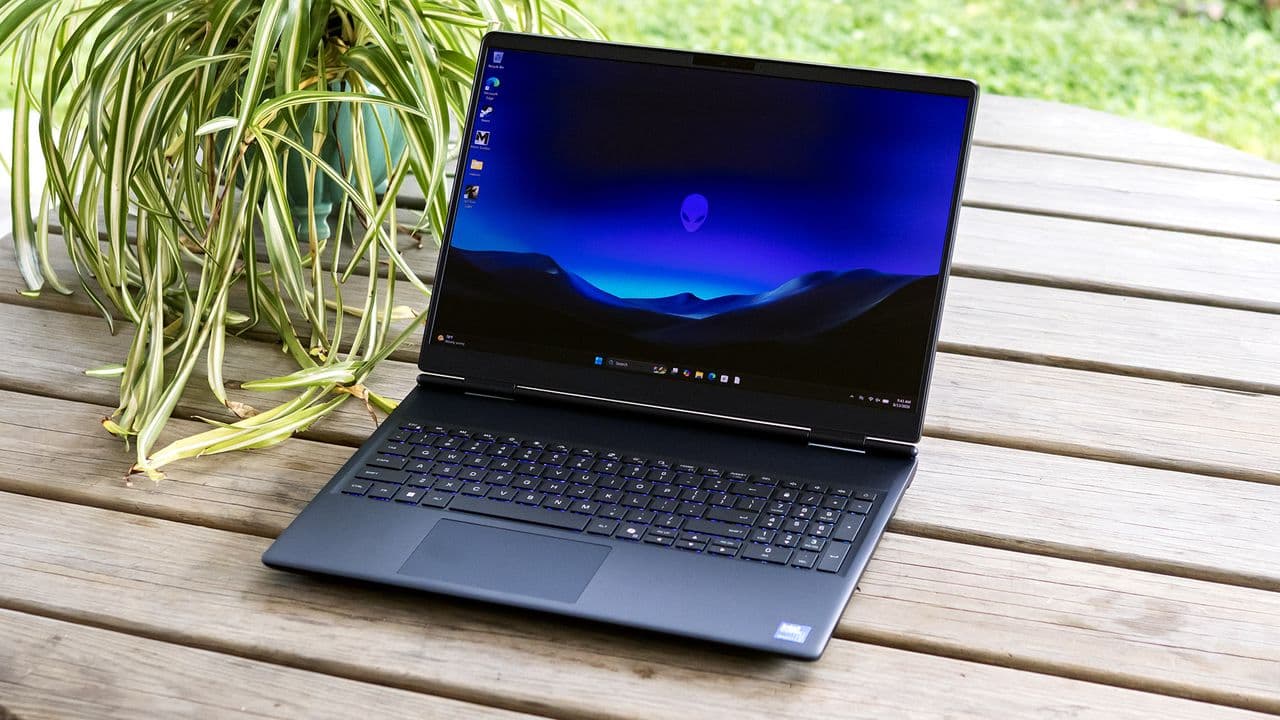
Alienware has taken a sharp turn with its new 16X Aurora gaming laptop, stripping away the flashy lights and bold branding that defined its predecessors. The Aurora instead focuses on raw hardware, packing an OLED 240Hz display, an Intel Core Ultra HX-series CPU, and an Nvidia RTX 50-series GPU into a subdued indigo chassis. While its nearly inch-thick profile and 5.66-pound weight keep it tethered to a desk, the Aurora delivers the kind of gaming competence that makes it a serious contender in the premium laptop segment.
Design Shift Toward Minimalism
The Aurora presents a nearly anonymous appearance. Its “interstellar indigo” aluminum chassis lacks external lighting, and the iconic Alienware logo on the lid is barely visible against the dark finish. The absence of RGB is a deliberate move by Alienware to cater to users who prefer a professional look without sacrificing gaming power. The build quality remains high, with aluminum panels and a magnesium internal frame that keeps the laptop rigid. The Aurora can be opened one-handed, and rounded edges make it comfortable to carry, though at 5.66 pounds it still feels heavy compared to Acer’s Nitro V 16S AI (4.55 pounds) or Gigabyte’s Aero X16 (4.2 pounds).
Display and Performance
The Aurora’s centerpiece is its 16-inch OLED panel with a 2560 x 1600 resolution and a 240Hz refresh rate, supporting Nvidia G-Sync for smooth gameplay. In testing, the laptop ran 007 First Light at 60–70 fps at native resolution with medium settings and DLSS enabled, without stuttering. The combination of the CPU and RTX 5060 GPU handled demanding titles well at 1080p, though the entry-level configuration limits ultra-high settings at 1600p.
Ports, Connectivity and Battery Life
Alienware includes a well-placed port array: Thunderbolt 4, USB-C (10 Gbps), two USB-A (5 Gbps), HDMI 2.1, Ethernet, and a headphone jack. The rear-mounted power connector keeps cables away from mouse movement. Wi-Fi 7 via a MediaTek MT7925 card provides the latest wireless speeds. The 96 Whr battery, however, struggles to deliver more than a few hours of unplugged gaming, reinforcing the desktop replacement nature of the Aurora.
Why This Matters
The Aurora represents a broader industry trend: premium gaming laptops are moving away from overt “gamer” aesthetics toward designs that blend into professional or shared spaces. By removing external RGB and toning down branding, Alienware directly competes with more subtle offerings from Razer and Lenovo. The Aurora also shows that high refresh rate OLED screens are becoming standard in this price tier, pushing competitors to match both performance and display quality. For enthusiasts who value raw power over flashy looks, the Aurora proves that performance can thrive without the lights.