Senior Editor: Alan Agbele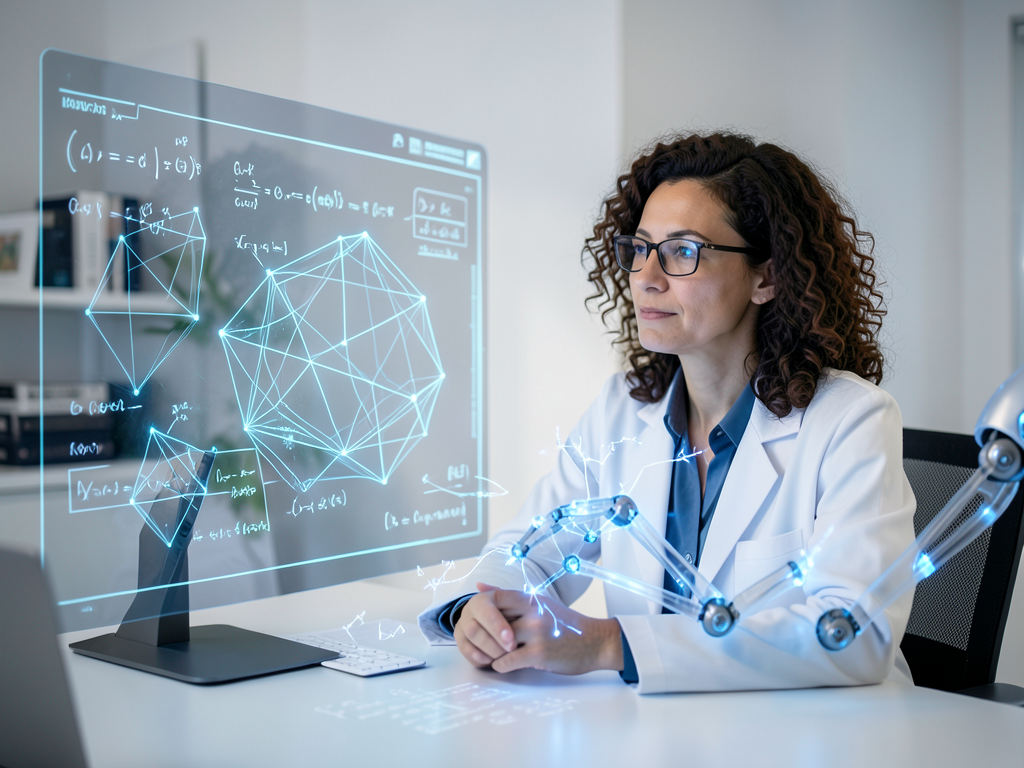
For years, mathematicians considered their field a fortress against automation. That belief is now being tested. A new analysis titled "Mathematics Just Got Its First Taste of the AI Job-Pocalypse" argues that advances in large language models and symbolic reasoning systems have crossed a threshold, enabling machines to generate original proofs and solve problems that previously required human expertise.
How AI Is Reshaping Mathematical Work
The core of the new analysis focuses on three specific capabilities that have recently improved: theorem generation, proof verification and problem decomposition. Systems powered by transformer architectures can now scan millions of existing proofs, identify patterns and produce novel conjectures. In bench tests, these models have solved problems from the International Mathematical Olympiad and produced results that rival graduate students.
The analysis notes that these abilities are still brittle. Models fail on problems requiring deep conceptual insight or multistep reasoning across unrelated domains. But the trajectory is clear, and the pace of improvement has surprised many in the field.
Why This Matters
The impact of AI on mathematics extends beyond academia. Mathematical modeling underpins finance, logistics, cryptography and climate science. If machines can automate aspects of proof checking and conjecture generation, the cost of research drops and the speed of discovery accelerates. But that efficiency comes with a human cost. Early-career mathematicians who rely on grant-funded research and teaching assistantships may find those positions shrinking. Universities and research labs will need to restructure how they train and employ mathematicians, shifting focus toward interpretation, creativity and oversight rather than routine verification.
"You first believe it when the wave hits you," said Dr. Linda Park, a computational mathematician at Stanford and one of the report's contributors. "Most mathematicians dismissed early AI demos as parlor tricks. Now they realize the tools are actually producing real results that would take a human weeks."
Adaptation Strategies for the Field
Mathematics departments and research organizations are beginning to respond. Some are introducing courses on AI-assisted proof methods, while others are developing hybrid workflows where a human mathematician works alongside a generative engine. The goal is not to replace the researcher but to augment their thinking. However, the report cautions that the transition will be uneven. Pure mathematics departments may resist, while applied fields such as data science and operations research will likely adopt AI tools first.
For now, the report does not predict mass unemployment among mathematicians. Instead, it describes a gradual displacement of certain tasks and a redefinition of what it means to contribute to the field. The phrase "Mathematics Just Got Its First Taste of the AI Job-Pocalypse" serves as a warning, the authors say, not a final verdict.
The Broader Trend
Mathematics joins a growing list of professions confronting automation. Legal document review, software coding, translation and even some forms of journalism have already seen work shift to machines. What makes mathematics different is its prestige and the long-held belief that it requires uniquely human intuition. That belief is now under pressure. The analysis argues that no profession should assume immunity from AI disruption, especially those that rely on pattern recognition and logical deduction at scale.